

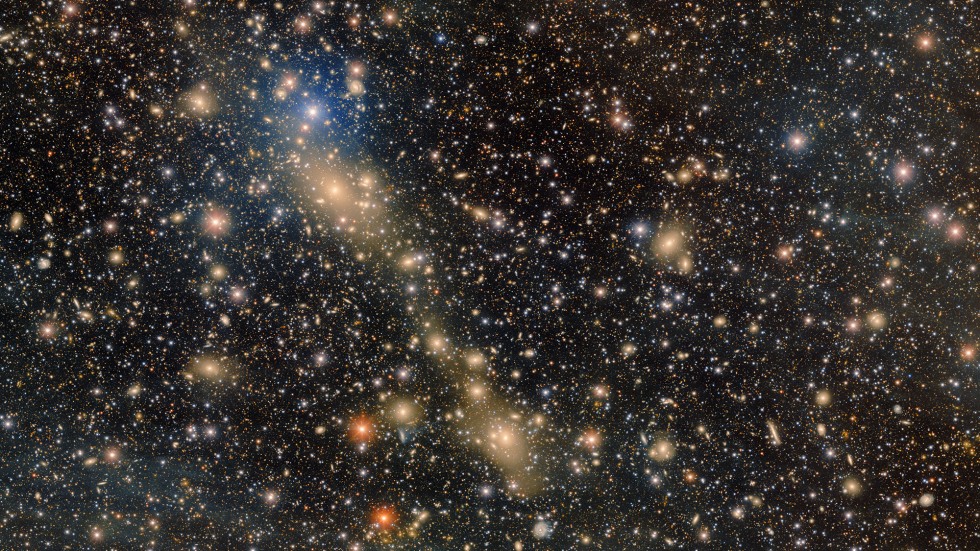
Every new powerful telescope reminds us how tiny we are in the vastness of space. This feeling is reinforced by the latest impressive achievement. Astronomers have managed to obtain the most detailed images ever taken of the Abell 3667 galaxy cluster, located 700 million light-years away. Every tiny dot in the photo is an entire galaxy. But this panorama also hides a witness to an ancient cosmic catastrophe.
Traces of a giant collision
The images captured by the Brown University team revealed an incredible object — a giant “bridge” of stars stretching across the entire cluster. The discovered formation is a direct result of the merger of the two brightest galaxies in Abell 3667. Their catastrophic collision generated powerful gravitational shocks that literally tore billions of stars from their home galaxies and scattered them across intergalactic space.
Solving the mystery of Abell 3667
These lonely stars, scattered by gravitational chaos, emit an extremely dim light known as intracluster light (ICL). It became the key to unlocking the past. By analyzing the structure and distribution of this light, astronomers obtained the first optical evidence that Abell 3667 was formed as a result of an even larger event — the merger of two separate galaxy clusters. This hypothesis had previously been proposed based on X-ray and radio observations, but visual confirmation is decisive.
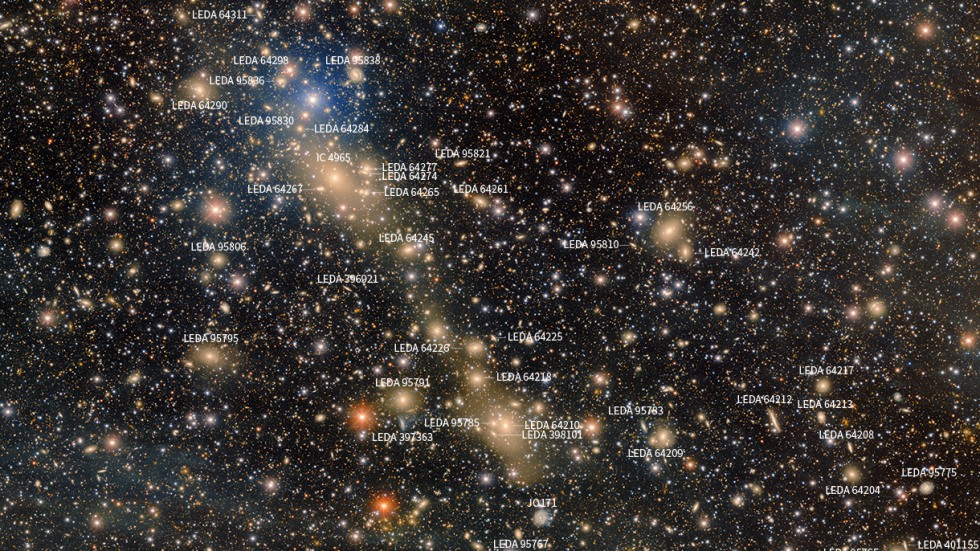
“This is the first time an object of this scale has been detected in a local galaxy cluster,” emphasizes Anthony Englert, head of the research team. “We knew that it was possible for a bridge like this to form between two galaxies, but it hadn’t been documented anywhere before now. It was a huge surprise that we were able to image such a faint feature.”
Success was ensured by a unique combination of factors: many years of observation and a fortunate coincidence that Abell 3667 was observed frequently. In addition to ICL, scientists have also discovered blue “ribbons” of sparse cosmic dust – integrated nebulae.
Our place among the giants
The new image of Abell 3667 is not only a scientific breakthrough, but also a vivid demonstration of the grandeur and dynamism of cosmic processes. If it doesn’t make you feel tiny, just wait for even deeper and more detailed images that will soon be coming from the Vera Rubin Observatory. They will show even more of these “star bridges” and even more light from long-past catastrophes. And then our place in the Universe will become even more insignificant — and at the same time incredibly exciting.
Earlier, we reported on how the collision between the Milky Way and another galaxy occurred quite recently.
According to brown.edu

