

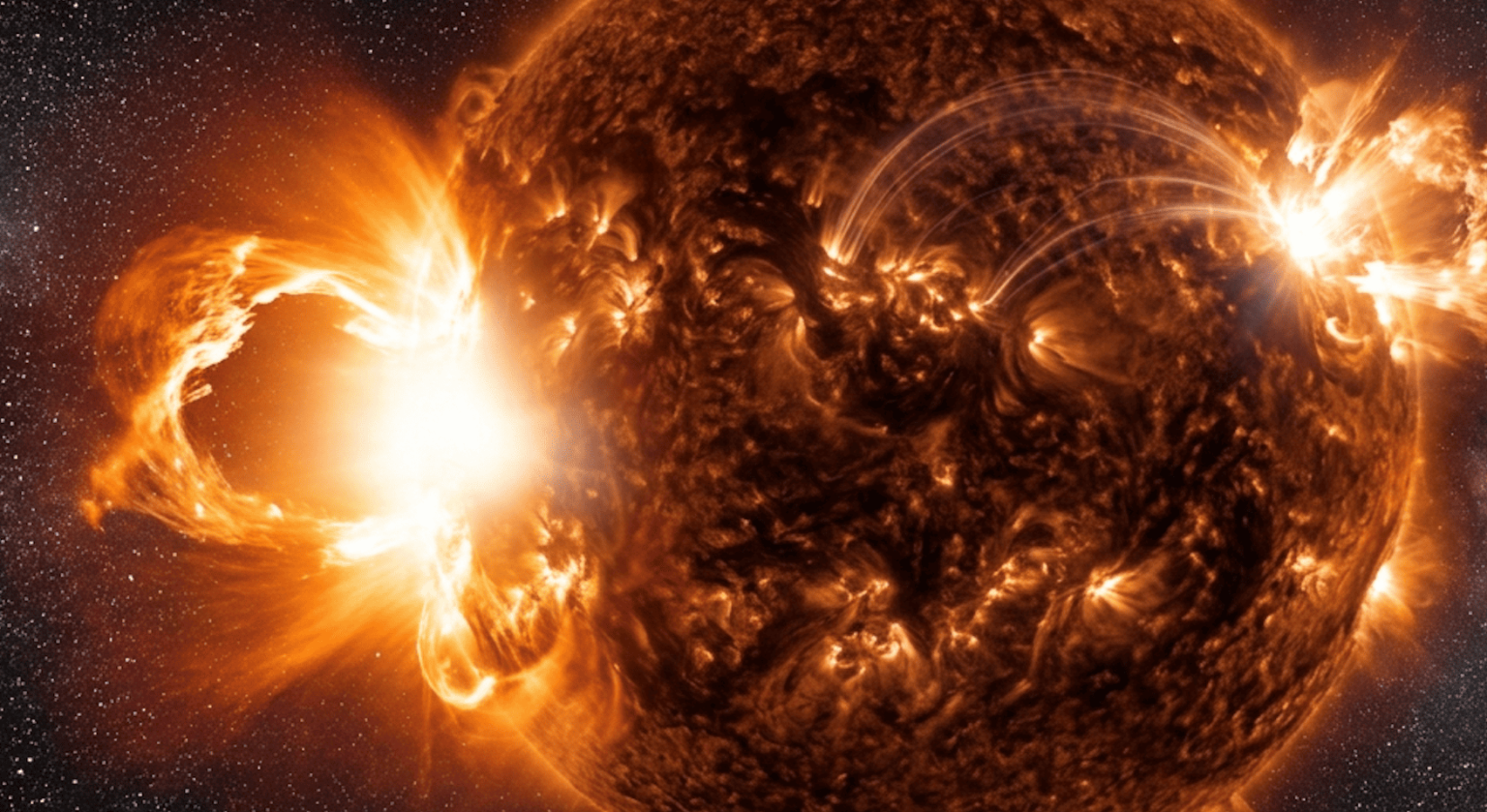
When a solar flare occurs, it sometimes triggers a second one—and this phenomenon, as it turns out, is not unique to our star. Astronomers at Tufts University (U.S.) have confirmed for the first time that so-called sympathetic flares—where one flare triggers another—are observed in thousands of stars across the Milky Way. The results of the study were published in April 2026 in the Astrophysical Journal.
Not just the Sun
Such solar flares have been known about for a long time: roughly one in twenty—or about 5%—triggers a subsequent flare. But whether this is a property unique to our Sun or a more general pattern remained an open question. A team led by graduate student Veronica Pratt analyzed more than 200,000 flares on over 16,000 stars using data from the TESS space telescope.
The key tool was the TOFFEE algorithm, developed by the team specifically for this task: to detect a second explosion before the first one has gone out. Conventional methods simply cannot distinguish between them. The results were striking: double flares occur in 4–9% of cases on the stars studied, almost exactly the same as on the Sun. The interval between the first and second flare ranges from 30 minutes to an hour and a half.
Unexpected leaders
The most surprising finding was that the majority of these flares were observed on red dwarfs—M-class stars, which are the smallest and coolest, yet also the most common in the Galaxy. They are half as hot as the Sun and significantly more active. The fact that the mechanism operates in the same way despite such striking differences leads researchers to speculate that sympathetic flares share a common cause across different types of stars. The exact nature of this cause remains unknown.
According to phys.org

