

Space seems infinitely distant: telescopes, orbits, nebulae, billions of stars that we see only as cold dots in the sky. But sometimes a model of the universe appears not in an observatory, but in the warmest place – under the ceiling of a Christmas hut. There, where candles and kutia are, where the silence of Christmas Eve mixes with carols, a straw mobile slowly rotates – a light geometric creation that, in the popular imagination, personifies the cosmic order.
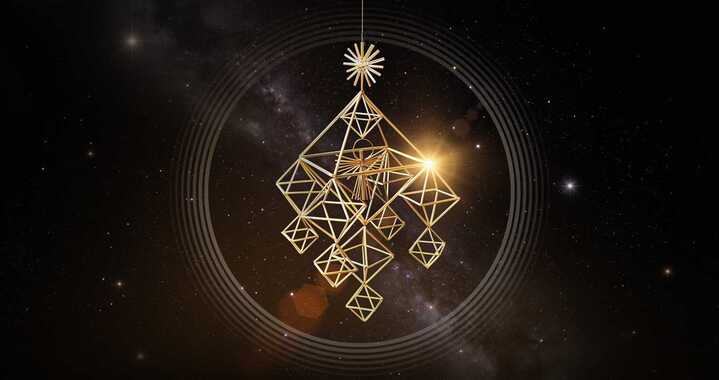
Its rotation from warm air resembles the simple physics of motion: like a small system held in balance by forces and symmetry. And the shadows on the walls resemble cobwebs – a vivid image of how everything in the universe is connected: from a grain of straw to galaxies in the darkness. And that is why this Christmas decoration is interesting not only as a decoration, but also as a cultural translation of cosmology into simple, everyday words.
Spider geometry – a model of the universe
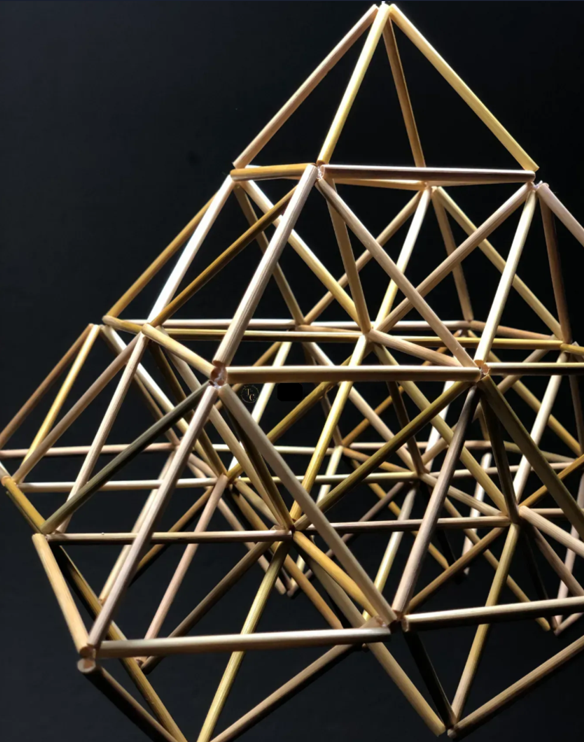
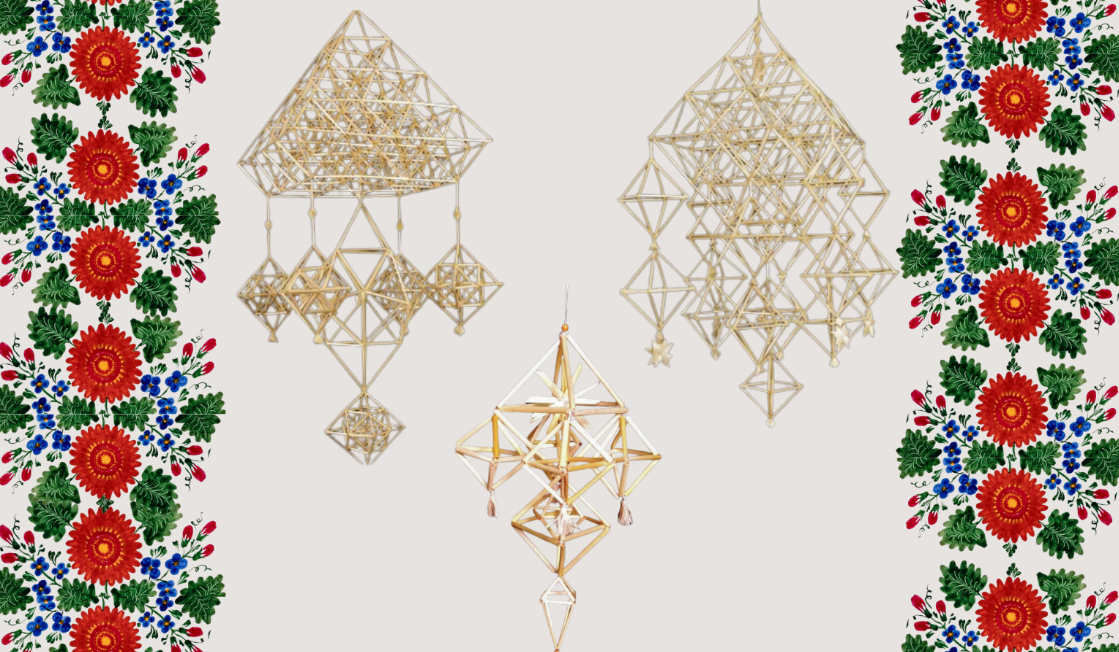
The design of the straw mobile amazes with its geometric perfection. Traditionally, it is made of straw, rye, or wheat: straws are cut into equal pieces, soaked for flexibility, and strung on a thread (in ancient times, on horsehair). Individual elements (rhombuses, squares) are used to form simple shapes, which are then connected to create more complex three-dimensional modules. At the center of the classic spider is a double pyramid, i.e., two quadrangular pyramids connected at their bases (this shape is called an octahedron). Additional rays of straws diverge from the main pyramidal figure on all sides, and smaller pyramids or cubes, the so-called “baby spiders,” are suspended from its vertices. The result is a symmetrical spatial structure, light and balanced, like a miniature model of the universe.
The finished spider was hung from a beam (a wooden beam under the ceiling of a traditional hut) on a strong thread or hair, most often near the stove or dining table. The warm air rising upward continuously swayed the straw edges, and the entire structure slowly rotated around its axis. This rotation caused the spider to sparkle and cast moving shadows on the walls, making it truly resemble a multi-layered web. It is believed that it was because of this similarity that the decoration was named “spider.” Visually, it combined the simplicity of natural materials with the complexity of perfect symmetry, which seemed to reflect the structure of the cosmos.
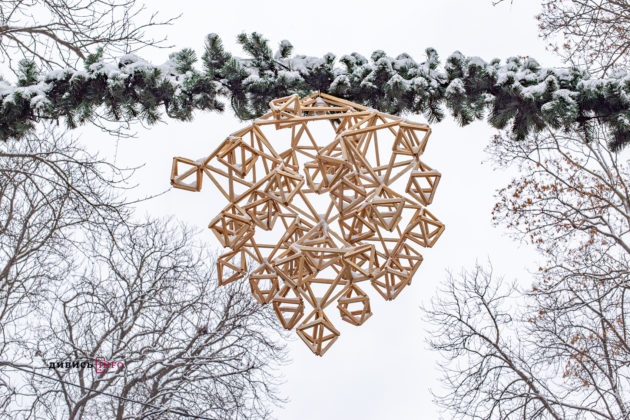
It is no coincidence that Ukrainians attributed deep symbolic meaning to the straw mobile. Ethnographers note that such geometric straw decorations were perceived as a model of the world, a kind of small image of the cosmos and the starry sky in the hut. The square base of the double pyramid was associated with the four sides of the world – North, South, West, and East – that is, the ordered universe with its cardinal directions. The top of the pyramid, pointing upwards, represented the celestial sphere, and the bottom part represented the earth, which was united into a single whole. Thus, the straw mobile was a symbol of the world’s structure, where everything is in balance and in motion simultaneously. Its continuous smooth rotation under the ceiling reminded us that the universe is alive, dynamic, and harmonious, even if, at first glance, the structure seems fragile and immovable.
The origin of the straw mobile
In ancient myths, spiders occupied a special place: there were legends that spiders helped create the world by weaving the cosmic web of existence. Therefore, these small animals were revered, and weaving a straw mobile in the folk consciousness was likened to establishing order and prosperity in one’s home. It is no coincidence that many Christmas carols and songs still contain motifs of the creation of the world, where cobwebs, straw, and sheaves (didukh) are sacred attributes of prosperity.
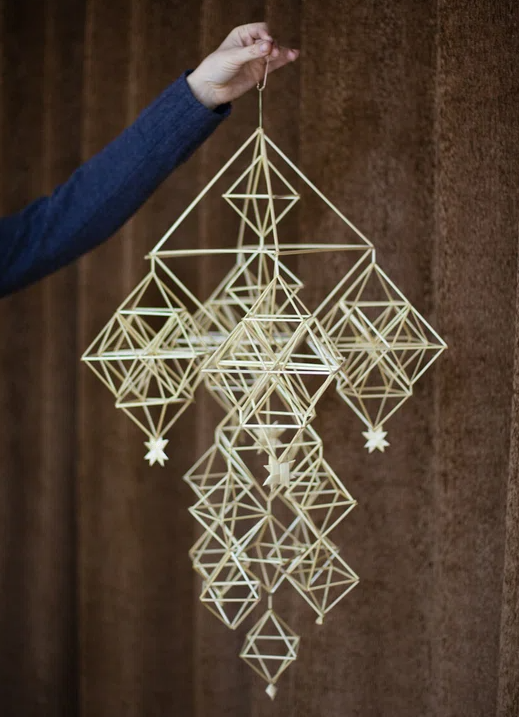
Historians and ethnographers believe that straw mobiles as Christmas decorations appeared relatively recently – probably in the late 19th to early 20th centuries, with the earliest such items recorded in Polissya. In this region, they were called “straw mobiles.” From there, the custom quickly spread to other parts of Ukraine. Spiders were usually made before Christmas (on Christmas Eve or on St. Anne’s Day) and hung from the ceiling. In low rural houses, the decoration was often placed so that every guest could lightly touch it with their head for good luck. Today, such symbolic decorations can be easily found on popular marketplaces as ready-made selections from craftsmen, or you can order a kit and make a straw mobile yourself with your family.
Mythological images and their protective role
The straw mobile served as a talisman. Our ancestors believed that this decoration purified and protected the space of the home. When the straw mobile spun under the ceiling, it seemed to collect all the negative energy in the house and scare away evil spirits. After the Christmas holidays were over, the large spider was usually not kept until the following year, but was ceremoniously burned. The purifying flame was supposed to symbolically renew the energy of the home. In some regions, however, the spider was left hanging until the following Christmas, so that it would constantly protect the home.
In addition to its protective function, the image of the spider and the web was closely associated with the concept of fate and time. In world mythology, the thread of the web is often associated with the thread of life: just as the spider weaves a pattern, invisible forces weave the fabric of human destiny. Ukrainian folklore has preserved legends that spiders “founded” the world by weaving the first cosmic web. This cosmogonic metaphor is also reflected in the straw mobile, as it literally spins a model of the universe out of straw.
Another similar fairy tale explains the origin of the shiny “tinsel” on the Christmas tree: in it, good spiders decorated the Christmas tree with cobwebs at night, which God turned into gold and silver at dawn. Since then, cobwebs have been considered a harbinger of wealth and happiness. Such legends have further cemented the spider’s reputation as a sacred creature associated with the miracle of Christmas.
Similar symbols in other cultures
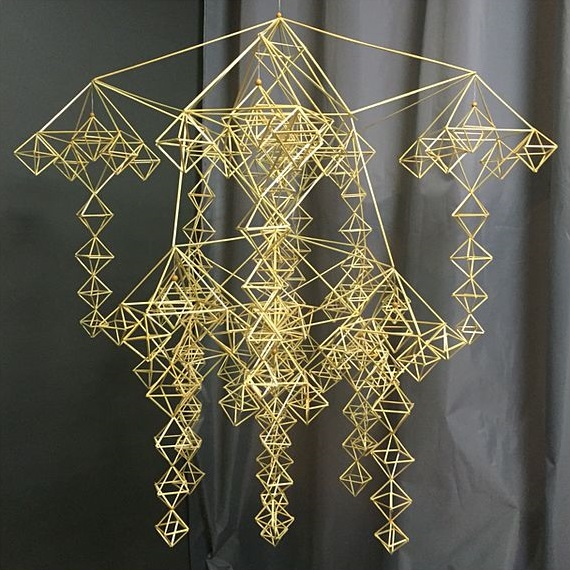
The tradition of creating hanging straw “cosmic” figures is not unique to Ukrainians. Similar Christmas decorations are known among many people of Northern and Eastern Europe. For example, in Finland, Sweden, and other Scandinavian countries, straw himmeli (from the Swedish himmel, meaning “sky”) are popular. The classic Finnish himmeli consists of 12 symmetrical fragments symbolizing the twelve months of the year, and it is customary to hang it above the festive table from Christmas until mid-summer.
The motif of the web as a model of the universe is also found in the mythology of peoples outside Europe. In many ancient conceptions of the creation of the world, there is a great Spider-Creator who forms the world order with his web. For example, the North American Indians have a legendary Spider Woman who wove the fabric of life, connecting the heavens, the earth, and people. In general, researchers note that in different cultures, the spider is associated with the act of creation, as it weaves its own artistic world – its web. Similar stories and symbols emphasize the universality of the image: everywhere, the web was imagined as a diagram of the universe, whose threads unite all that exists.
That is why the modest Ukrainian straw mobile, born in the depths of centuries, is so important. It is not just a Christmas decoration, but a microcosm that reminds us that our world is fragile and beautiful, that everything in it is interconnected, and that the harmony of the universe should be remembered even in a festive home.

