

There are amazing vortices at the poles of the largest planets in the Solar System, Jupiter and Saturn. Scientists have studied them and concluded that their shape is related to processes occurring deep inside these gas giants.
The mysteries of polar vortices
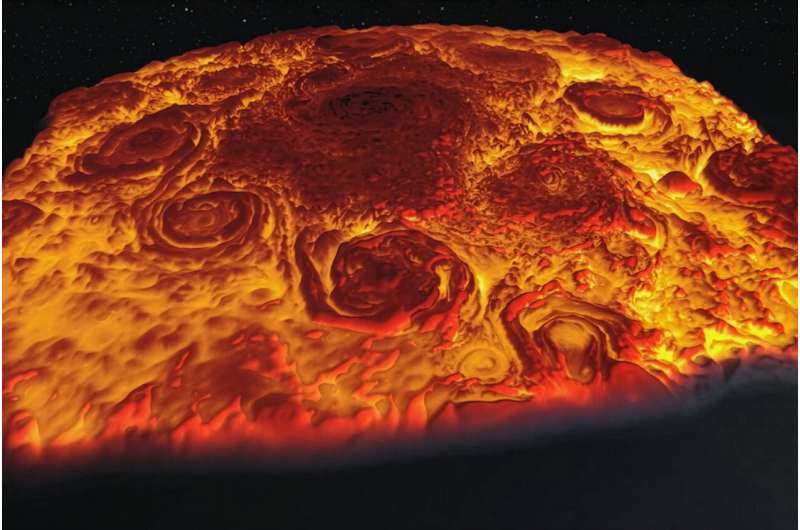
For many years, passing spacecraft have observed mysterious weather phenomena at the poles of Jupiter and Saturn. These two planets have different types of polar vortices — huge atmospheric whirlpools rotating above the polar regions of the planet. On Saturn, one enormous polar vortex appears to cover the north pole in a strange hexagonal shape, while on Jupiter, the central polar vortex is surrounded by eight smaller vortices resembling a frying pan with mixed cinnamon rolls.
Given that the two planets are similar in many ways — they are roughly the same size and consist of the same gaseous elements — the stark difference in their polar weather conditions has long been a mystery.
Now, scientists at the Massachusetts Institute of Technology have identified a possible explanation for how two different systems could have developed. Their findings may help scientists understand not only the weather conditions on the surface of planets, but also what may lie beneath the clouds, deep within the interior.
In a study published this week in the Proceedings of the National Academy of Sciences, the team models different ways in which well-organized vortex patterns can form from random stimuli on a gas giant. A gas giant is a large planet that consists mainly of gaseous elements, such as Jupiter and Saturn. Among the wide range of plausible planetary configurations, the team found that in some cases the currents merged into one large vortex, similar to Saturn’s pattern, while other simulations produced several large circulations, similar to Jupiter’s vortices.
New theory of vortex formation
After comparing the simulations, the team found that vortex patterns and questions about whether a planet develops one or more polar vortices are reduced to one main property: the softness of the vortex base, which is related to the internal composition. Scientists compare an individual vortex to a twisted cylinder rotating through numerous atmospheric layers of the planet.
When the base of this twisted cylinder is made of softer, lighter materials, any vortex that arises can only grow to a certain size. The final pattern may then allow for the existence of several smaller vortices, similar to Jupiter. However, if the vortex’s base is made of harder, denser materials, it can grow significantly larger and then absorb other vortices, forming a single enormous vortex similar to the giant cyclone on Saturn.
“Our study shows that, depending on the interior properties and the softness of the bottom of the vortex, this will influence the kind of fluid pattern you observe at the surface,” says study author Wanying Kang, assistant professor in MIT’s Department of Earth, Atmospheric and Planetary Sciences (EAPS). “I don’t think anyone’s made this connection between the surface fluid pattern and the interior properties of these planets. One possible scenario could be that Saturn has a harder bottom than Jupiter.”
How to work with weather models
The new work by Kang and Shi was inspired by images of Jupiter and Saturn taken by the Juno and Cassini missions. NASA’s Juno spacecraft has been orbiting Jupiter since 2016 and has taken stunning images of the planet’s north pole and its numerous whirlpools. Based on these images, scientists estimate that each of Jupiter’s whirlpools is enormous, stretching approximately 3,000 miles across — almost half the width of Earth.
Before deliberately burning up in Saturn’s atmosphere in 2017, the Cassini spacecraft orbited the ringed planet for 13 years. Its observations of Saturn’s north pole recorded a single polar vortex in the shape of a hexagon, approximately 18,000 miles wide.
Shi and Kang decided to identify the physical mechanism that would explain why one vortex can form on one planet, while several vortices are observed on another. For this purpose, they worked with a two-dimensional model of surface flow dynamics. Although the polar vortex is three-dimensional in nature, the team concluded that they could accurately reflect the evolution of the vortex in two dimensions, as the rapid rotation of Jupiter and Saturn provides uniform motion along the axis of rotation.
Get to the point
Following this logic, the team developed a two-dimensional model of vortex evolution on a gas giant, based on an existing equation describing how a fluid rotates over time. This equation has been used in many contexts, including modeling mid-latitude cyclones on Earth. Scientists have adapted the equations for the polar regions of Jupiter and Saturn.
The team applied their two-dimensional model to simulate how the liquid would change over time on a gas giant under different scenarios. In each scenario, the team varied the planet’s size, rotation speed, internal heating, and the softness or stiffness of the rotating liquid, among other parameters. Then they set up a random “noise” condition, where the liquid initially flowed in random patterns across the planet’s surface. Finally, they observed how the liquid changed over time, taking into account the specific conditions of the scenario.
In several different simulations, they observed that some scenarios developed into a single large polar vortex similar to Saturn, while others formed several smaller vortices similar to Jupiter.
The single mechanism of weather and the internal structure of planets
After analyzing the combinations of parameters and variables in each scenario and how they affected the final result, they came up with a single mechanism explaining whether one or more vortices would form: when random fluid motions begin to coalesce into distinct vortices, the size to which a vortex can grow is limited by how soft the vortex bottom is.
The softer or lighter the gas rotating at the bottom of the vortex, the smaller the vortex will be, allowing several smaller vortices to coexist at the planet’s pole, similar to those that exist on Jupiter. Contrary to this, if the bottom of the vortex is harder or denser, the system can become larger, to the point where it can eventually replicate the curvature of the planet as a single planetary-scale vortex, similar to that on Saturn.
If this mechanism really works on both gas giants, it may indicate that Jupiter may consist of softer, lighter materials, while Saturn may contain heavier substances in its interior.
“What we see from the surface, the fluid pattern on Jupiter and Saturn, may tell us something about the interior, like how soft the bottom is,” say the authors of the study. “And that is important because maybe beneath Saturn’s surface, the interior is more metal-enriched and has more condensable material which allows it to provide stronger stratification than Jupiter. This would add to our understanding of these gas giants.”
According to phys.org

