

In 2020, research confirmed that two planets orbit the red dwarf GJ 887, located close to the Sun. Now astronomers have confirmed the existence of two more orbiting GJ 887, one of which is located in a zone suitable for life.
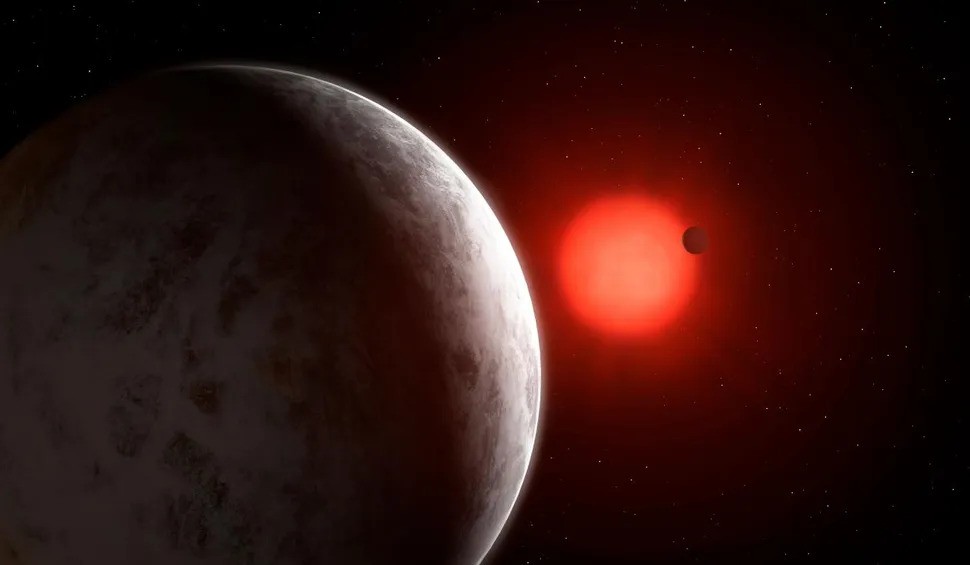
The GJ 887 red dwarf system
GJ 887 is a bright red dwarf located approximately 10.7 light-years from our Solar System — a relatively short distance compared to other star systems. Previous research revealed two exoplanets with short orbital periods of 9 and 21 days and a potential third planet with a period of 50 days. At that time, the available data did not allow determining whether the signal, which was interpreted as potentially coming from a third planet, originated from a planet or from the magnetic activity of a star.
Red dwarfs are the primary targets for the search for low-mass planets in the habitable zone (HZ) – an area at a certain distance from the star where the planet’s surface temperature allows liquid water to exist. The team involved in the new study aimed to determine whether the potential third planet could be confirmed and whether additional planets might exist.
Discovery of additional planets
Researchers combined new radial velocity (RV) measurements using the High Accuracy Radial Velocity Planet Searcher (HARPS), the Echelle SPectrograph for Rocky Exoplanets and Stable Spectroscopic Observations (ESPRESSO), and archival data. They also used photometric data from the Transiting Exoplanet Survey Satellite (TESS) and the All-Sky Automated Survey (ASAS) to determine transits and stellar rotations.
The results confirmed that four planets orbit GJ 887 with periods of 4.4, 9.2, 21.8, and 50.8 days. They also confirmed that the planet with a period of 50.8 days (GJ 887 d) is in the habitable zone, making it the second planet in the habitable zone in terms of proximity after Proxima Centauri b. The team notes that the planet is likely a super-Earth with a minimum mass of more than six times that of Earth.
Scientists note that without an independent assessment of the radius, it is impossible to determine the density and, consequently, the composition of the planet. Planets in this mass range can have either a rocky composition, an aquatic composition, or a loose sub-Neptune structure.
The study detected a fifth signal at 2.2 days, but it could not be confirmed. The team suggests that it could be a planet with a mass less than that of Earth. Future studies may confirm the existence of this potential planet with additional high-precision radial velocity data.
Ideal target for future research
The GJ 887 system will likely remain in the field of view of astronomical instruments for many years to come. GJ 887 d is a prime target for future direct observation missions that study atmospheres and search for biosignatures, such as the HWO and LIFE missions. Interest in determining the composition of GJ 887 d will likely continue in order to find out whether it can support life.
“GJ 887 is a compelling system for further study. It is a nearby and, hence, bright, M dwarf, hosting a minimum of four planets, including a super-Earth-mass, Earth-mass, and potentially sub-Earth-mass planets. At least one of the planets is in the habitable zone,” the authors of the study write.
According to phys.org

