

The Large Magellanic Cloud is a companion to our galaxy. Recently, a nova super-remnant was discovered in it. This is a nebula formed from matter ejected from a star, where powerful explosions occur every few decades.
Nova super-remnant in the Magellanic Cloud
A group of astronomers led by Michael W. Healy-Kalesh from Friedrich-Alexander University Erlangen-Nuremberg in Germany used the South African MeerKAT telescope to study the Milky Way’s largest satellite, the Large Magellanic Cloud. They discovered a nova super-remnant in it.
These objects should not be confused with supernova remnants. The second case involves black holes, neutron stars, and other objects that remain after the complete or near-complete destruction of a star in a single giant explosion. Nova super-remnants is a nebula formed as a result of the ejection of matter during many repeated explosions on a smaller scale.
What are nova super-remnants
In general, novae are phenomena in which a white dwarf in a binary system accumulates material from its neighbor on its surface, causing an explosive thermonuclear reaction. It leads to the release of large amounts of matter into space. The dead star is not destroyed in the process, and this process can be repeated as many times as desired.
Theoretically, all novae should be recurrent, and small nebulae should form around them. However, in reality, only three such objects have been discovered in the entire Milky Way, and now another one is known to exist beyond its boundaries. Scientists can only speculate as to why this is the case. Perhaps in other instances, they simply occur too infrequently and the substance has time to dissipate.
New object
LMCN 1971-08a is one of four known repeat novae discovered in the Large Magellanic Cloud. It has a lifespan of 38 years and last lit up in 2009. It consists of a white dwarf and a companion star, orbiting each other in 1.2 days.
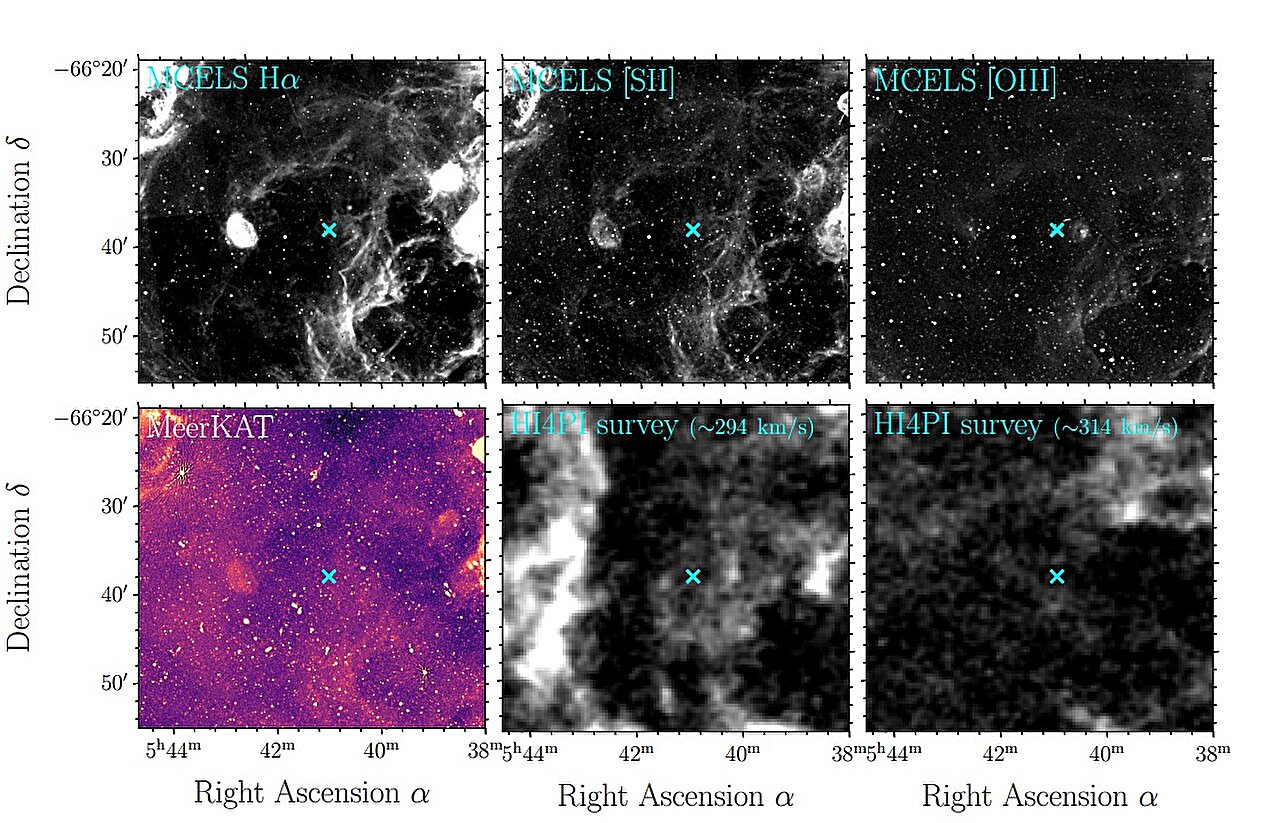
Healy-Kalesh’s team discovered a coherent, shell-like structure that spatially coincides with LMCN 1971-08a. With a circular morphology, the structure appears brighter in the northeast and southwest, with a fainter boundary connecting the two components in the northwest, defining the outer edge of the shell.
According to the study, the collected data indicates that the new structure has a diameter of about 650 light-years. The inner and outer boundaries of the supernova shell, as measured, were 284 and 329 light-years from the nova LMCN 1971-08a, respectively. The dimensions of the NSR make it the largest nova super-remnant found to date.
Observations also showed that the outer shell of the nova super-remnant around LMCN 1971-08a is expected to have a mass of 4130 solar masses and an expansion velocity of about 20 km/s. Its age is estimated to be approximately 2.4 million years.
According to phys.org

