

TRAPPIST-1 is a system consisting of seven rocky planets, located only a few dozen light-years from Earth. A recent study of one of them, TRAPPIST-1e, has shown that the chances of an ocean and atmosphere existing on it remain, but they are quite low.
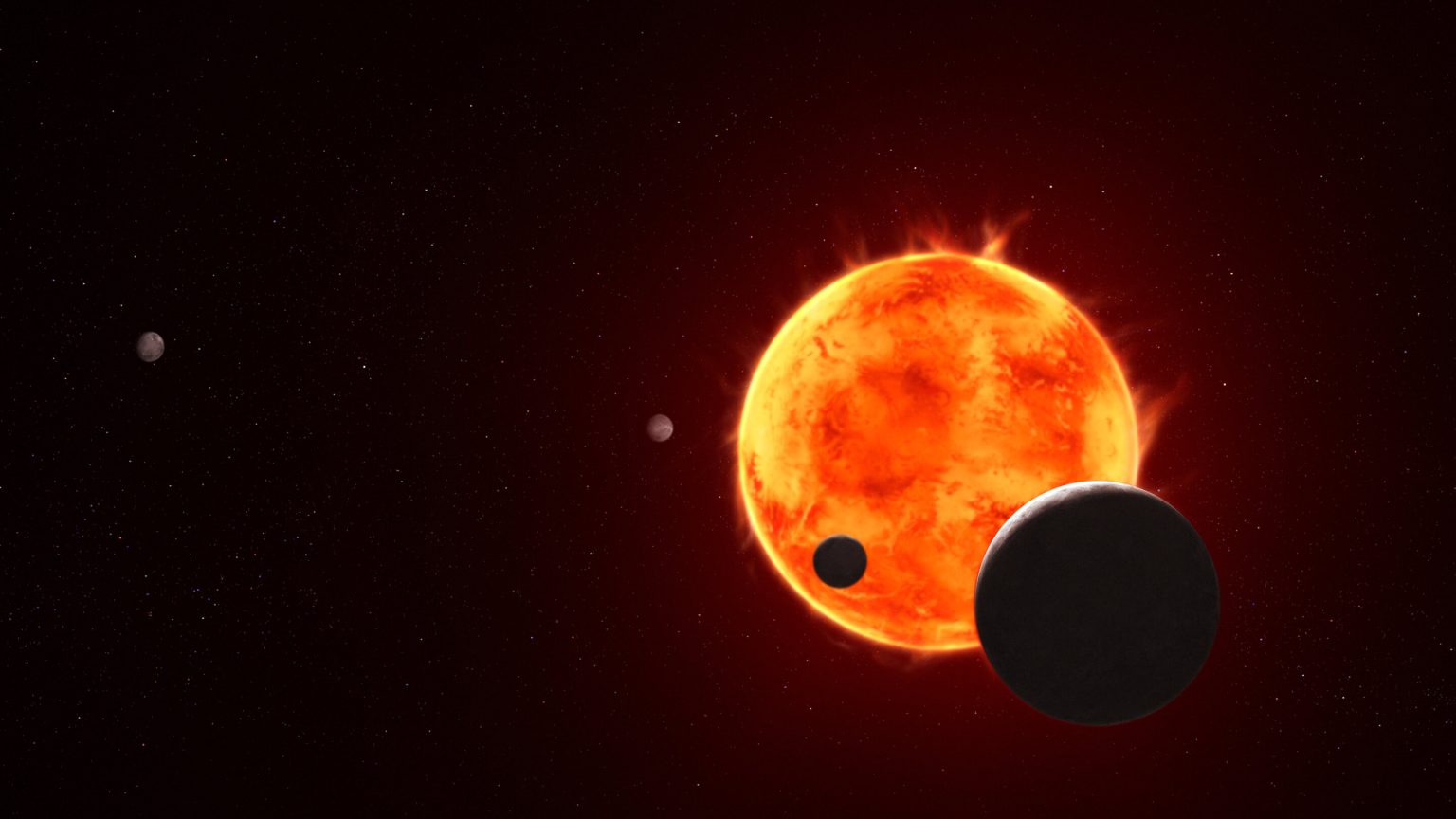
TRAPPIST-1 system
Several years ago, the TRAPPIST-1 system caused a considerable stir. This is not surprising: there are seven planets similar to Earth, at least three of which are in a zone that allows liquid water to exist, and all of this is only a few dozen light-years away from us.
Then, however, the system was a little forgotten, and now, after the launch of James Webb, there is an opportunity to conduct spectroscopic studies and find out whether they can at least theoretically support life. And the results are not very promising yet.
In a recently published article in The Astrophysical Journal Letters, researchers describe their studies of the planet TRAPPIST-1e, which orbits in the so-called habitable zone and is highly likely to have an ocean and atmosphere.
Research results
The main conclusion that scientists have drawn from the results of the first four observations is that TRAPPIST-1e most likely has an atmosphere, but there is still a chance that it does not. On the other hand, there is no certainty about what the planet’s gas envelope is.
It is safe to say that TRAPPIST-1e does not have a primary atmosphere of hydrogen and helium. If it ever existed, it was long ago destroyed by the flares of a star which, despite its size, is much more active than the Sun.
The presence of a secondary atmosphere means that liquid water can exist on the surface, and if so, researchers understand that this will be accompanied by a greenhouse effect similar to Earth’s, in which various gases, especially carbon dioxide, maintain the stability of the atmosphere and the warmth of the planet.
However, researchers reject this option as well, stating that it is unlikely that the atmosphere of planet e is dominated by carbon dioxide, as is the case in the dense atmosphere of Venus and the thin atmosphere of Mars. However, it is important to note that there are no direct parallels with our Solar System. TRAPPIST-1 is a very different star from our Sun, and the planetary system around it is also different.
Dr. Hannah Wakeford added: “A small greenhouse effect can have a big impact, and the new measurements do not rule out the presence of enough carbon dioxide to support liquid water on the surface. Liquid water can take the form of a global ocean or cover a smaller area of the planet where the star is always at noon, surrounded by ice. This will be possible because, due to the size of the TRAPPIST-1 planets and their close orbits to the star, they are all tidally locked, with one side always facing the star and the other side in perpetual darkness”.
The next steps in the research involve more detailed observations, comparing data with another exoplanet — planet b — which orbits closer to TRAPPIST-1, in order to gain further insights.
Further research using the James Webb Telescope
One of the principal investigators on the TRAPPIST-1e team, Dr. Néstor Espinoza, an associate astronomer and mission scientist for exoplanet science at the Space Telescope Science Institute (STScI) in Baltimore, Maryland, said: “Webb’s infrared instruments are giving us more detail than we’ve ever had access to before, and the initial four observations we’ve been able to make of planet e are showing us what we will have to work with when the rest of the information comes in.”
The project is part of the JWST-TST DREAMS program. This international project involves more than 30 scientists from the UK, the US, and India, five of whom are members or former members of Dr. Wakeford’s team. It includes the groundbreaking discovery of quartz clouds in the atmosphere of a hot exoplanet, reported in a 2023 study led by Dr. Grant and co-authored by Dr. Wakeford.
According to phys.org

