

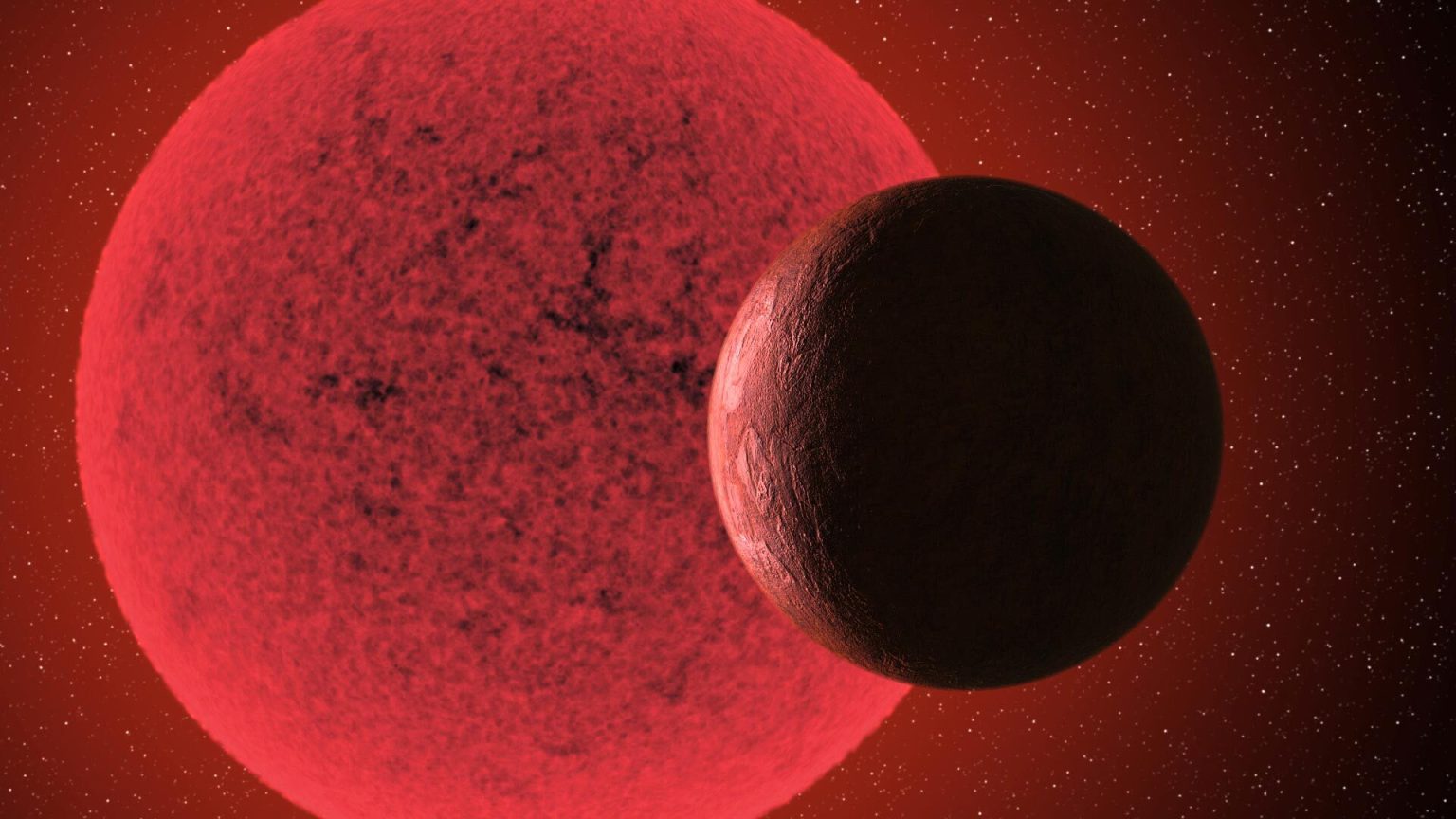
Red dwarfs, small stars with a mass less than 1/6 that of the Sun, may have several small Earth-like planets in their orbits. At least, this is the conclusion reached by scientists working with the CARMENES spectrograph.
Red dwarfs
Scientists from Heidelberg University working with the CARMENES spectrograph claim that low-mass stars have a large number of Earth-like planets in their orbits. A study on this topic has been published in the journal Astronomy & Astrophysics.
The CARMENES spectrograph system at the Calar Alto Observatory near Almería (Spain) was developed and built at the Königstuhl Observatory of Heidelberg University. Thanks to it, scientists are able to observe red dwarfs — stars that are many times less massive and thousands of times less luminous than the Sun — with high precision.
Scientists recently used it to study 15 stars from a catalog containing 2,200 red dwarfs. And thanks to this, four new exoplanets were discovered. The largest of them has a mass 14 times greater than that of Earth and orbits its star approximately every 3.3 years. Other planets have masses ranging from 1.03 to 1.52 times that of Earth and orbital periods ranging from 1.43 to 5.45 days.
Exoplanet statistics
The discovery of four exoplanets in 2025 will surprise no one. That is why their existence is not the main conclusion that scientists draw from their research. What is much more important is that only one of the discovered planets is a gas giant, while the other three are quite comparable to Earth.
Therefore, the main conclusion is that stars with a mass less than 0.16 solar masses have, on average, about two planets with a mass less than three Earth masses. This is a very interesting result, since just a few years ago, the majority of exoplanets discovered were gas giants, including those located close to their stars.
The conclusion that there may be two Earth-sized planets near a red dwarf could well fuel the debate surrounding red dwarfs. After all, these stars are already the most common in the Universe, but there is still debate about the habitability of their planets.
According to phys.org

