

Using the MeerKAT radio telescope, an international team of astronomers has discovered a new fast radio burst, designated FRB 20240304B. It became the most distant such event found to date.
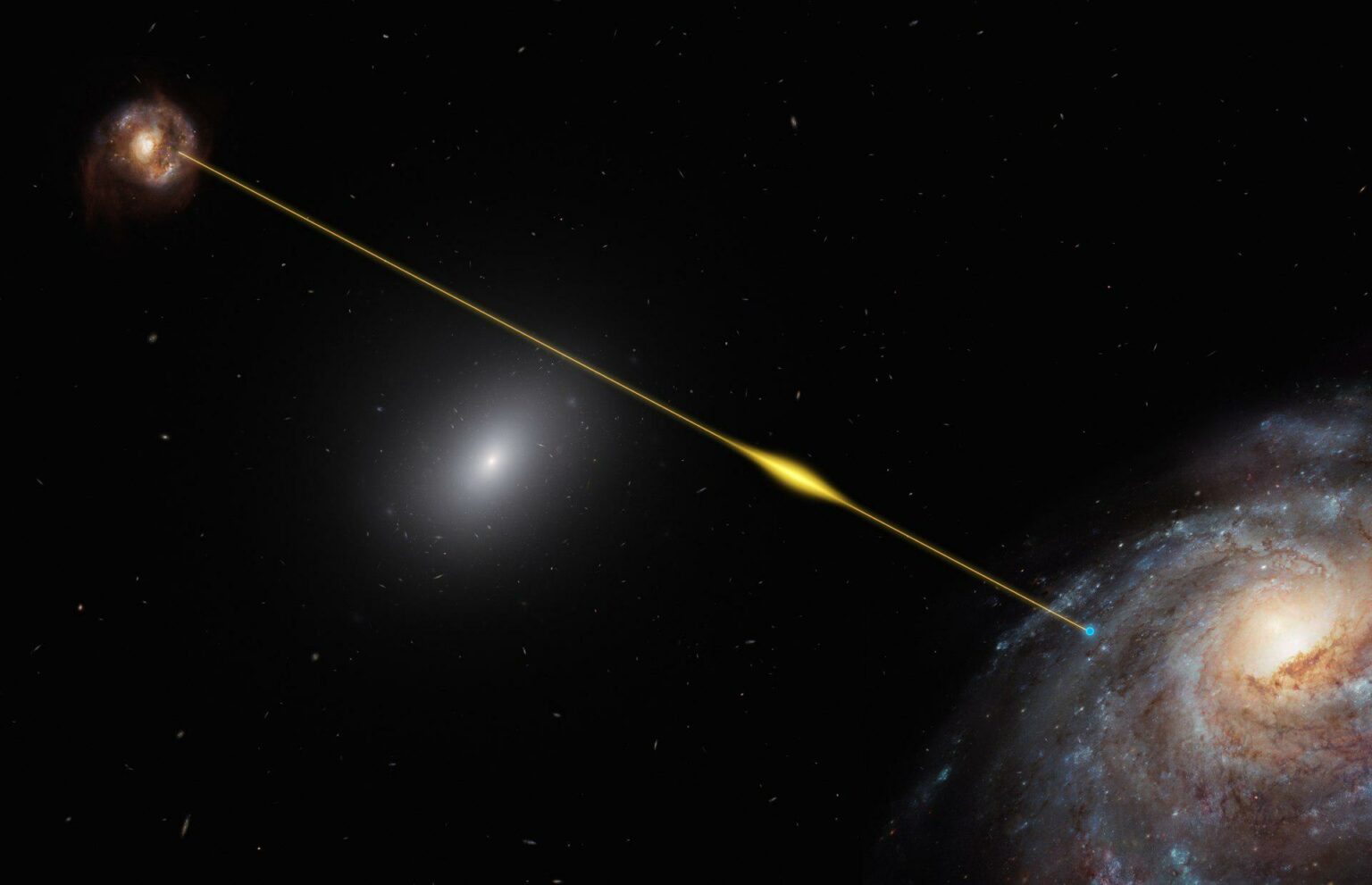
Fast radio bursts (FRBs) are intense bursts of radio waves that last only a few milliseconds and release energy equivalent to that emitted by the Sun over several days. To date, the physical nature of this mysterious phenomenon remains unknown, but astronomers are considering various explanations, ranging from radiation from young magnetars in supernova remnants to cosmic strings.
The vast majority of FRBs are located in the local Universe and have redshifts below 0.5, while their distribution at higher redshifts is still poorly understood. This is why astronomers are particularly interested in searching for distant FRBs, as they can provide important clues about the formation of galaxies when the Universe was several billion years old.
A group of astronomers from the University of Sydney in Australia reported the discovery of such a distant burst. It was designated FRB 20240304B. Its redshift is approximately 2.148, which corresponds to only 3 billion years after the Big Bang.
FRB 20240304B was identified on March 4, 2024, by the Transient User Supplied Equipment (TUSE) instrument installed on the MeerKAT radio telescope. Subsequently, the James Webb Observatory managed to determine the position of its source. It is located in a small, lumpy, star-forming galaxy. Its stellar mass is about 10 million solar masses, its star formation rate is 0.2 solar masses per year, and its metallicity is 10–20% of the Sun’s metallicity.
Overall, the results confirm that FRB 20240304B is the most distant FRB detected to date. So far, this is the first radio burst from the cosmic noon epoch — a period in the history of the Universe (about 10–11 billion years ago) when star formation was at its peak.
Earlier, we reported on a radio burst from a dead galaxy that surprised astronomers.
According to Phys.org

