

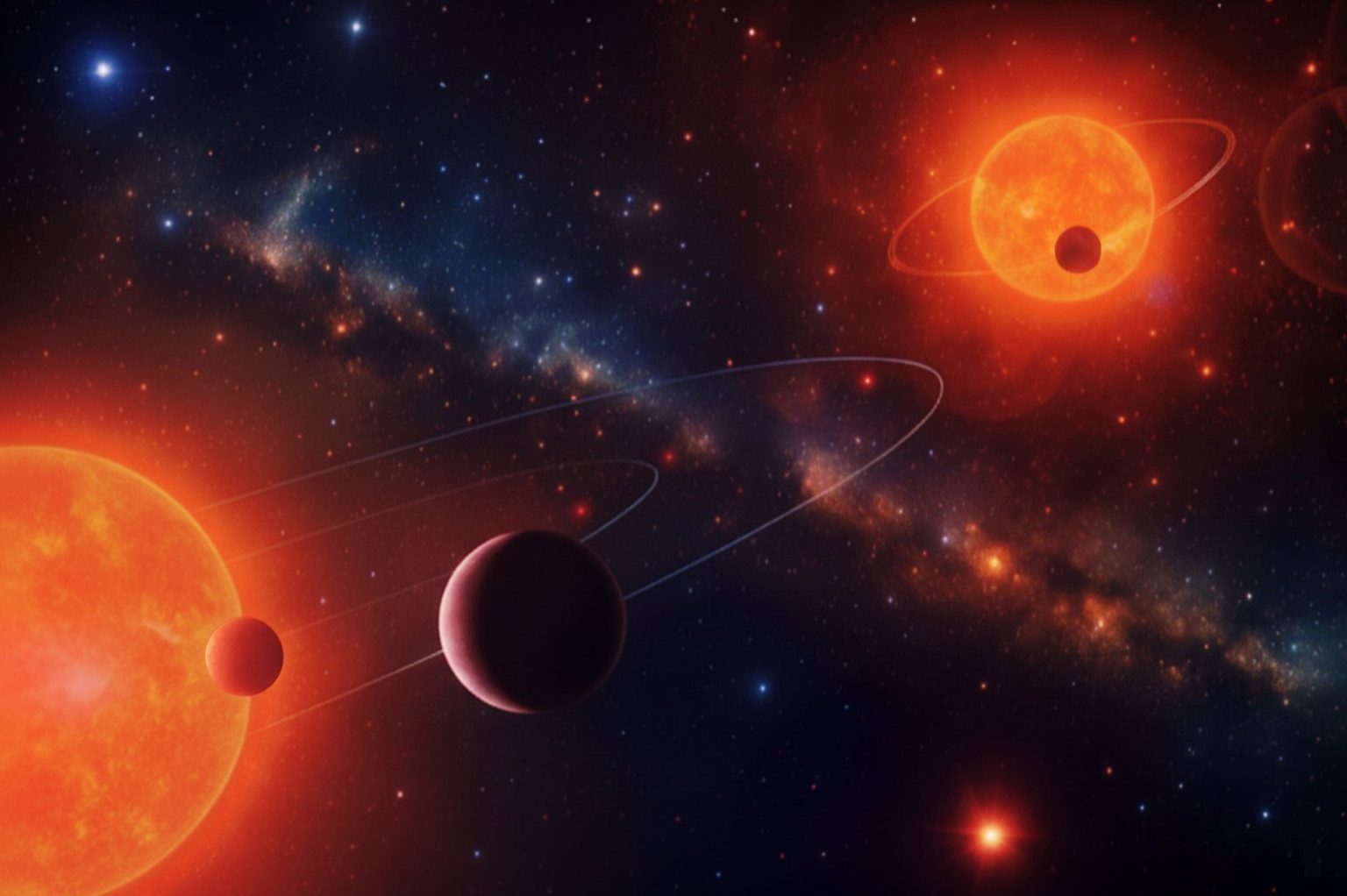
TOI-2267 is a close system consisting of two stars rotating very rapidly around a common center of mass. Recently, three Earth-like planets were discovered in this system.
Unusual binary star system
An international team of scientists recently discovered three Earth-sized planets in the TOI-2267 binary star system, located about 190 light-years away from us. This discovery is extremely important because it sheds new light on the formation and stability of planets in binary star systems, which have long been considered unfavorable for the development of complex planetary systems.
“Our analysis shows a unique planetary configuration: two planets orbiting one star and a third orbiting its companion,” says Sebastián Zúñiga-Fernández, researcher and member of the ExoTIC team at the University of Liège (ULiège) and first author of the study. “This makes TOI-2267 the first binary system known to host transiting planets around both of its stars.”
TOI-2267 is a compact binary system: two stars orbit each other in a close configuration, creating a gravitationally unstable environment for planet formation. However, researchers have discovered three Earth-sized worlds in short orbits, which is a surprising result that challenges several classical models of planet formation.
How was the system discovered?
Although the data was provided by NASA’s TESS space telescope, the initial identification of two of the three planets was first made by astronomers at ULiège and IAA-CSIC using their own SHERLOCK detection software. This early discovery allowed the team to begin ground-based observations ahead of schedule.
Subsequent confirmation of the planetary nature of these signals required intensive work by several observatories. Among them, the SPECULOOS and TRAPPIST telescopes, led by ULiège, played a central role. These robotic installations, optimized for studying small exoplanets around dim, cold stars, were crucial in confirming the existence of the planets and the characteristics of the system.
Natural laboratory for planet formation
“The discovery of three Earth-sized planets in such a compact binary system is a unique opportunity,” explains Zuniga-Fernandez. “It allows us to test the limits of models of planet formation in complex environments and better understand the diversity of possible planetary architectures in our galaxy.”
Scientists believe that this system is an example of a true natural laboratory for understanding how rocky planets can form and survive in extreme dynamic conditions where their stability was previously thought to be compromised.
This discovery raises many questions about planet formation in binary systems and paves the way for new observations, including with the James Webb Space Telescope (JWST) and the next generation of giant ground-based telescopes. These instruments will provide precise measurements of the mass, density, and possibly even the composition of the atmospheres of these distant worlds.
Beyond its striking nature, this discovery highlights the power of combining space missions with specialized ground-based telescopes such as SPECULOOS and TRAPPIST to push the boundaries of exoplanetary science.
According to phys.org

