

Researchers at the Massachusetts Institute of Technology (MIT) have developed the first comprehensive model that predicts wave behavior under conditions existing on other planets—with different gravity, atmospheric pressure, and fluid composition. The findings were published in the Journal of Geophysical Research: Planets.
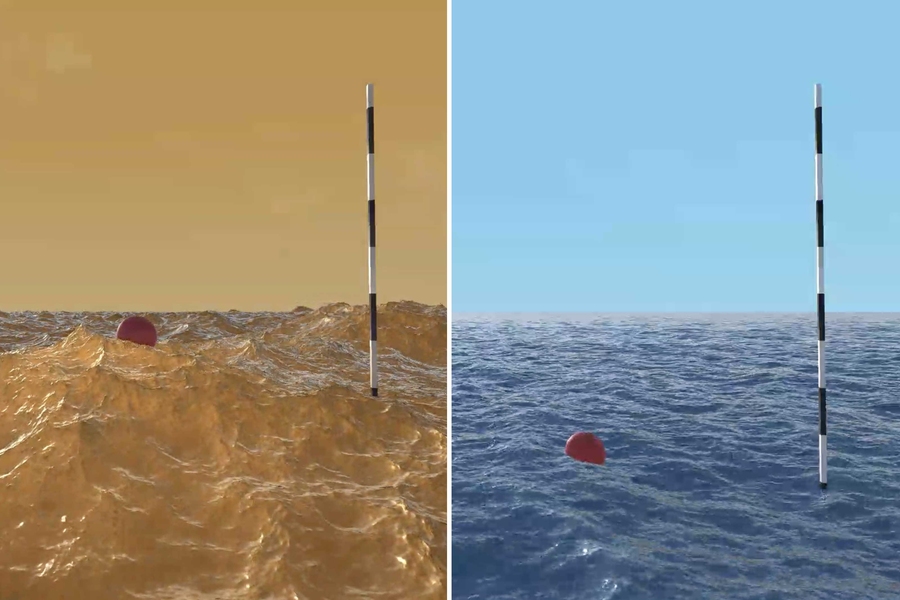
The model is called PlanetWaves. Unlike previous attempts, it takes into account not only gravity but also the properties of the surface liquid—density, viscosity, and surface tension (i.e., the extent to which the liquid resists the formation of ripples)—as well as the planet’s atmospheric pressure.
Before applying the model to other worlds, the team tested it using real-world data: twenty years of wave measurements from Lake Superior on Earth. The model accurately reproduced the relationship between wind speed and wave height.
Titan: Giant waves from a gentle breeze
The unexpected finding concerns Titan—Saturn’s largest moon and the only object in the Solar System where open pools of liquid hydrocarbons have been observed. According to data from NASA’s Cassini mission, these lakes are most likely filled with methane and ethane.
The model shows that, due to the light fluid, low gravity, and low atmospheric density, even a light breeze can generate waves about three meters high. “If you were standing on the shore of such a lake, you would feel only a light breeze, but you would see huge waves slowly rolling in,” says MIT graduate student Una Schneck, the study’s lead author.
Mars and three exoplanets
The team also simulated waves on ancient Mars, when craters—such as Jezero, which is currently being explored by the Perseverance rover—may have been filled with water. It turns out that as the atmosphere becomes less dense, increasingly stronger winds are needed to generate the same waves.
The most intriguing contrast among the three exoplanets: super-Earth LHS 1140b, which has liquid water but stronger gravity, produces smaller waves than Earth under the same wind conditions. Meanwhile, on 55 Cancri e—a planet with oceans of molten rock—even hurricane-force winds (about 130 km/h) generate waves only a few centimeters high due to the extremely dense and viscous liquid.
Why is this necessary?
In addition to its purely scientific value, the model has practical applications. If a probe is ever sent to Titan’s lakes, engineers will need to take into account the waves it will encounter.
In addition, researchers hope that PlanetWaves will help solve the mystery of Titan: despite the presence of rivers and shorelines, deltas are almost nonexistent on this moon—and waves may be the very factor that destroys them.
According to news.mit.edu

