

The global industrial robot market has reached a record high of $16.7 billion. This isn’t just a rise in sales—the industry is undergoing structural changes that will shape the future of manufacturing in the coming years.
1. Intelligence instead of rules
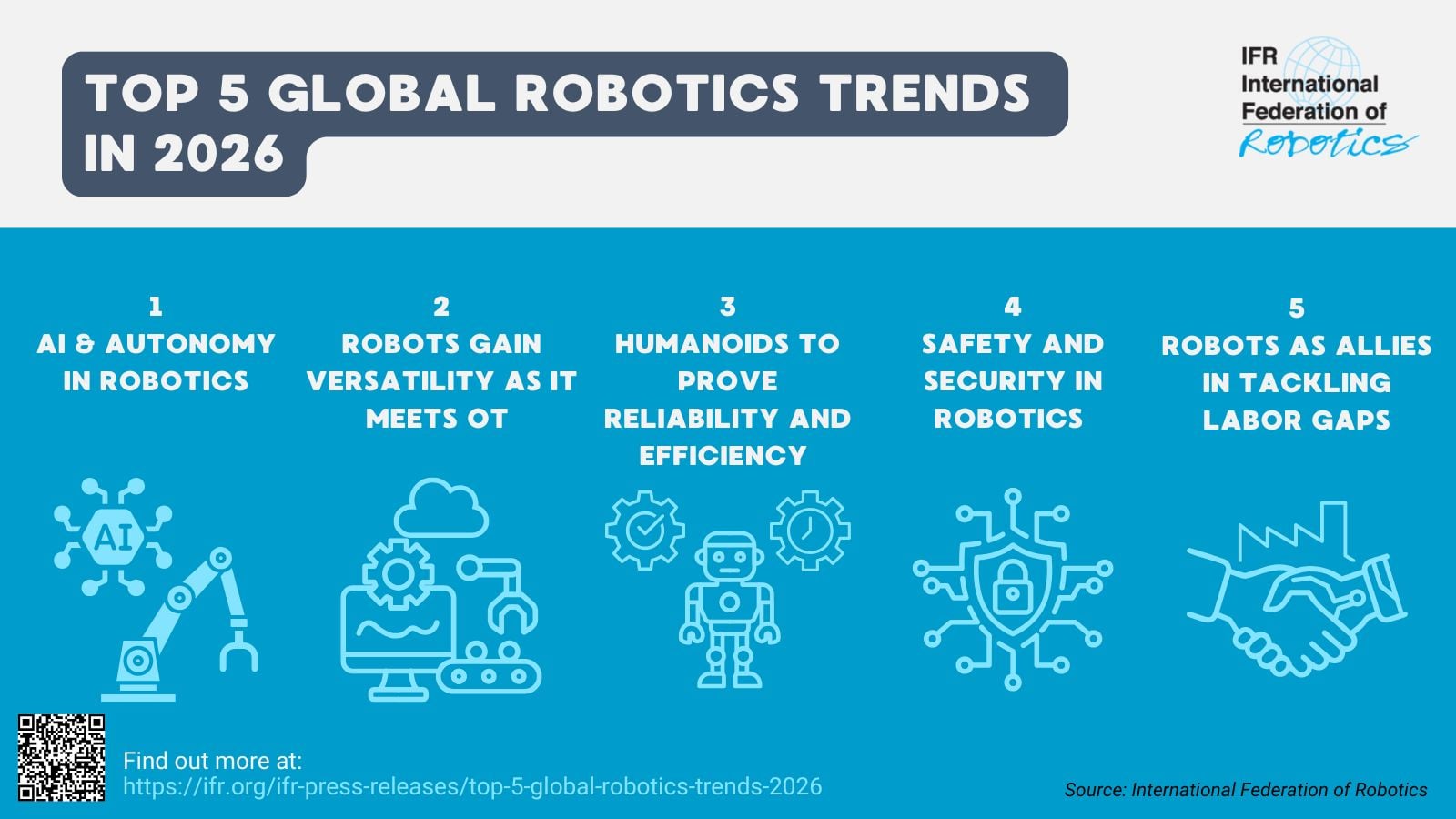
In its annual report, the International Federation of Robotics (IFR) identified five key trends for 2026. First and foremost is the rapid adoption of artificial intelligence. Analytical AI enables machines to predict breakdowns before they occur and to autonomously plan routes within warehouses.
Generative AI has taken a step further: instead of rigidly defined algorithms, it now learns new tasks through simulations and understands commands in natural language. The combination of both approaches—known as agent-based AI—is designed to enable machines to act independently in truly unpredictable conditions.
2. Digital and physical worlds are converging
Another trend is the convergence of information technology and operational technology. Put simply: data processing systems and systems for managing physical processes used to exist in parallel and had almost no interaction. Now these barriers are breaking down.
The actual exchange of data between the digital and physical layers gives robots greater context and flexibility—and forms the foundation of what is known as the Fourth Industrial Revolution.
3. Humanoids are coming out of the labs
The third area is humanoid robotics. Companies and research teams are moving from prototypes to actual deployments in manufacturing facilities and warehouses. The automotive industry has taken the lead in this field.
However, in order for humanoids to compete with conventional automation, they have to meet strict industrial requirements: keep up with the pace of the production cycle, not consume too much energy, and not require excessive maintenance. The IFR notes that the key criterion for success is achieving human-level agility and productivity.
4. Safety and New Risks
The increasing autonomy of machines makes it more difficult to monitor and verify their behavior. Connecting robots to cloud platforms creates new vulnerabilities: experts are noting an increase in attempts to hack controllers and gain unauthorized access to systems.
Privacy is also a concern—devices collect video, audio, and sensor data streams. Deep learning models are often unable to explain their own decisions even to their developers, and the legal framework for determining liability for AI actions is still taking shape.
5. A partner, not a replacement
The fifth trend concerns the labor market. Robots are increasingly viewed not as a threat to employment, but as a solution to the shortage of skilled workers. IFR emphasizes that the successful implementation of automation depends on whether employees themselves are involved in the process.
Governments and companies are investing in reskilling programs so that people can compete in an economy where automation is becoming the norm.
According to ifr.org

