

TOI-3884 is a red dwarf star with a planet orbiting it. The planet is transiting, meaning that it occasionally passes between its star and us. Thanks to one of these events, it was possible to refine the parameters of its orbit.
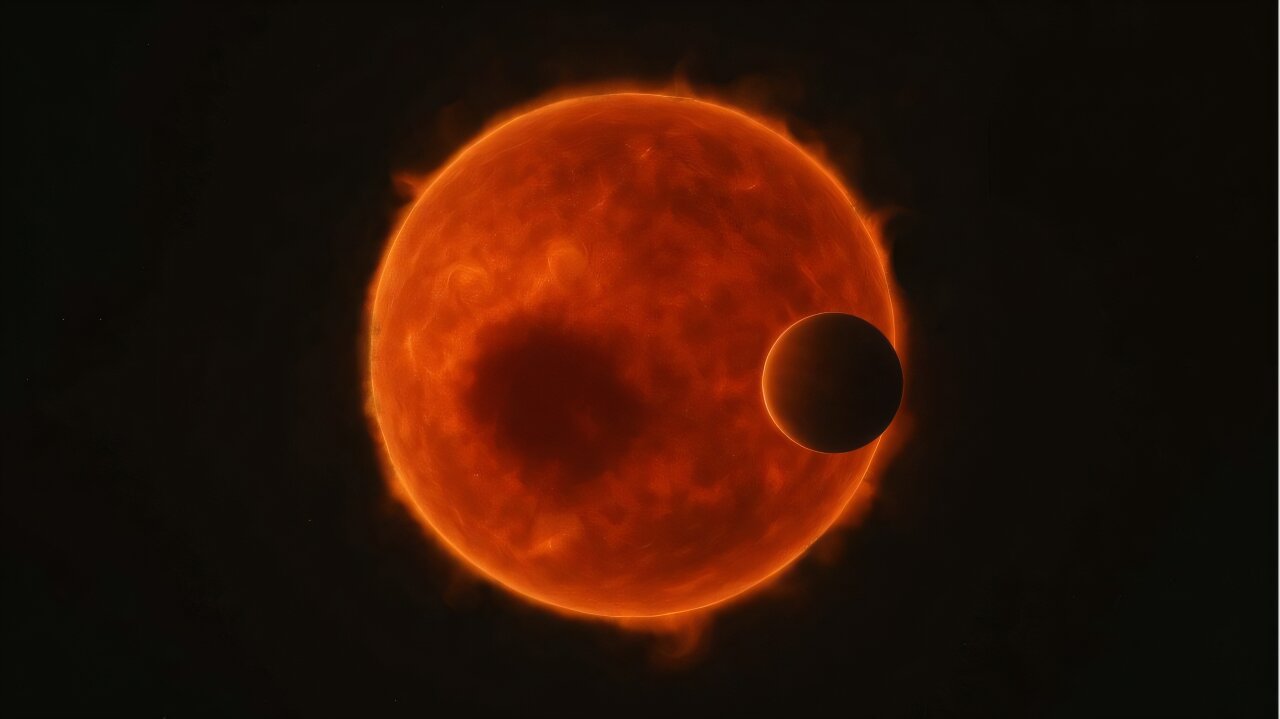
The transit method of exoplanet research
As atmospheric observations of exoplanets become increasingly precise, it is more important than ever to correctly account for the effect of starspots on host stars. An ideal opportunity to study starspots arises when a transiting planet passes directly across them – a phenomenon known as a spot-crossing transit.
An international research team led by scientists at the Astrobiology Center (Tokyo, Japan) has combined ground-based observations to reveal the detailed properties of the starspots and the orbital geometry of the planetary system TOI-3884. The research is published in The Astronomical Journal.
NASA’s James Webb Space Telescope (JWST) has revolutionized the study of exoplanet atmospheres. Atmospheric observations primarily rely on transits – when a planet passes in front of its host star and blocks a fraction of its light. By comparing the transit depth at different wavelengths, astronomers can identify the atoms and molecules in the planet’s atmosphere.
JWST now enables the detection of subtle transit depth differences as small as 0.01%. However, this unprecedented precision also makes it necessary to account for effects that were previously hidden in the noise, such as those caused by starspots – cooler, darker regions on the stellar surface. Starspots can mimic or obscure atmospheric signals, making it crucial to understand and correct for their impact.
Starspots of TOI-3884
TOI-3884 is a red dwarf star located about 140 light-years away. It hosts the planet TOI-3884b, a “super-Neptune” about six times the radius of Earth. Remarkably, TOI-3884b’s transits show a persistent spot-crossing signal. Such systems are extremely rare and provide a valuable opportunity to simultaneously study both the properties of starspots and the system’s orbital geometry.
Previous studies produced conflicting results regarding key parameters of the TOI-3884 system, such as the stellar inclination and rotation speed. The present study aimed to resolve these discrepancies using more precise ground-based observations.
By studying the star TOI-3884 with instruments on the 2-meter telescopes at the Las Cumbres Observatory, astronomers were able to observe three transits and successfully detect clear signals of spot crossings. Analysis of the light curve showed that the star spots are about 200 K cooler than the star’s surface (3150 K) and cover about 15% of the star’s visible disk. In addition, the three transit light curves show changes in the shape of the spot crossing signal. Since these changes occurred over a short period of time, they are most likely caused by the rotation of the star rather than the evolution of the spot.
Geometry of the TOI-3884 star system
To confirm this, the team carried out a photometric monitoring campaign using the global network of LCO 1-meter telescopes. From December 2024 to March 2025, they measured the star’s brightness variations several times per night and detected clear periodic fluctuations. This revealed, for the first time, that the stellar rotation period is 11.05 days.
The measured rotation period was consistent with the spot position shifts inferred from the transit observations, enabling the team to obtain a unique solution for the system geometry. They found that the stellar spin axis and the planet’s orbital axis are misaligned by about 62°, revealing that TOI-3884 is a highly tilted planetary system. Such large tilts are typically attributed to past gravitational interactions with massive planets or stellar companions – yet no such companions are known to exist, making this system particularly intriguing.
Future studies of exoplanetary atmospheres and starspots
TOI-3884b is one of the prime targets for atmospheric studies with JWST and other telescopes. The detailed characterization of its starspots and orbital geometry from this study will be critical for correctly interpreting the results of atmospheric observations.
Moreover, the findings also provide new insights into stellar magnetic activity. Large polar starspots are often thought to be linked to strong magnetic fields on rapidly rotating stars. However, TOI-3884 does not rotate particularly fast, yet it still hosts a giant polar spot. This suggests that polar spots may be especially common among red dwarfs. In addition to continuing detailed observations of TOI-3884, it will also be important to deepen our understanding of the general properties of starspots.
Provided by: phys.org

