

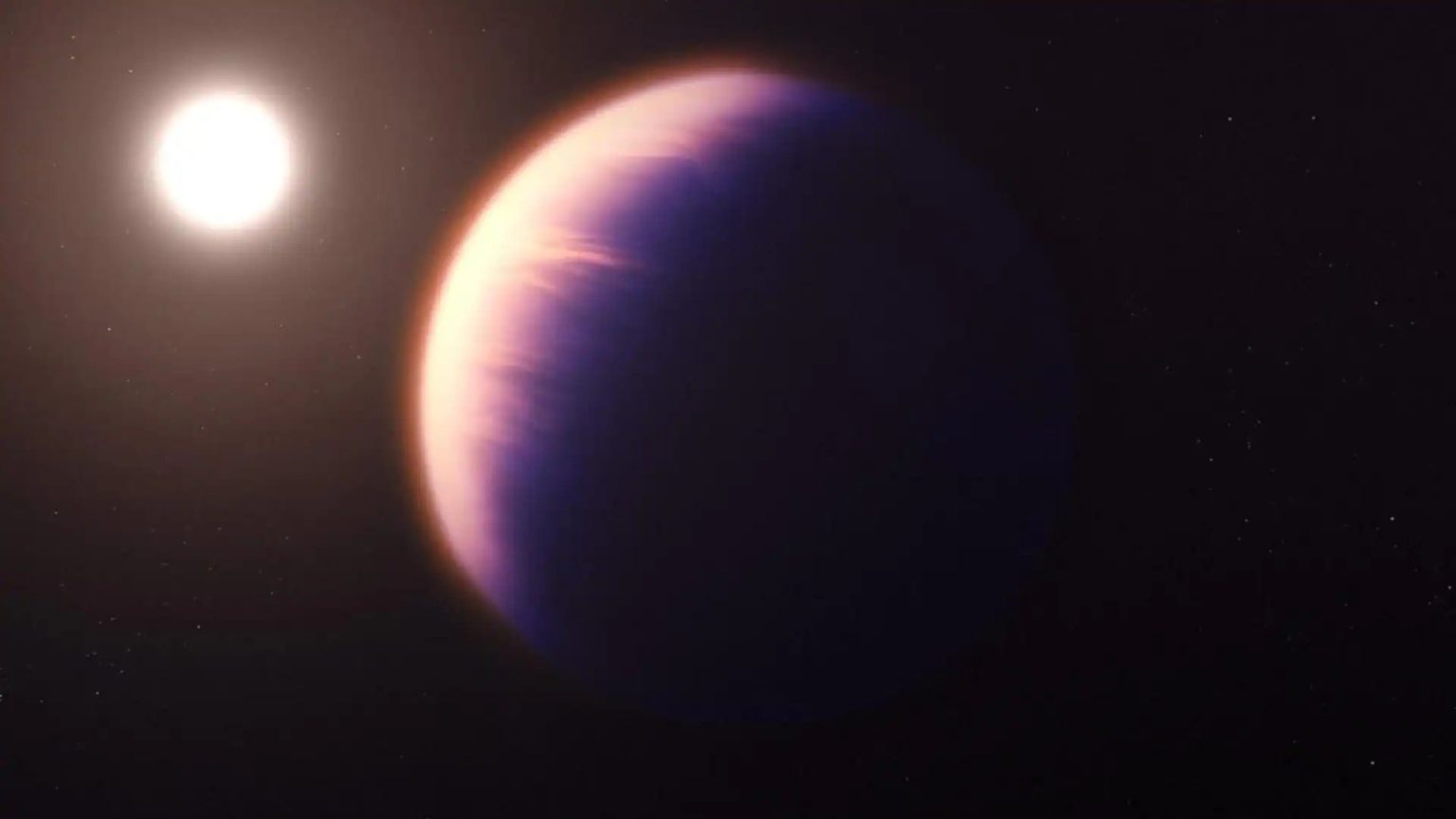
The TESS space telescope has discovered planets near the star TOI-2322, located 195 light-years away from us. There are two of them, and they are super-Earths orbiting quite close to their star.
New exoplanets
On August 25, a team of scientists published a study of the star TOI-2322 on the arXiv preprint server. Using the TESS space telescope, they were able to determine two planets orbiting around it.
TOI-2322 or TIC 300812741 is a star of spectral class K4, i.e., an orange dwarf. It is located 195 light-years away from us. It is approximately 30% smaller than the Sun in terms of mass and size. Its surface temperature is 4664 K. The age of the star is estimated at 3.9 billion years.
TESS observed it from 2018 to 2023. Even then, traces were found in its radiation that could indicate the presence of a planet. However, their nature was only confirmed in the current study.
What do the planets represent?
The first of the newly discovered exoplanets, which is closer to TOI-2322, has been designated TOI-2322 b. It is the size of Earth, while its mass is estimated to be less than 2.03 times that of Earth. The planet orbits its star every 11.3 days, at a distance of approximately 0.09 astronomical units from it, and its equilibrium temperature is estimated at 603.1 K.
The outer, larger planet, TOI-2322 c, has a radius of approximately 1.87 Earth radii and is 18 times more massive than Earth, giving it a density of 14.69 g/cm3. The planet, located approximately 0.13 astronomical units from its parent star, has an orbital period of 20.2 days and equilibrium temperatures of approximately 500 K.
The properties of the two worlds indicate that they are rocky exoplanets with short periods. Astronomers have noted that TOI-2322 c has an internal structure very similar to Earth’s, making it the largest and one of the most massive Earth-like planets known to scientists.
The authors of the study noted that TOI-2322’s orbital period is 21.28 days, which is close to the orbital period of TOI-2322 c, which may conceal the presence of a transiting planet. Therefore, the TOI-2322 system is an excellent place to test methods for separating planetary and active signals in radial velocity measurements.
According to phys.org

