

Using the TESS space telescope, astronomers have discovered two new exoplanets orbiting red dwarfs. The newly discovered worlds are similar in size to Jupiter and have a density similar to that of Saturn. The discovery is reported in an article published on the arXiv preprint server.
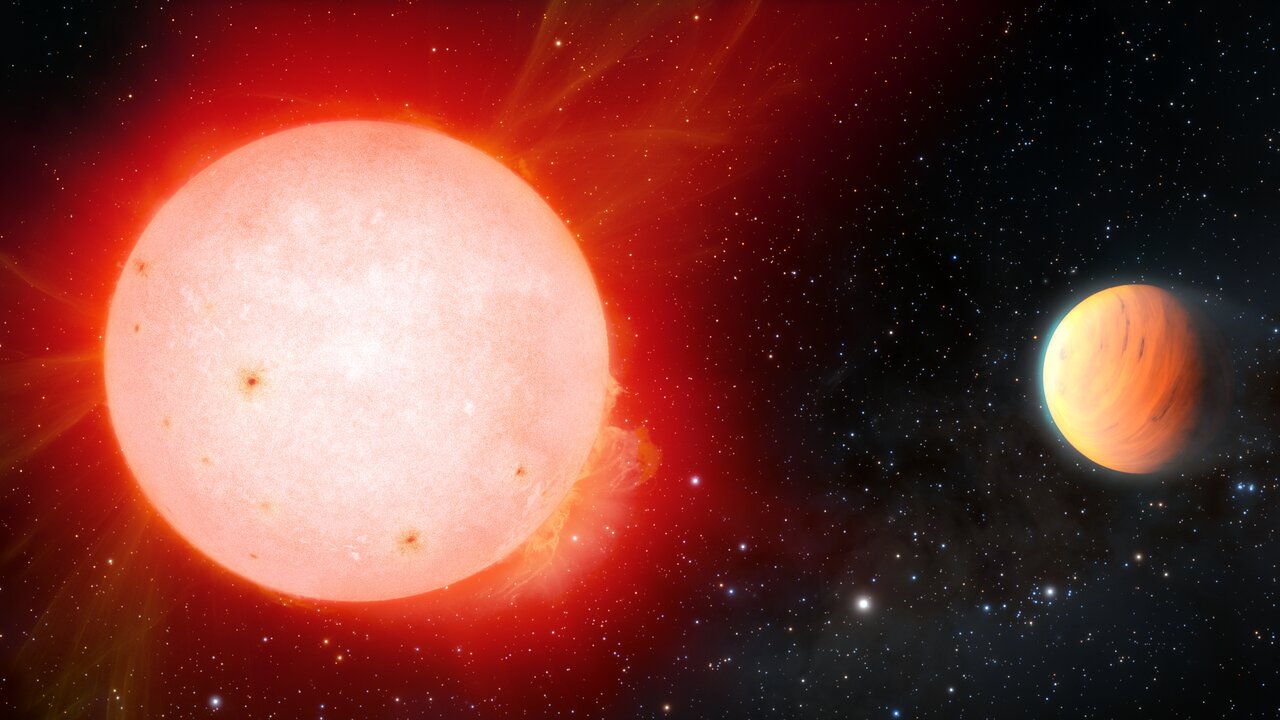
The TESS telescope is observing 200,000 of the brightest stars closest to the Sun in order to detect transiting exoplanets. To do this, it tracks fluctuations in their brightness. Since it began operating in 2018, the telescope has identified more than 7,700 candidates. 705 of them have been confirmed so far.
Recently, two more exoplanets have been added to this list. Astronomers from the University of California, Irvine, have reported the discovery of companions to the stars TOI-5916 and TOI-6158. These are red dwarfs, which are about half the size and mass of the Sun. They are located 640 and 594 light-years from Earth, respectively.
The first exoplanet, designated TOI-5916 b, has a radius approximately 1.05 times that of Jupiter. Its mass is 0.69 times that of Jupiter, giving it a density of 0.73 g/cm3. This is comparable to the density of Saturn. The exoplanet orbits its star every 2.37 days at a distance of about 0.028 AU (4.2 million km) from it. Its equilibrium temperature is estimated at 443 °C.
The second newly discovered exoplanet, TOI-6158 b, is smaller and less massive than TOI-5916 b. Its radius is 0.93 times that of Jupiter, and its mass is 0.42 times that of Jupiter. The orbital period of this world is 3.04 days, and its orbit passes at a distance of 0.033 AU from the star (4.93 million km). Calculations show that the equilibrium temperature of TOI-6158 b is 363 °C, and its density is about 0.66 g/cm3.
TOI-5916 b and TOI-6158 b are the latest additions to the relatively small list of 32 known gas giants orbiting red dwarfs. Until recently, astronomers believed that due to the small mass of protoplanetary disks around red dwarfs, Jupiter-like bodies could not form. However, observational results suggest that this is not entirely true. Gas giants, although rare, are found in red dwarf systems.
Earlier, we discussed the possibility of life in red dwarf systems.
According to Phys.org

