

Astronomers from the Main Astronomical Observatory of the National Academy of Sciences of Ukraine and Taras Shevchenko National University of Kyiv, as well as a Ukrainian student from Northwestern University in the United States, have discovered three new polar ring galaxies.
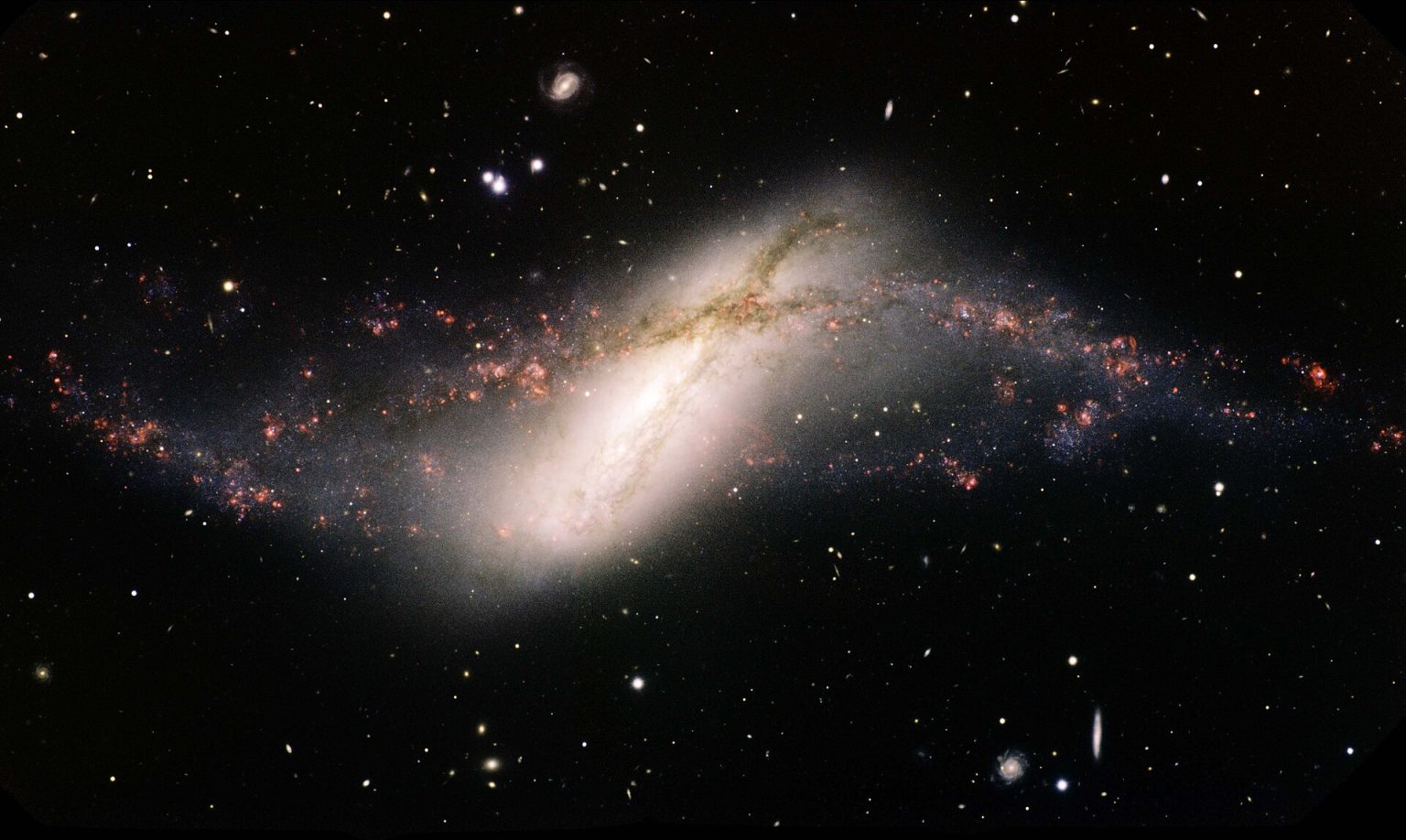
New polar ring galaxies
Ukrainian astronomers have discovered three new polar ring galaxies using machine learning methods with an extremely small training sample. This was reported to Universe Space Tech by the authors of the study.
The results of the study will be published in the authoritative scientific journal Astronomy and Astrophysics. The article has gone through all stages of editing and is awaiting publication. Its text is available on the publication’s website.
Similar galactic systems have been known since the late 1970s. The central galaxy belongs to the class of early galaxies (elliptical or lenticular), while the ring, rotating at an angle to the central part, has the characteristics of a late galaxy (spiral or irregular).
The formation of polar ring galaxies remains unclear. Currently, the scientific community offers three theories. One of them suggests that such a system is the result of the merger of two galaxies of different sizes. Specifically, when the larger galaxy does not merge with the smaller one directly, but instead the smaller one, approaching at a certain inclination, forms a ring around the larger galaxies.
In the second theory, two galaxies of different sizes also interact, but they do not merge; instead, the larger one pulls matter from the smaller one (accretion of matter from one galaxy to another occurs), resulting in the formation of a ring. According to the third theory, rings are formed due to the flow (accretion) of cold gas along cosmological filaments, which causes the formation of a polar ring.
Galaxy SDSS J140644.42+471602.0
A team of Ukrainian scientists consisting of Daria Dobrycheva, Oleksandr Hetmantsev, Iryna Vavilova, Oleksandr Gugnin, Andrii Shportko, and Olena Kompaniiets used machine learning methods to search for polar ring galaxies. The uniqueness of this study lies in the fact that the training sample of galaxies consisted of 87 objects, which is extremely small for this task. Despite the difficulties, the scientists managed to discover a new polar-ring galaxy – SDSS J140644.42+471602.0. Along with it, two more similar systems were discovered, one of which (SDSS J095717.30+364953.5) is important and may confirm the first or second theory of the formation of such unique objects, since it involves a merger.
Scientists conducted a detailed multiwavelength study of the object SDSS J140644.42+471602.0, using data from the Sloan Digital Sky Survey (SDSS) in combination with infrared observations from the Wide-field Infrared Survey Explorer (WISE) and ultraviolet observations from the Galaxy Evolution Explorer (GALEX).
To analyze this data, scientists used the CIGALE (Code Investigating GALaxy Emission) software package. This is a modern tool that allows scientists to recreate an energy “portrait” of galaxies – their spectral distribution from the ultraviolet to the infrared range – determine their key characteristics, and, based on this, recreate the history of star formation.
Thanks to this approach, it was possible to determine that about 500 million years ago, this galaxy experienced a powerful burst of star formation. Ukrainian researchers concluded that the most likely scenario for the formation of the polar ring in SDSS J140644.42+471602.0 was the accretion of matter from a satellite galaxy. Since no such object is currently observed next to it, it was most likely destroyed as a result of this process.
Catalog of polar ring galaxies
In order to search for such unique objects and apply machine learning methods, a group of Ukrainian scientists has done extensive work on revising existing catalogs of polar ring galaxies. Currently, there are three catalogs of polar ring galaxies in the literature, which were created by different authors in 1990, 2011, and 2019. Before the machine learning algorithm can start searching for such objects, it must be trained, i.e., shown as many examples as possible of what these galaxies are and what shape they have. To do this, our scientists collected all existing galaxies with polar rings from all existing catalogs, which turned out to be 463 objects. They conducted a visual inspection of them and found that only 87 polar ring galaxies; all the others were rejected. But why were all the other galaxies previously included in these catalogs? Our scientists explain this by the fact that earlier telescopes did not have such high-quality images compared to modern ones, and the shapes of those galaxies resembled polar ring galaxies, which is why they were included in the catalogs.
As a result, 87 galaxies for training a neural network are an extremely small training sample. However, Ukrainian researchers still managed to apply machine learning methods to process the data. The result was the creation of a catalog containing 167 galaxies. It can be used for further research into how polar rings are formed.
Provided by: ui.adsabs.harvard.edu

