

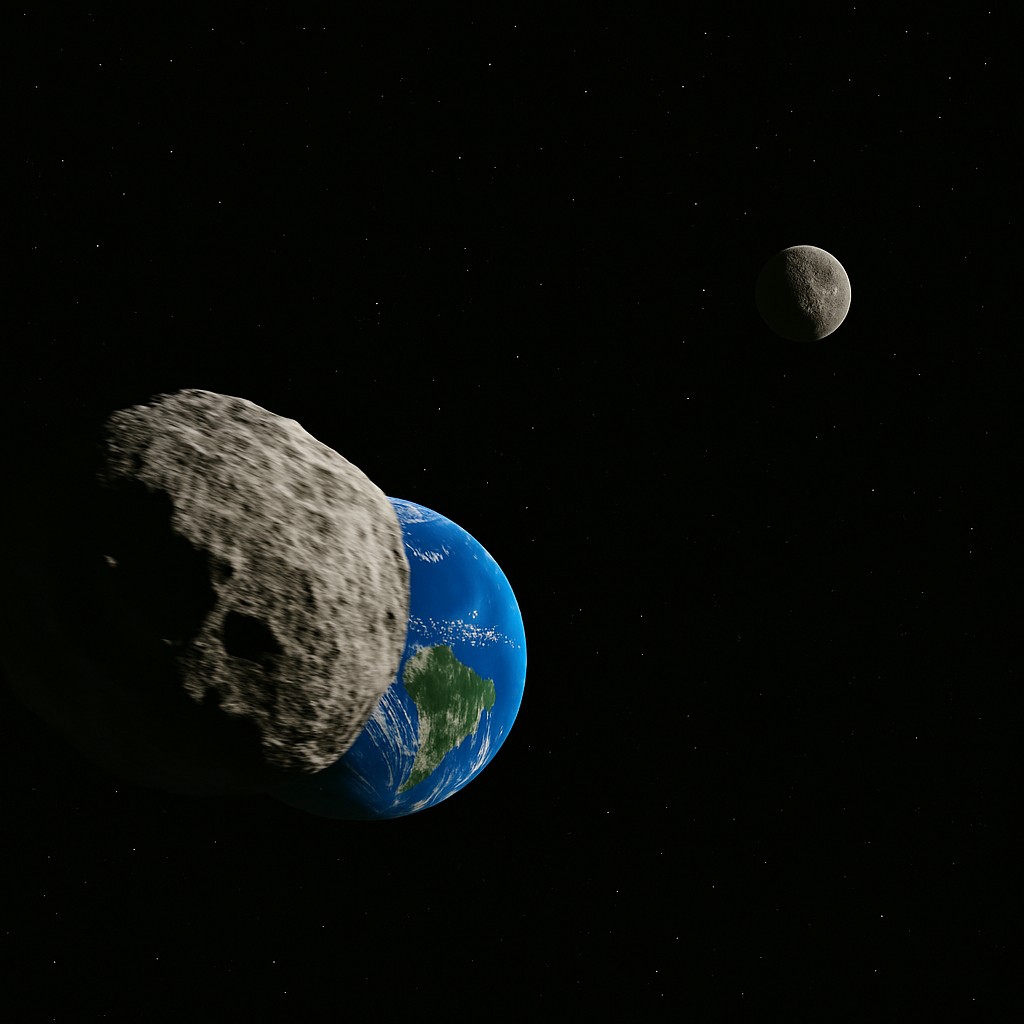
Astronomers have made an interesting discovery: an unknown space object that has remained an unnoticed moon of our planet for decades. This quasi-moon, named 2025 PN7, was discovered by the Pan-STARRS observatory in Hawaii on August 2. The discovery prompted scientists to delve deeper into archival data, where they found evidence of its existence as early as 2014. However, further calculations revealed an even more surprising fact: this cosmic rock has been silently accompanying Earth for at least 60 years. The discovery was reported in Research Notes of the American Astronomical Society.
What is a quasi-moon?
Unlike our permanent natural satellite, the Moon, quasi-satellites do not orbit directly around the Earth. They move around the Sun in an orbit almost identical to ours, under the influence of our planet’s gravity. This creates the illusion that they accompany Earth on its long journey around the star. They are not captured by our gravity, but seem to walk alongside us, remaining temporary but faithful cosmic companions. 2025 PN7 is one of seven objects of this type known to science.
It is very important not to confuse quasi-moons with mini-moons. Mini-moons are small asteroids that are temporarily captured by Earth’s gravity and become its actual moons for several months, orbiting around it before leaving orbit. Quasi-moons, on the other hand, never orbit directly around a planet. They move in their own orbit around the Sun, which is simply synchronized with Earth’s.
Little Neighbor 2025 PN7
The size of 2025 PN7 is estimated to be approximately 19 meters in diameter. It moves at a distance of 4.5 to 59 million kilometers from our planet. Scientists predict that this unwavering space satellite will remain in its stable orbit for at least another 60 years before losing synchronization with Earth.
The discovery of 2025 PN7 is boosting interest in this class of objects. The most famous quasi-moon is Kamoʻoalewa (2016 HO3), to which a spacecraft is already planned to be sent. China’s Tianwen-2 space mission, launched this year, aims to collect samples from Kamoʻoalewa and deliver them to Earth by 2027. This research may shed light on the deepest mysteries of the origin of our solar system.
The discovery and study of objects such as 2025 PN7 helps scientists better understand the complex gravitational interactions in our cosmic neighborhood.
Earlier, we reported on all types of temporary Earth’s moons.
According to gizmodo.com

