

June 21 marks the summer solstice, when the Northern Hemisphere experiences the longest daylight hours and shortest night of the year. However, this phenomenon hides several unexpected facts that make this date much more interesting than it seems at first glance.
What is the solstice?
There are two solstices yearly: one in June and one in December. The June solstice marks the longest day north of the equator and the shortest day south.
The June solstice is when the Sun is directly over the Tropic of Cancer in the Northern Hemisphere. The Tropic of Cancer is a parallel at latitude 23°26′15″ where the Sun is at its zenith only once a year, during the summer solstice. In ancient times, this point was indeed in the constellation of Cancer, but due to the precession of the Earth’s axis, since 1988 it has been located in the constellation of Taurus. After the solstice, the Sun begins to move south again.
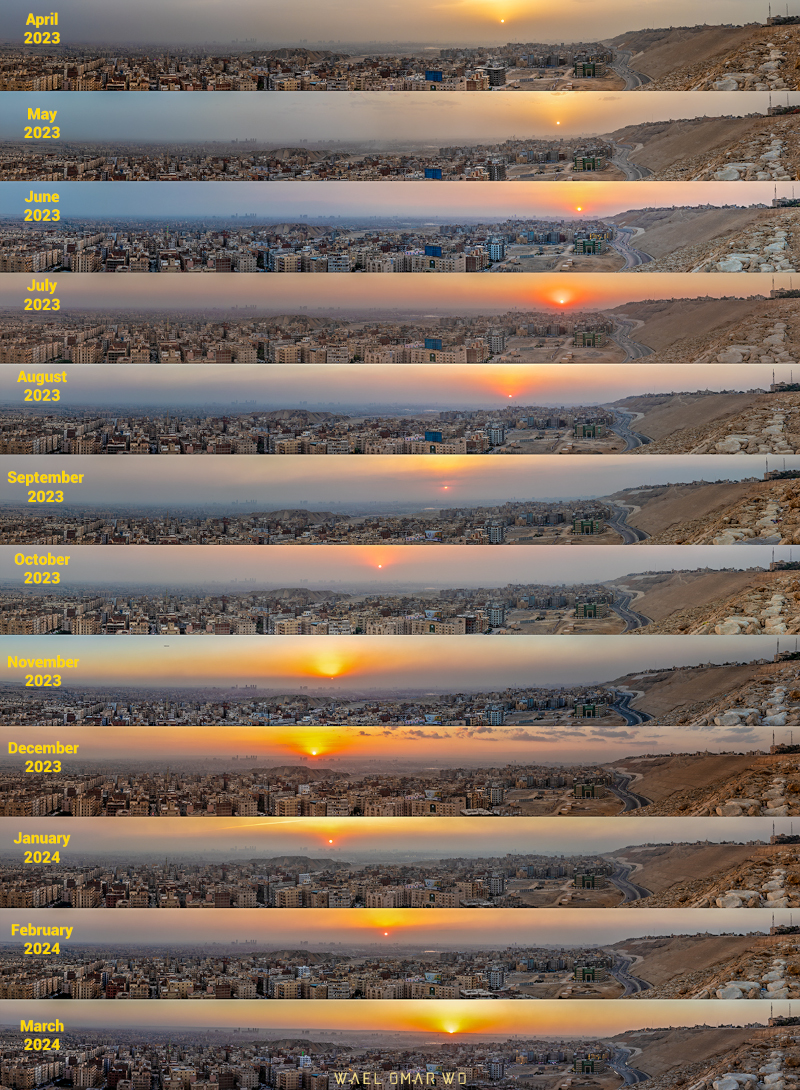
Image Credit & Copyright: Universe Space Tech
Because the Northern Hemisphere is tilted toward the Sun in June, it receives more sunlight during the day. The North Pole’s tilt toward the Sun is greatest on the solstice, making it the longest day of the year north of the equator.
This effect is most pronounced in places farther from the equator. In tropical zones, the longest day is just over 12 hours, in temperate latitudes it is much longer, and beyond the Arctic Circle, there is a polar day when the Sun does not set at all.
When is the summer solstice in 2025?
The moment of the summer solstice in 2025 will take place on Saturday, June 20-21, at 2:41 a.m. GMT (9:41 p.m.EST).
Although most people think of the June solstice as June 21, it can occur any day between June 20 and June 22, depending on the time zone. The June 22 solstice is rare; the last one was in 1975, and the next one will be in 2203.
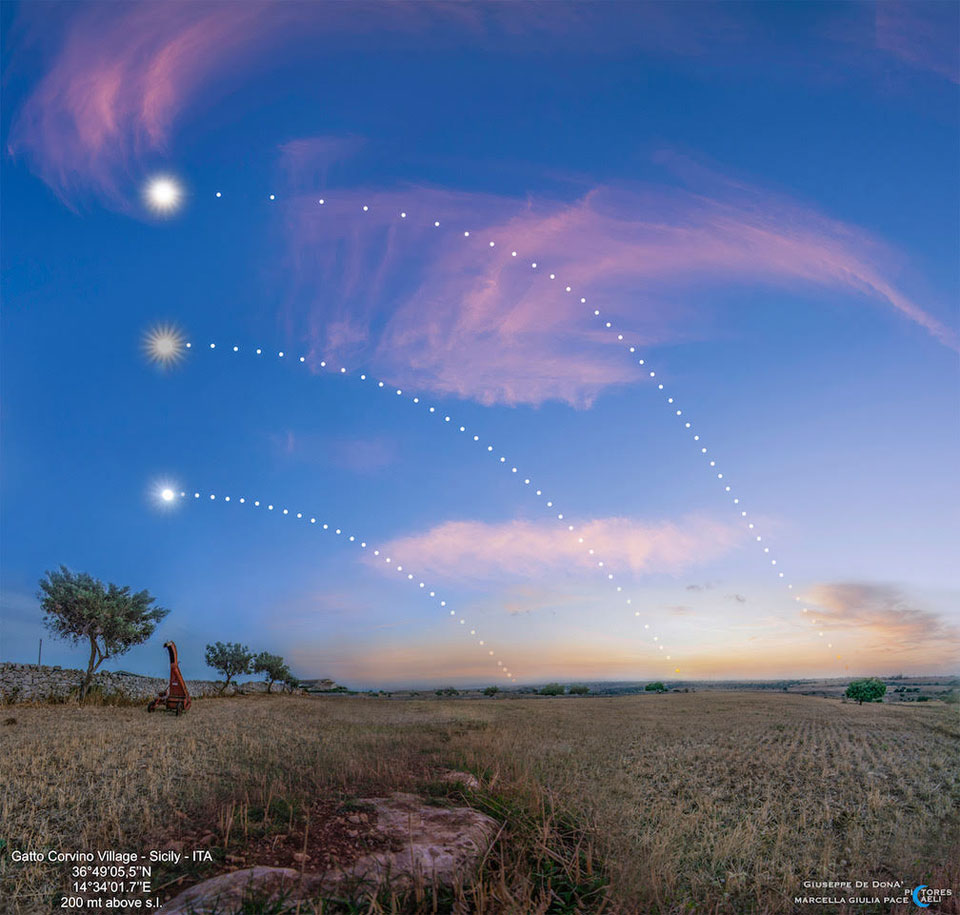
Image Credit & Copyright: Marcella Giulia Pace & Giuseppe De Donà
The difference in the dates of the equinoxes and solstices arises from the discrepancy between the calendar and tropical years (the time it takes for the Earth to complete a full revolution around the Sun, approximately 365.242199 days). As a result, the solstice occurs about 6 hours later each year, until the accumulated difference shifts the event to the next date.
To align the calendar with the tropical year, a leap day is introduced about once every four years. After that, the dates of the equinoxes and solstices are shifted back to an earlier date. The solstice is also influenced by factors such as changes in the length of the tropical year, the Earth’s orbital movements, and the “wobble” of the Earth’s axis (precession).
How long is a day during the summer solstice?
The length of the day depends on the geographical latitude. In Kyiv, for example, the day will last 16 hours and 27 minutes, while in Chernihiv it will be 16 hours and 38 minutes, and in Odesa it will be only 15 hours and 49 minutes. Beyond the Arctic Circle, the sun does not set at all, so there is no night.
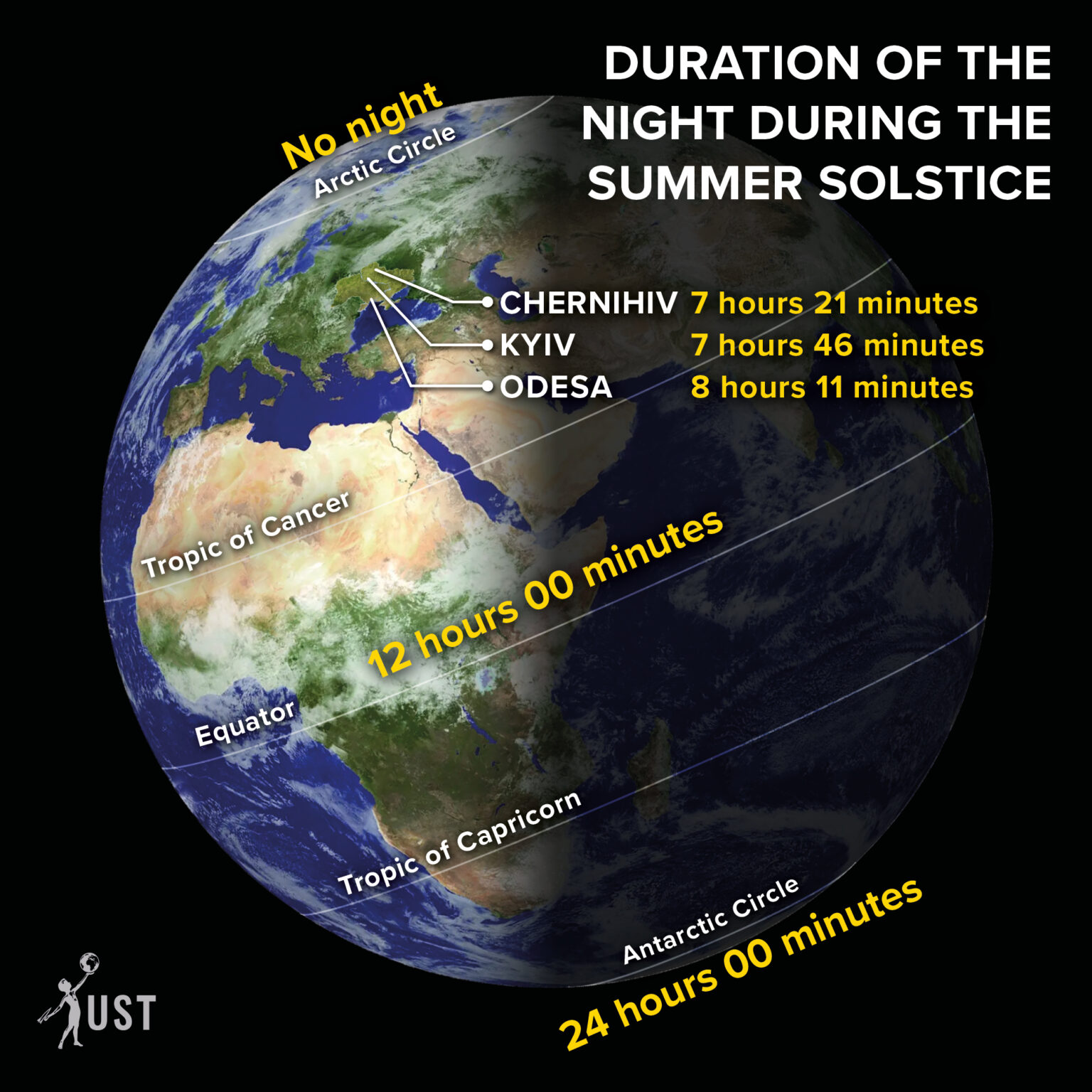
Here is the length of the day on June 21, 2025, for the largest cities in Ukraine:
- Chernihiv – 16 hrs. 38 min. 13 s
- Rivne – 16 hrs. 28 min. 41 s
- Kyiv – 16 hrs. 26 min. 48 s
- Kharkiv –16 hrs. 22 min. 08 s
- Lviv – 16 hrs. 20 min. 36 s
- Ternopil – 16 hrs. 17 min. 40 s
- Cherkasy – 16 hrs. 16 min. 30 s
- Vinnytsia – 16 hrs. 14 min. 30 s
- Dnipro – 16 hrs. 07 min. 06 s
- Chernivtsi – 16 hrs. 05 min. 29 s
- Zaporizhzhia – 16 hrs. 01 min. 17 s
- Mykolaiv – 15 hrs. 53 min. 29 s
- Odesa – 15 hrs. 49 min. 19 s
- Simferopol – 15 hrs. 36 min. 39 s
How to observe the summer solstice?
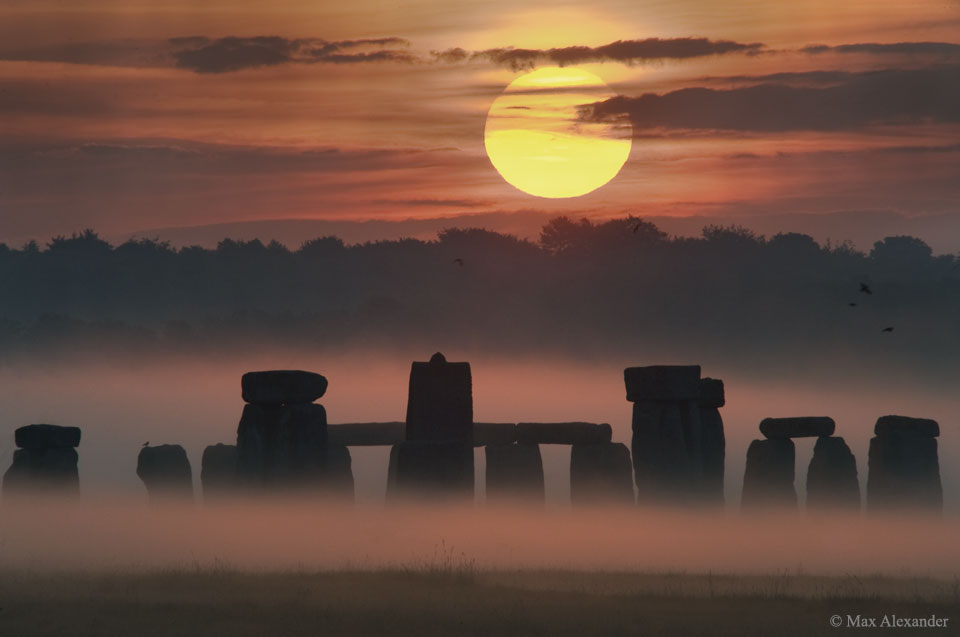
Every year, thousands of people come to the English town of Salisbury to watch the sunrise at Stonehenge, the famous horizon observatory. It is here that you can see the Sun rise during the summer solstice at the exact point determined by our ancient ancestors.
Sunrise over Stonehenge during the summer solstice
The Sun can only be safely observed when it is close to the horizon, and ancient astronomers used a gnomon, a vertical stick, to accurately measure the Sun’s height. However, even large sundials cannot accurately record minor changes in the Sun’s height.
However, the most accurate method of observation is the camera obscura, a small hole that projects the image of the Sun onto the opposite wall of a dark room. This principle was also used in famous historical observatories, such as the Council of Florence.
How to make a camera obscura yourself
How does Ukraine celebrate the summer solstice?
The traditional Ukrainian holiday of Kupala’s Night is closely related to the summer solstice. Although it is officially a Christian holiday (the Nativity of John the Baptist), its roots are pagan, and the date of the celebration has shifted for historical and calendar reasons. Today, Ukraine has returned to the tradition of celebrating on June 24, closer to the true astronomical date of the solstice, when the Sun begins to gradually decline in the sky.

