

Dark energy — a mysterious force accelerating the expansion of the Universe — remains one of the greatest mysteries of modern cosmology. But revolutionary new research offers an incredible explanation: black holes may be the source of this power.
The hypothesis known as the Cosmologically Coupled Black Hole (CCBH) model asserts that dark energy is not static, meaning that it has not undergone the process of formation for a long time. Instead, it is born in the depths of black holes, which transform the absorbed stellar matter into this mysterious force. Thus, dark energy is an organic product of the cosmic life cycle and has been growing for billions of years alongside the processes of star birth and death.
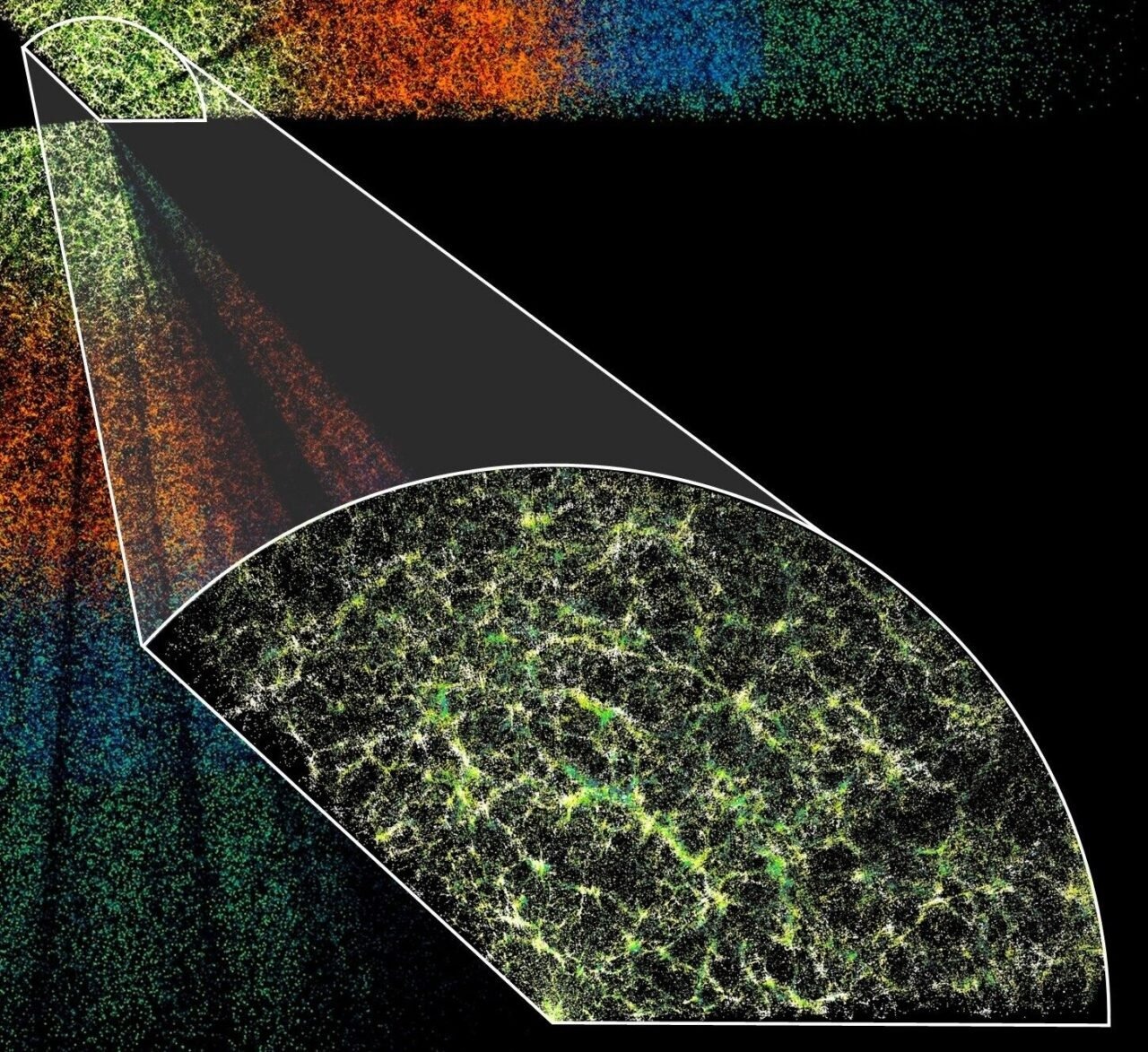
Key evidence was obtained using the Dark Energy Spectroscopic Instrument (DESI). This powerful device, located in Arizona, is equipped with 5,000 robotic “eyes” that scan thousands of galaxies every 15 minutes. Since 2018, DESI has created the most detailed 3D map of the Universe, enabling scientists to make groundbreaking discoveries.
Resolution of conflicts
One of the biggest mysteries that this model helped solve is the contradiction between DESI data and the results of ground-based neutrino experiments. The CCBH model not only reconciles these data, but also accurately predicts the neutrino mass, which is fully consistent with laboratory measurements.
Scientists emphasize that the results are extremely convincing but require further verification. The scientific community is awaiting new data from DESI and other observatories to confirm this bold theory. We are on the threshold of a new era in cosmology that promises to reveal the deepest secrets of our Universe.
We previously reported on how dark energy weakened over time.
According to umich.edu

