

American astronomers have announced the discovery of an asteroid with a record rotation period. It completes one rotation around its axis in less than two minutes.
Record-breaking asteroid
The discovery was made during the analysis of data collected by the recently commissioned Vera Rubin Observatory. In April–May 2025, it conducted a series of test observations to calibrate instruments and test the LSST, the world’s largest digital camera.
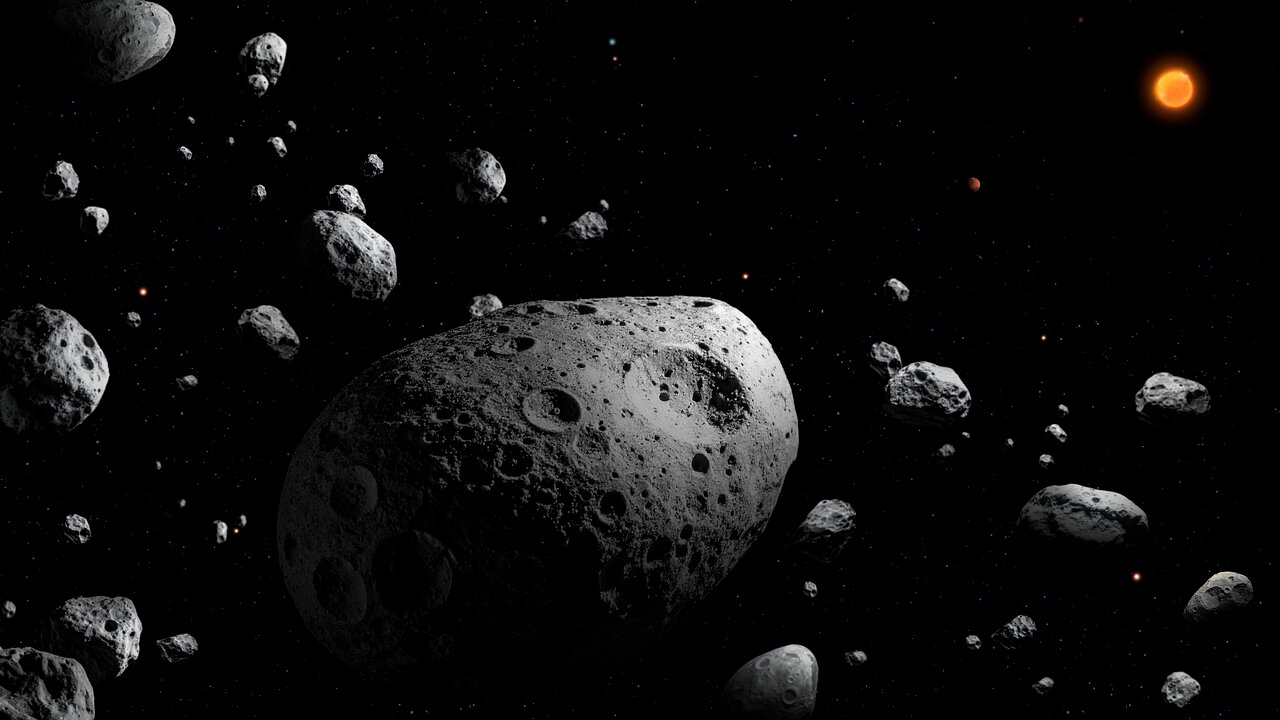
In just ten hours of observation, the observatory recorded thousands of asteroids, including 1,900 that were previously unknown. Nineteen of them are of particular interest to researchers because of their rotation period. For 16 asteroids, it ranges from 13 minutes to 2.2 hours. Three more ultra-fast asteroids complete a full rotation in less than five minutes.
The fastest-rotating asteroid discovered by the Vera Rubin Observatory has been designated 2025 MN45. It has a diameter of 710 meters and completes a full rotation in just 1.88 minutes. This combination makes it the fastest-rotating asteroid with a diameter of more than 500 meters ever discovered by astronomers.
In addition to 2025 MN45, other notable discoveries by Vera Rubin Observatory include 2025 MJ71 (rotation period of 1.9 minutes), 2025 MK41 (rotation period of 3.8 minutes), 2025 MV71 (rotation period of 13 minutes), and 2025 MG56 (rotation period of 16 minutes). All of them have a diameter of several hundred meters.
Reasons for ultra-fast rotation
Asteroids rotate at different speeds. They not only give us an idea of the conditions under which they were formed billions of years ago, but also tell us about their internal composition and evolution. In particular, an asteroid could have accelerated as a result of a collision with another asteroid in the past, suggesting that it may be a fragment of a larger object.
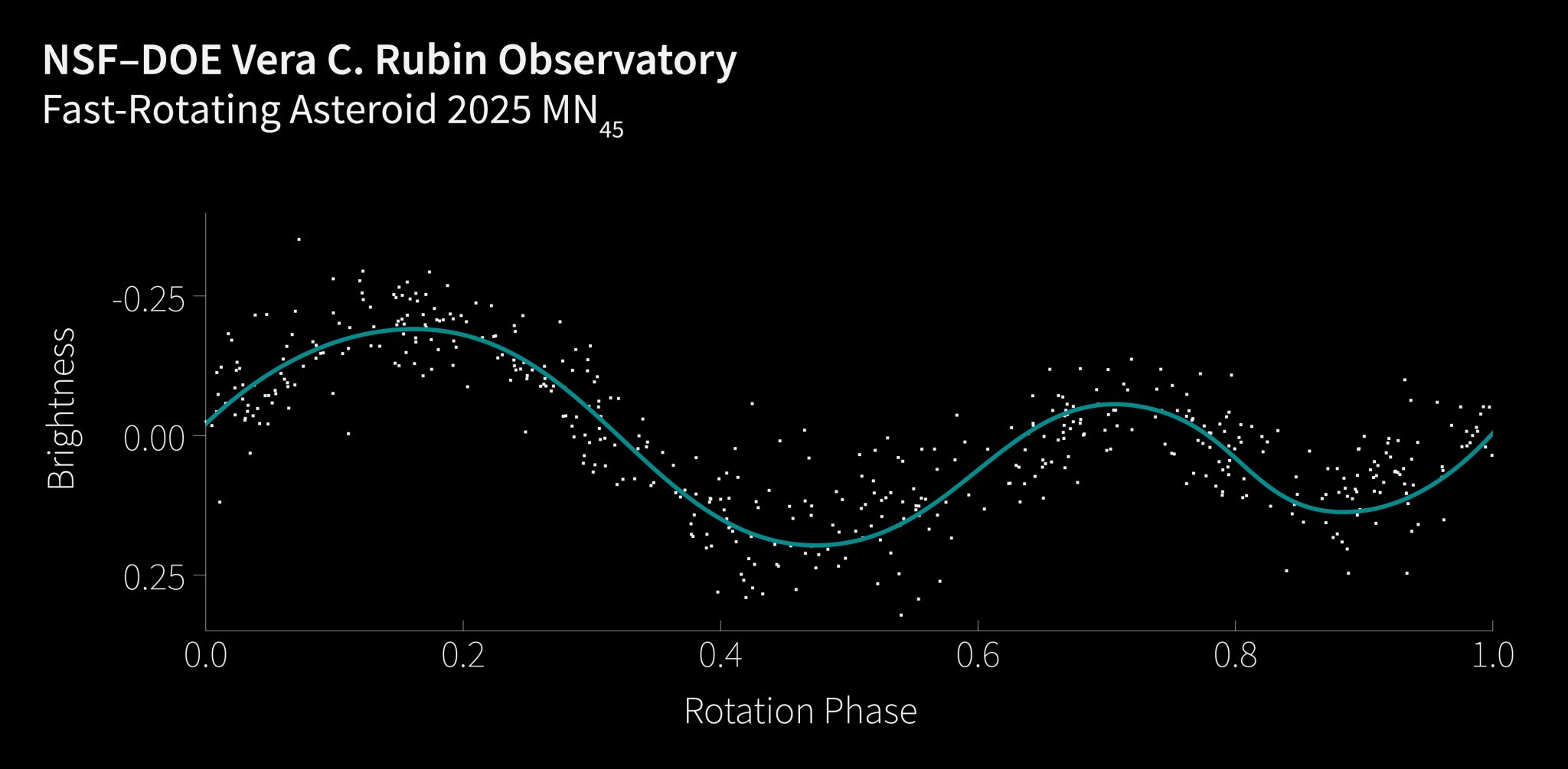
Rapid rotation also requires that the asteroid have sufficient internal strength to prevent it from breaking into many small pieces. Most small bodies are “rubble piles,” meaning they consist of many small pieces of rock held together by gravity, and therefore have limits on the rotation speed at which they will not break apart. For most objects in the Main Asteroid Belt, the limit for rapid rotation that avoids fragmentation is 2.2 hours. Asteroids rotating faster than this limit must be structurally strong to remain intact.
Until recently, most of the fast-rotating asteroids known to astronomers were not located in the Main Belt, but were special near-Earth objects. The reason for this is that as the distance increased, it became more difficult for telescopes to detect their light. Now this is set to change. Scientists expect to find even more such objects after the Vera Rubin Observatory begins full-scale scanning of the sky.
According to NOIRLab

