

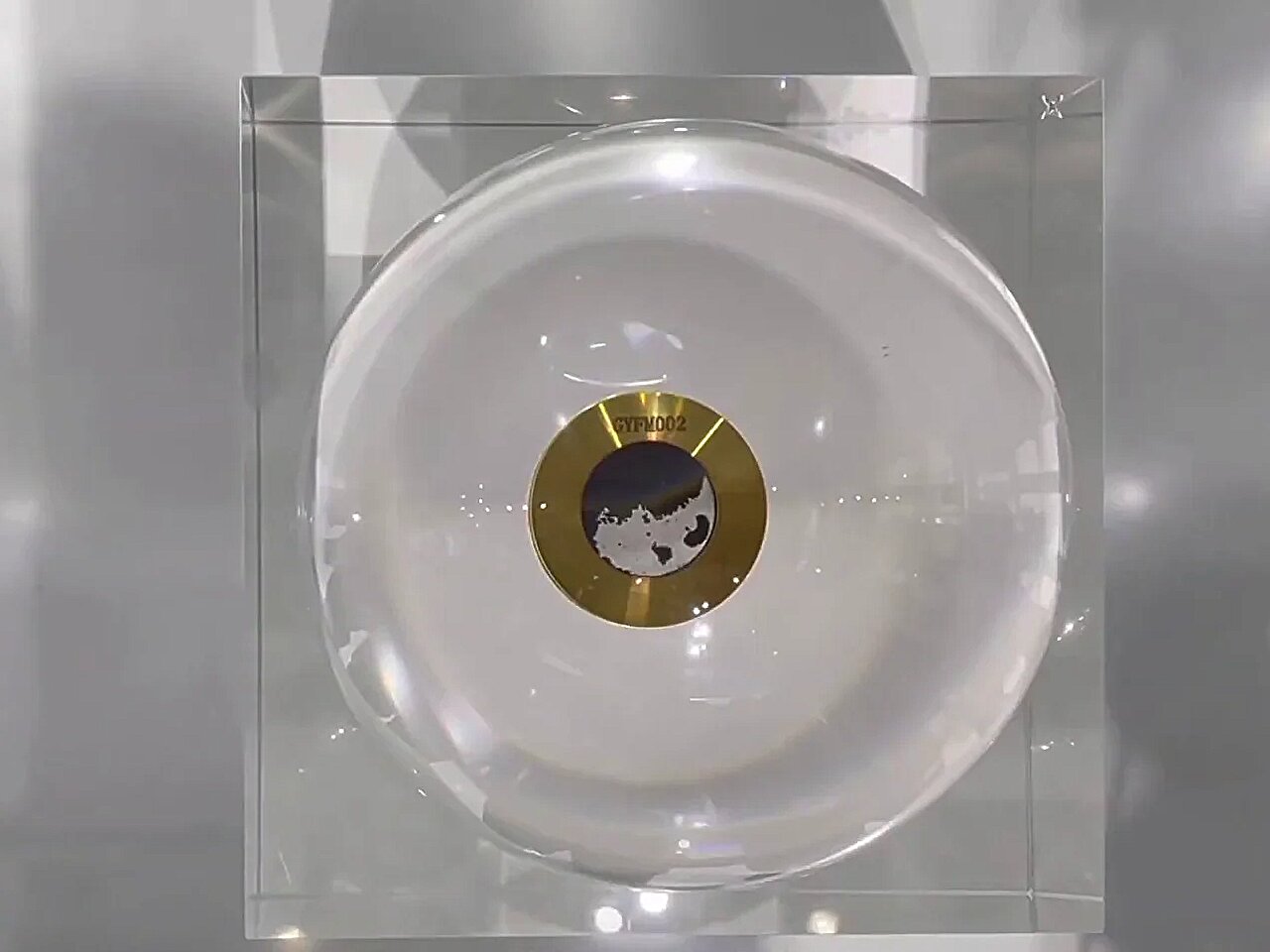
The topic of the Moon’s magnetic field is very complex. It does not exist now, but it did once. However, there is no answer as to when exactly it disappeared. Nevertheless, Chinese scientists have attempted to figure this out based on just a few dust particles brought to Earth by the Chang’e-5 mission.
New technology for studying lunar dust particles
Magnetism on the Moon has always been slightly unclear. Remote sensing probes have detected certain magnetic signs, but they were far from the strong cocoon surrounding the Earth itself. Previous attempts to detect it in returned regolith samples mixed all the rocks in these samples, leading to confusion about the source — whether they were caused by strong internal dynamics in the past or by powerful asteroid impacts that magnetized the rocks they fell into.
A new study by Yibo Yang of Zhejiang University and Lin Xing of the Chinese Academy of Sciences, recently published in the journal Fundamental Research, suggests that the correct answer appears to be: a little of both.
Their research was based on analyzing the magnetic signal of a single grain of lunar dust using a modern diamond sensor doped with nitrogen vacancy centers, which allowed it to act as a quantum magnetic sensor. They used a technique called optically detected magnetic resonance (ODMR) to monitor the fluorescence emitted by the diamond as a laser beam passed through it. Changes in this fluorescence indicated changes in the local magnetic field strength of the particle.
Magnetic signals from different types of particles and what they mean
The system they developed was significantly more powerful than commercially available quantum magnetic sensors, allowing them to analyze dust grains returned from the Chang’e-5 mission in greater detail than was previously possible. Most importantly, they were able to see which specific parts of the grain caused the field to change — whether it was iron-sized nanoparticles or cracks in the grain itself. They found a very clear distinction based on the type of dust they analyzed.
Basalt is a type of rock formed by the cooling of magma. Under the new quantum magnetic sensor, basalt dust grains showed relatively weak magnetic signals, but with very uniform orientation. Most of the magnetism seems to come from iron contained in the rock, or from a type of iron sulfide mineral called troilite. But it is the orientation that is important here — it seems that during the cooling of the magma that formed the basalt, the lunar magnetic field caused them to align in one direction. Most likely, this was caused by an active lunar “dynamo,” which apparently existed at least 2 billion years ago when these grains were formed.
This provides additional evidence of whether an active dynamo effect existed. But the researchers analyzed another type of dust grain — breccia. These grains were formed by the fusion of fragments of other rocks, most likely under the heat of asteroid impacts. They exhibited much stronger magnetization and had a completely random distribution. Probably, as a result of a process called “Shock Remnant Magnetization,” their diverse magnetic characteristics are due to iron-nickel alloys or nanophase iron formed as a result of meteorite impacts that created the dust grains themselves.
“Cosmic weathering” of particles
Some cracks in the rock had noticeable magnetic stripes that formed in perfect alignment with them. Researchers suggest that their appearance could have been caused either by the influence of solar wind or by micrometeorite impacts, which significantly later, after the rock had already formed, chemically altered the material inside the cracks. If this hypothesis is confirmed, it will become clear evidence of cosmic weathering processes in a visible form.
The types of quantum magnetic sensors used in this work are becoming increasingly common in geology, so this is undoubtedly not the last article to use this technique to analyze space rocks. But for now, given that the Chang’e samples are the youngest ever returned from the Moon, they are the best evidence of our closest neighbor’s magnetic history.
According to phys.org

