

In the modern world, the global information transmission system is built around satellite constellations. However, experts say that this system is a house of cards that could collapse due to a single event and bury humanity’s space ambitions for a long time.
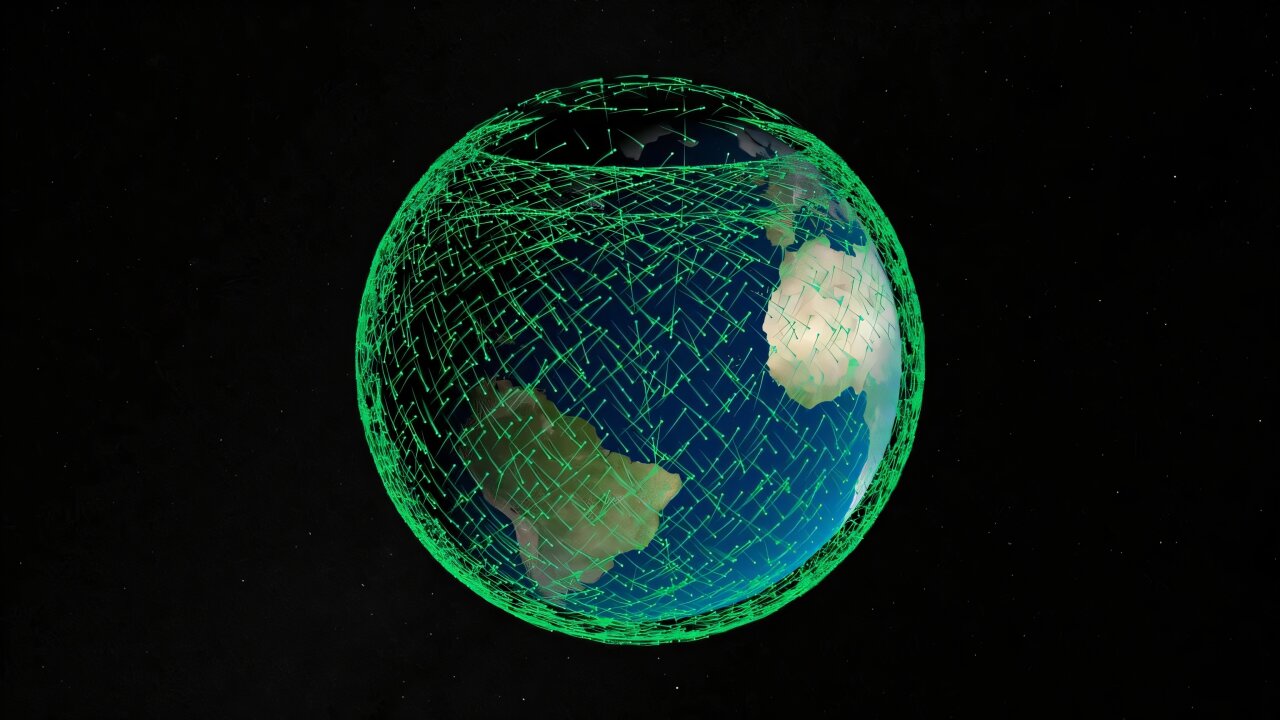
Mega-constellation
Sarah Thiele, formerly a doctoral student at the University of British Columbia and now at Princeton, and her co-authors recently played the role of Cassandra, predicting another major catastrophe awaiting humanity. The subject of her research, which has resulted in an article already published on arXiv, is the mega-constellation of satellites in Earth’s orbit.
These systems, consisting of hundreds and thousands of devices, have become the basis of modern wireless Internet. Theoretically, there is a need for so many of them precisely so that even if some of them are damaged, you can always send gigabytes of information to the other side of the world.
However, scientists say that in reality, it is all a house of cards, ready to collapse from a single serious incident. This is because the orbit is so densely populated that spacecraft come within less than a kilometer of each other on average every 22 seconds. Even two Starlink satellites meet in orbit every 11 minutes. On average, SpaceX spacecraft have to make 41 course corrections per year just to avoid collisions.
Solar flare
One could even say that this is how it is supposed to be, that modern technologies should operate under constant control by automation systems. But there is one event that system developers cannot do anything about—solar flares. They occur constantly and already pose a threat to satellite systems, but physicists say that everything we have dealt with so far is trivial compared to what could happen.
Solar flares pose a threat to satellites in two ways: by causing the Earth’s atmosphere to become more turbulent and by the direct impact of charged particles on electronics. While the former causes spacecraft to slow down due to increased friction and eventually fall to Earth, the latter simply renders them uncontrollable.
Even in recorded history, there was the Carrington event in 1859, when the currents caused by the flare were observed directly on Earth, and geological findings indicate that significantly worse events have occurred in the past.
Kessler syndrome
In fact, the complete loss of satellite control is not just a collapse of the communication system. It leads to the realization of the old fear of Kessler syndrome. This is the name given to a hypothetical situation in which a collision between two satellites creates debris that damages other spacecraft, and then more and more, until orbit becomes too dangerous a place to fly.
In 2018, even before the era of megaconstellations, scientists predicted that if all satellites in orbit failed, the first collision would occur in 121 days. Now, this time is estimated to be only 2.8 days, and it is quite possible that the fatal collision that will trigger Kessler syndrome will occur within the first 24 hours after a solar flare disables the satellites.
According to phys.org

