

Charon is a moon of the dwarf planet Pluto, studied by the New Horizons spacecraft. There are traces of cryovolcanism on it, and scientists believe that an ocean may be hidden beneath its ice, or at least that it may have been there in the past.
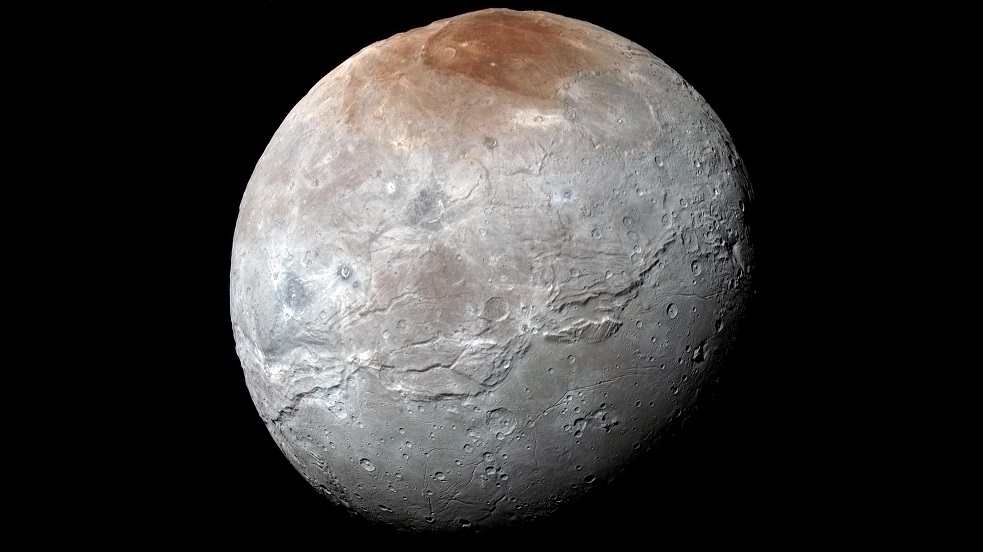
Cryovolcanism on Charon
During the 56th Lunar and Planetary Science Conference, which recently concluded, many interesting presentations were given. One of them concerned the origin of cryovolcanism on Charon, a moon of the dwarf planet Pluto.
This celestial body is one of the few objects beyond Neptune’s orbit that scientists can say they have seen its surface. In order to learn more about Pluto and Charon, the New Horizons spacecraft had to fly to them for a full 9.5 years.
Nevertheless, it flew past them at high speed, so scientists did not even see the entire surface of these bodies. But what was accessible turned out to be very interesting. Scientists saw huge cliffs and traces of cryovolcanism.
Ocean on Charon
A new study is dedicated to modeling how all this could have formed on Charon. One possible explanation is that Charon once collided with Pluto. Another thing is that an ocean of liquid water existed on it, and possibly still exists, deep beneath the surface.
It was precisely this last assumption that scientists decided to test. Numerous simulations have shown that the ocean on Charon has not survived to the present day. But it existed much longer than previously thought and caused cryovolcanism approximately 4 billion years ago.
Scientists have determined that the history of the ocean beneath Charon’s surface began approximately between 370 and 400 million years ago and ceased to exist between 2.2 and 2.12 billion years ago. However, this conclusion is based on very limited data, and it is entirely possible that future missions will discover liquid water beneath the surface of Pluto’s moon.
According to phys.org

