

Snow is stunning and is associated with winter holidays. However, it is also an exciting physical phenomenon: solid water, but not like ordinary ice. Astronomers can tell truly interesting stories about “white flies flying from the sky.” After all, other planets also have snow.

What is snow?
Usually, Christmas and New Year are associated not only with Christmas trees and gifts, but also with snow falling from the sky and lying in drifts under the windows. Of course, there are countries where even winter holidays are celebrated on the beach under palm trees. However, these holidays are mainly celebrated in the temperate zone of the Northern Hemisphere of our planet. And there, winter is a rather sad, dark, and cold season, and snow is one of the best sights it offers.
But have you ever thought about what snow is? It is not hard to guess that it is a solid form of water – you just need to see how it melts. People figured this out a long time ago. Ice is also a solid form of water, but it’s not like snow at all. So what is the difference between them?

The basic form of snow is a snowflake. That same white star that falls from the sky. Sometimes they fall, clinging to each other, and snowdrifts are also made up of them. So the question of what snow is is really a question of what a snowflake is. The Chinese philosopher Han Yun first thought about this in 135 AD. He made one of the most important observations about them – they all have six-sided symmetry, that is, they look like six identical pieces joined together in the center.
The mystery of a snowflake
The question of why snowflakes have this particular shape has puzzled scientists for a very long time. As early as the 17th century, various scientists were studying it. Robert Hooke was the first to examine snowflakes under a microscope. Later, they attracted the interest of astronomers – first Tycho Brahe, and then Johannes Kepler, the same man who discovered the laws of planetary motion around the Sun.
The latter even wrote a paper in 1611 entitled “The Six-Cornered Snowflake,” in which he examined a number of questions about why hexagonal shapes occur so often in various natural objects, particularly in honeycombs. In this context, he expressed a mathematical assumption that later became known as the “Kepler conjecture.”
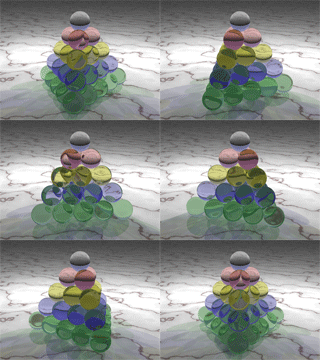
He began with the fact that if you try to fill a plane with identical polygons without gaps, the largest area of one such figure will be that of a hexagon. It follows that if you try to surround one circle with several similar ones, the densest arrangement is achieved when there are six of them and their centers form a regular hexagon. From there, Kepler moved on to formulating a three-dimensional version of the problem. If you try to fill a vessel with identical balls, the densest arrangement will be if they are arranged in a pattern called cubic syngony. In this pattern, there are 14 balls around each ball, the centers of which form hexagons in three different planes.
The Kepler conjecture can be easily verified by an experiment showing that if you simply pour balls into a glass, their total volume will be 64% of its volume, but if you carefully build a cubic syngony, this value will reach 74% – the value predicted by the theory.
However, for 400 years, it was impossible to mathematically prove the correctness of this statement. It was only in 2008 that Thomas Gales published a proof, which was recognized as correct in 2009.
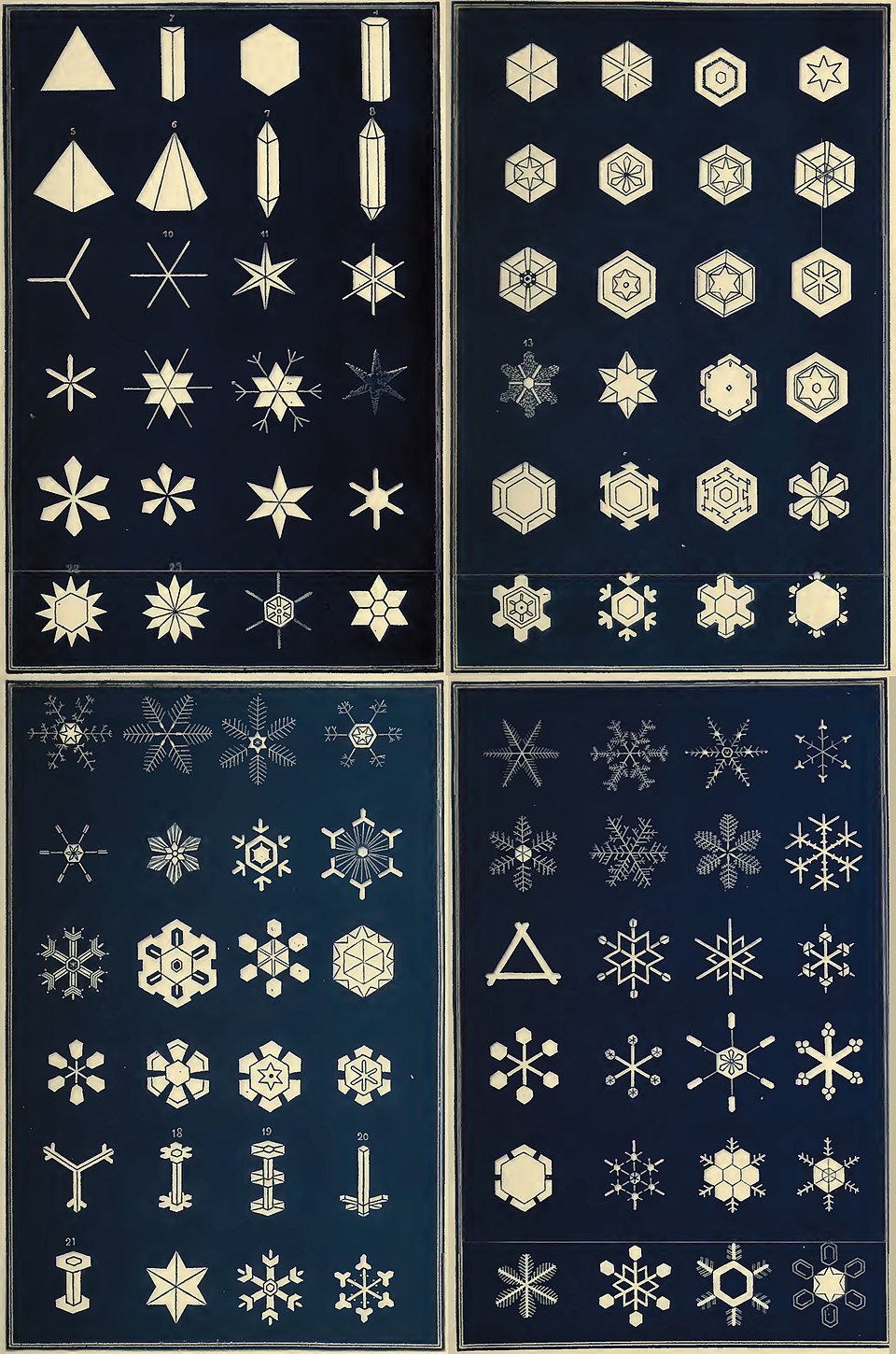
Kepler was unable to explain why ice crystals in snowflakes grow in the shape of hexagons. At the same time, cubic symmetry occurs in many crystals. As a result, this work gave rise to a new field of knowledge – crystallography, which combined ideas about the molecular structure of substances, geometry, and the patterns of crystal growth.
Crystallography explained the hexagonal shape of snowflakes. The fact is that their crystallization always occurs in the upper layers of the atmosphere. And there are always dust particles present there. It is around them that water crystallization begins. And the shape of a water molecule is such that crystals can only form at angles of 60° and 120°. A circle is 360°. So it is not surprising that the ice crystal that forms around a snowflake always has the shape of a hexagonal plate.
It is this crystal that becomes the heart of the future snowflake. When the hexagonal crystal grows, hydrostatic forces no longer hold it in the air, and it begins to fall. On its way to Earth, it passes through zones with different temperatures and humidity levels, and this path is unique for each snowflake. At the same time, all six faces of the crystal are equally suitable for attaching new water molecules and undergo the same changes in conditions. Thus, the snowflake grows uniquely, maintaining symmetry in all six directions. Upon reaching the ground, it is truly one of a kind, yet it retains its characteristic hexagonal shape.
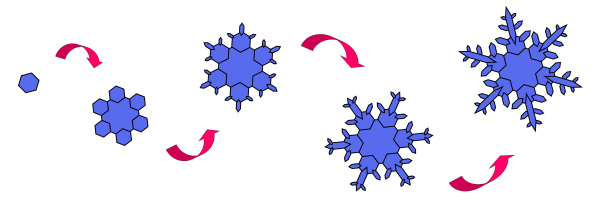
Although the main material of a snowflake that we see is ice, most of its volume consists of ordinary air trapped between crystals. It is this air that gives it its white color and causes its very low average density.
Interestingly, sometimes snowflakes reach incredibly large sizes. The Guinness Book of Records states that in 1887, snowflakes with a diameter of 38 cm fell in Montana.
Snow on other planets
Snow is not unique to our planet. However, it is not found on all celestial bodies. For snow to form, there must be an atmosphere containing solid particles and a substance in a gaseous state, but at a temperature and pressure close to the values at which its crystallization is possible.
That is why there can be no snow on bodies such as the Moon and Mercury, which have no atmosphere. However, despite the high temperatures on Venus, it is believed that snow does fall there. At least, many of the mountain peaks on this planet are covered with something white. Scientists believe that these are minerals such as hematite, pyrite, perovskite, or some other type.
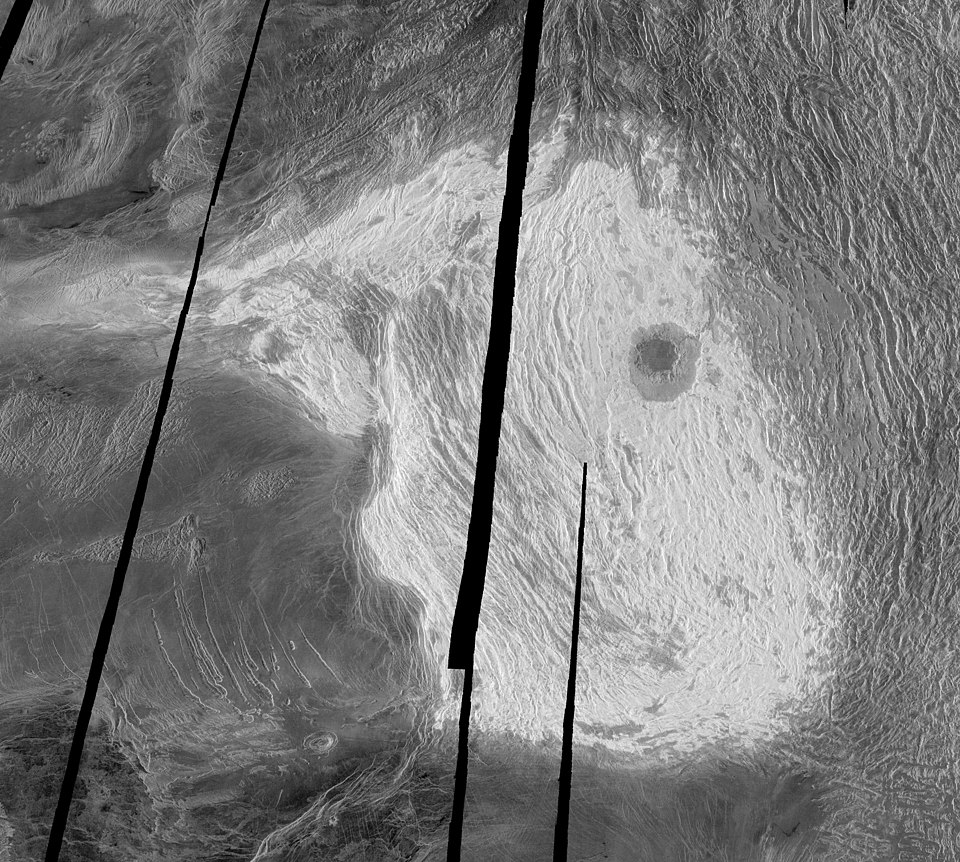
Under the influence of high temperatures, they evaporate and rise to the cloud layer, where the temperature is lower. There are also dust particles there, which become centers of crystallization. And then everything happens as it does on Earth, except that in low-lying areas, “rocky” snowflakes melt quickly upon reaching the surface, while at high altitudes, the snow cover can remain for many years.
There are two types of snow on Mars. The first is the same as on Earth. The second is based on carbon dioxide, also known to us as “dry ice.” The first melts at significantly higher temperatures than the second.
Snow also falls on Saturn’s moon Titan. There, it is formed from methane, a substance that on Earth is mainly found in the form of natural gas, but there it can be a liquid and form entire seas. In the upper layers of the moon’s atmosphere, snowflakes can form, which then fall to the surface.
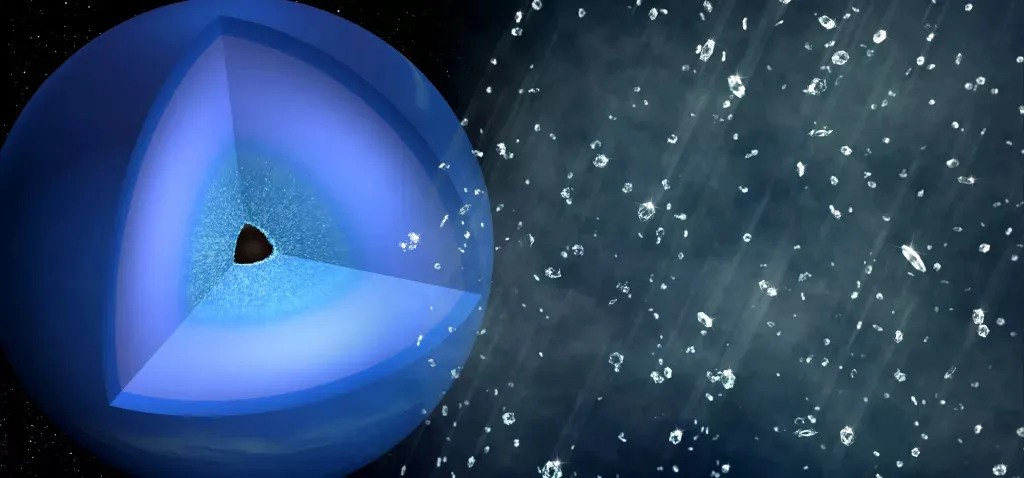
The most incredible snow falls on Uranus. There, at a certain depth, methane is under enormous pressure. Scientists say that under such conditions, hydrocarbons can break down into individual atoms, and then diamonds are formed from carbon, which begin to sink in the atmosphere.
As for planets outside the Solar System, we still don’t know exactly what conditions are like on them. However, if estimates of the temperature and chemical composition of their atmospheres are correct, some of these planets may experience incredible snowfall – made of iron, stone, and even sapphires.

