

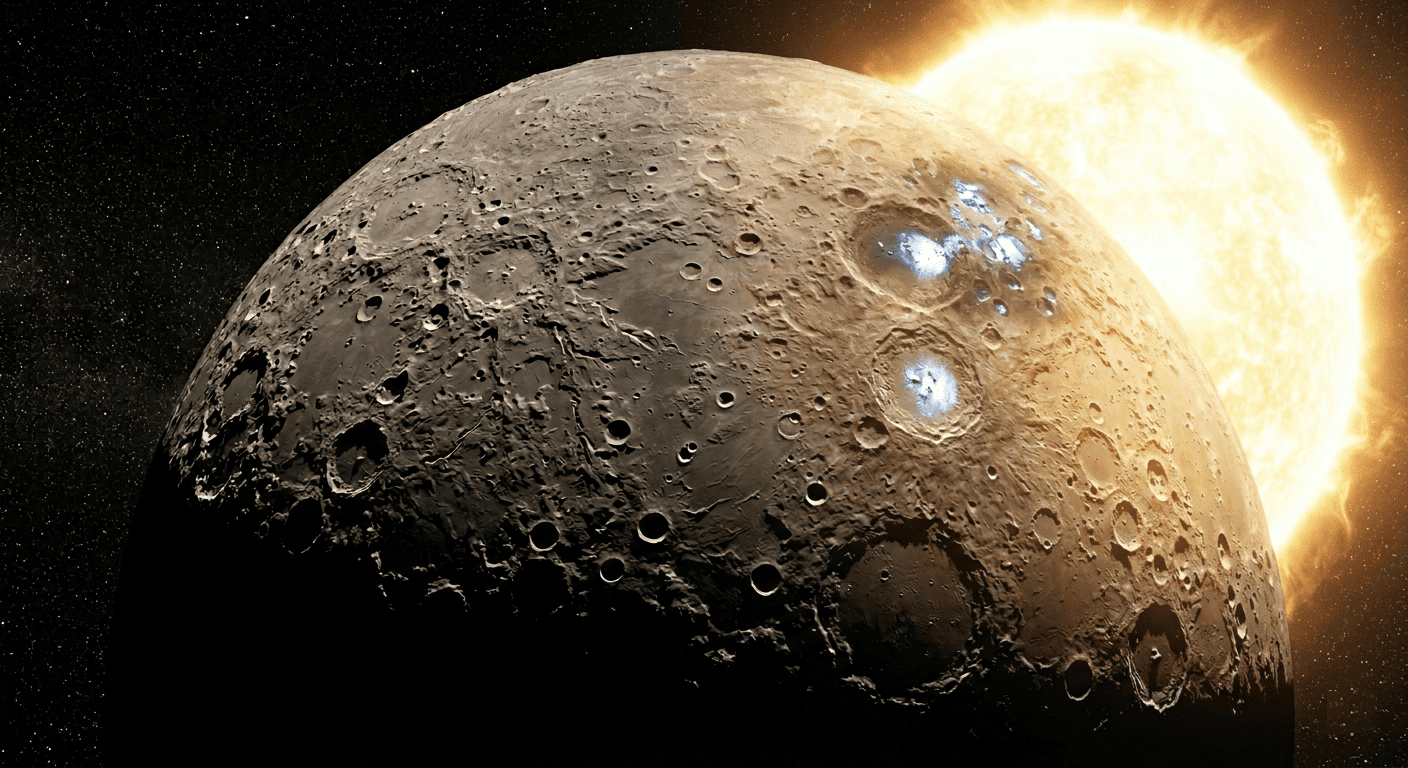
Mercury is the planet closest to the Sun, with daytime temperatures reaching up to 430°C. However, there is water ice in the shaded craters near its poles. A new study offers a surprisingly simple explanation: all of this ice could have formed in a single Mercurian day.
Mystery of polar ice
Mercury has no true atmosphere, only an extremely thin gaseous envelope that is constantly being stripped away and replenished by the solar wind. One might think that under such conditions, water could not possibly remain.
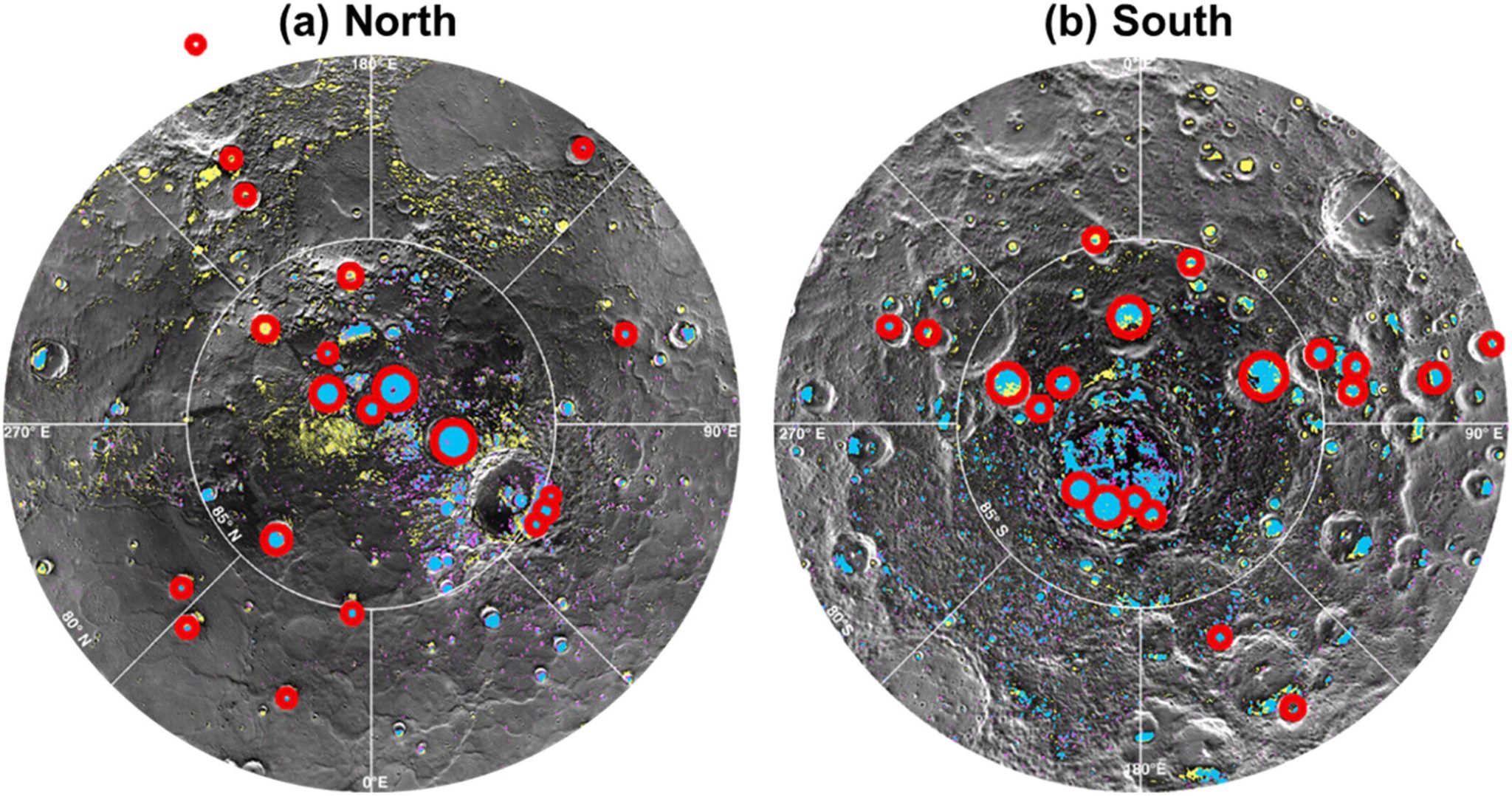
However, ground-based observations and orbital probes have detected bright patches near the poles. This is a sign of water ice in permanently shaded regions.
Crater as a starting point
These shaded areas never receive direct sunlight, so they remain cold enough to preserve ice for millions of years. Scientists have long speculated that a massive impact could be the source of the ice.
The researchers focused on the 97-kilometer-wide Hokusai crater, where an ancient impact is believed to have occurred. The team compared two scenarios. In the first, water enters the thin exosphere; in the second, it enters the dense atmosphere created by the impact itself. A new study published in the Journal of Geophysical Research: Planets has, for the first time, fully simulated this scenario.
Why does a dense atmosphere protect the water?
Most of the water vapor is typically destroyed by photolysis, that is, the breakdown of molecules under the action of solar photons. But in a dense post-impact atmosphere, self-shielding comes into play. The outer layers absorb radiation and protect the inner layers from destruction.
In the baseline scenario with a rarefied exosphere, photolysis destroyed up to 96% of the water vapor. In the impact scenario, only 46%. As a result, 22.4% of the total simulated water mass ended up in polar cold traps, rather than 3.4% as in the baseline scenario.
The ice is too thin
Despite the accurate reproduction of the total ice mass, the simulations revealed a discrepancy. The thickness of the deposits was only 37 centimeters, whereas observations indicate several meters.
Researchers explain this by suggesting that the simulated impactor may have been smaller and faster than the actual one. If the object had been larger and slower, it could have released more water and formed thicker deposits. Data from the BepiColombo mission, which is heading to Mercury and is expected to provide more detailed information about the thickness and distribution of polar ice, will be able to confirm or refute this.
According to phys.org

