

For a long time, the prevailing view in astronomy was that pulsar radio signals originated above the surface of these neutron stars, near their poles. However, a new study shows that their source lies deep beneath the surface.
Extreme beacons of the Universe
Pulsars are ultra-dense, rapidly rotating, and highly magnetized remnants of dead stars. They act as cosmic beacons, emitting regular pulses of radio waves—and sometimes gamma rays—in beams that sweep across the sky. A special class of pulsars known as millisecond pulsars rotate hundreds of times per second and are among the most accurate clocks in the Universe. For decades, astronomers believed that pulsar radio signals were produced only near the star’s surface, at its magnetic poles.
A new study casts doubt on this long-held belief. A team of German and Australian astronomers has found evidence that some of the fastest-spinning stars in the Universe emit radio waves from a great distance—a phenomenon that scientists previously believed to be impossible.
An unexpected discovery
Michael Kramer of the Max Planck Institute for Radio Astronomy (MPIfR) in Germany and Simon Johnston of Australia’s national science agency, CSIRO, analyzed radio observations of nearly 200 millisecond pulsars and compared them with gamma-ray data. Two researchers discovered something striking in this large dataset: about one-third of millisecond pulsars exhibit incoming radio signals from two or more completely separate regions, separated by intervals of silence. By comparison, this behavior is observed in only about 3% of slow-spinning pulsars.
Even more impressively, many of these isolated radio bursts coincide exactly with gamma-ray bursts detected by NASA’s Fermi satellite, suggesting that both types of signals originate in the same extreme region of space.
A “current sheet” of charged particles
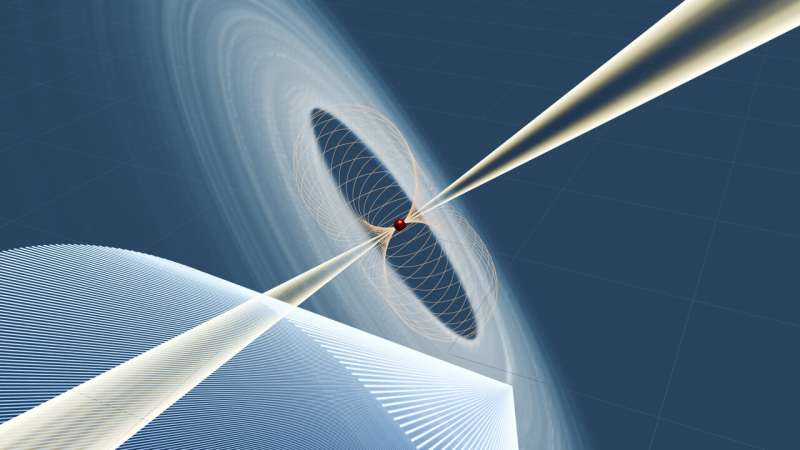
To explain these patterns, the authors propose that millisecond pulsars generate radio waves in two very different locations: one near the star’s magnetic poles, as is traditionally believed, and the other in swirling “current sheets” slightly along the so-called light cylinder. Located far from the magnetic poles, the light cylinder marks the boundary where magnetic fields move at nearly the speed of light in order to keep pace with the star’s rotation. Depending on the observer’s perspective relative to the pulsar, radio emissions may be detected either near the surface, from a distant location, or from both regions.
This results in unusual, fragmented radio profiles that have puzzled astronomers for many years. It is believed that the “current sheet” of charged particles is responsible for gamma radiation. The alignment of radio waves and gamma rays can be explained by their common origin.
Significance and prospects of the study
This discovery has several important implications: more pulsars may be detected than previously thought, because radio emissions may not be confined to a narrow cone at the magnetic poles. However, it covers a wider range of fields. This discovery helps explain why astronomers often find it difficult to interpret the polarization (orientation) of radio waves from millisecond pulsars.
Moreover, this suggests that nearly all gamma-ray millisecond pulsars also emit radio waves, even if these signals may be faint or difficult to detect. This poses new challenges for the theory: scientists now need to explain how stable radio pulses can be generated far from the star, in an extreme and turbulent environment.
“Millisecond pulsars are key tools for studying gravity, dense matter, and even gravitational waves. Understanding where their signals come from—and why they look the way they do—is essential for using them as precision instruments,” explains Kramer.
According to phys.org

