

They are brighter than entire galaxies—and fade away in a matter of days. Astrophysicists have been observing them since 2018; they have counted only 11 in the entire known universe and still cannot explain what causes them. Now, the first convincing clue has emerged.
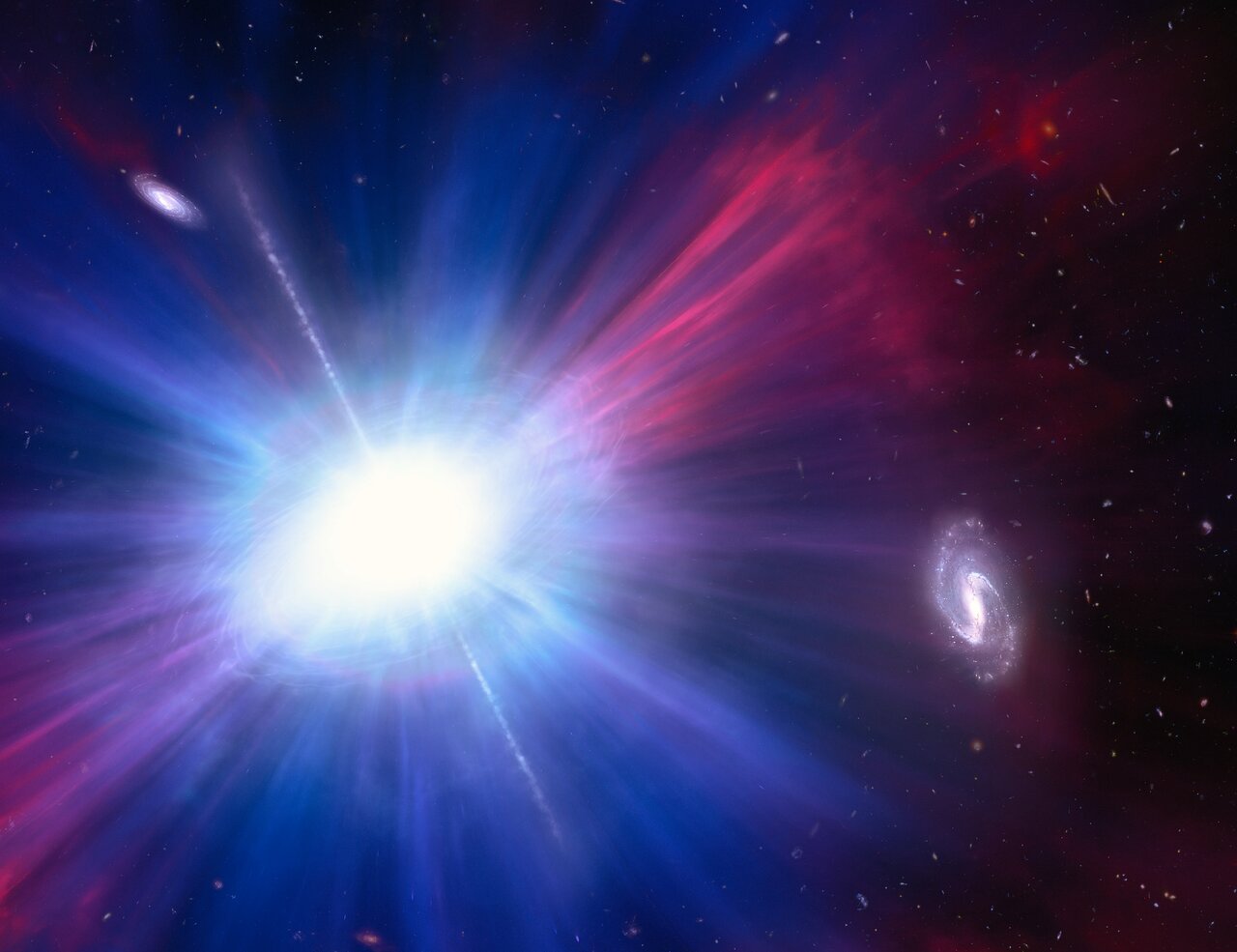
On March 24, 2026, a study was published on the arXiv preprint server in which the authors analyzed the galaxies of all confirmed events and concluded that these explosions are most likely the result of the merger of a neutron star or a black hole with a massive Wolf-Rayet star.
Star without a shell and a dead companion
The suspicion regarding Wolf-Rayet stars did not arise by chance. The spectra of LFBOTs (Luminous Fast Blue Optical Transients) contain almost no hydrogen or helium—which means that the progenitor star must have shed its outer layers before the explosion. This is exactly what Wolf-Rayet stars look like: extremely rare, supermassive objects with an exposed, glowing core. If a compact remnant of its progenitor is present alongside such a star in a binary system, the spiral approach could trigger an explosion unlike either a typical supernova or a gamma-ray burst. The X-ray radiation detected by several LFBOTs also indicates the presence of a compact object at the center.
Two tips from the galaxies
The researchers simulated the photometry and spectroscopy of the host galaxies of all 11 supernovae and identified two telling features. First, more than 30% of these outbursts occurred not where new stars are born, but in the faintest regions of galaxies or even beyond their boundaries—in places where, at first glance, nothing interesting seems to be happening. Second, unlike most other powerful cosmic explosions, the formation of LFBOTs is only slightly influenced by how rich a galaxy is in heavy elements. Both features point to a massive stellar origin with an atypical distribution. That is why the authors favor the scenario of star mergers in binary systems. The Vera Rubin Observatory, which has already begun operations and will soon be conducting full-sky surveys, will help expand the sample and test this hypothesis.
According to phys.org

