

Researchers at the University of Washington have estimated how much methane is destroyed in the stratosphere — the layer of the atmosphere that begins at approximately cruising altitude for airplanes. Methane is a powerful greenhouse gas, but the magnitude of its fluxes (processes of removal from the atmosphere) has remained poorly measured, resulting in significant discrepancies in estimates of the methane balance.
The team used satellite data from 2007–2010 and calculated methane flux based on measurements of CH₄ concentration, temperature, and radiative heating. This made it possible to obtain an observational, rather than purely model-based, estimate of methane losses in the stratosphere.
The result — 49.8 ± 7.8 Tg/year* — was higher than estimates from reanalysis (38.1 Tg/year) and typical estimates from chemical climate models (average 25.7 Tg/year; range 19.6–35.9). The authors show that models systematically underestimate stratospheric methane losses due to errors in reproducing CH₄ concentrations, as well as temperature and radiative heating.
*1 Tg (teragram) = 101210^{12} g = 10910^{9} kg = 1 million metric tons.
When the new estimate was incorporated into the global methane budget, the imbalance for the 2000s decreased from 23 to 3 Tg/year and almost coincided with the estimate of about 5 Tg/year (range −4…13). This increases confidence in methane trend estimates and helps to better understand the relationship between methane, stratospheric water vapor, and ozone chemistry.
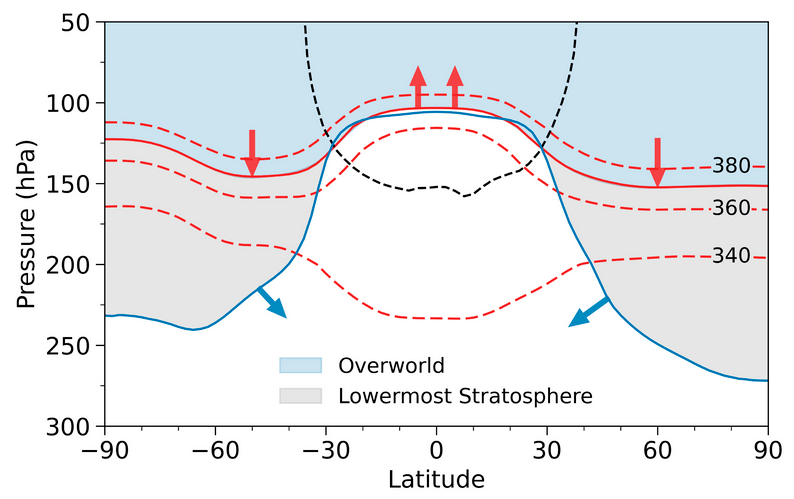
How does it work? The satellite measures how much methane (CH₄) is present in the air at different altitudes, as well as parameters that determine air movement between the troposphere and stratosphere (temperature and so-called radiative heating, which pushes air masses up or down on average). Next, researchers calculate how much methane enters the stratosphere through the tropical tropopause along with updrafts and compare this with changes in methane concentrations in the stratosphere. The difference between “how much went in” and “how much remained/came out” is interpreted as chemical losses: in the stratosphere, methane is destroyed mainly by reactions with highly active particles (radicals, primarily OH and Cl) under the influence of solar ultraviolet radiation. In other words, they do not receive a model estimate, but rather a balance based on actual observations: flow + stock change → how much methane was destroyed by chemicals.
Why is this important? Such work directly improves the calibration of satellite measurements and models of radiation transfer in the atmosphere — the basis for accurate remote sensing from orbit. In addition, better knowledge of stratospheric water vapor and ozone helps in planning ground-based astronomical observations (especially in the infrared range), where atmospheric absorption critically affects data quality.

