

Why do we exist? This question concerns not only philosophers, but also physicists. The answer may lie in a tiny but vital asymmetry between matter and its mysterious and dangerous twin, antimatter. New data from CERN brings us closer to solving this fundamental mystery.
The Large Hadron Collider at CERN has given science a long-awaited discovery. Researchers from the LHCb experiment have found strong evidence that baryons — the particles that form atomic nuclei and the basis of all visible matter in the Universe — and their antiparticles decay differently. This effect, known as CP-invariance violation, had previously only been observed in another class of particles (mesons). Now it has been confirmed for the key building blocks of matter. The article in Nature magazine describes this in detail.
A tiny difference makes a huge difference
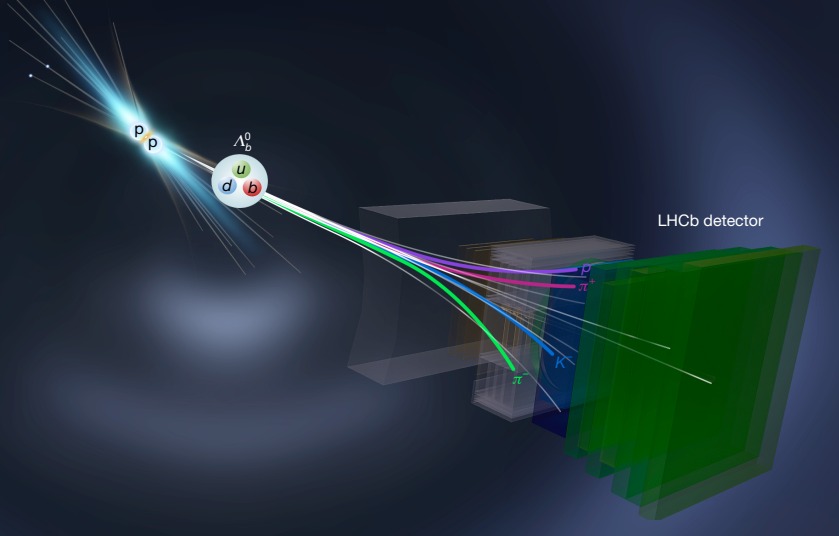
The team analyzed approximately 80,000 events involving the decay of lambda-b baryons (Λb) and their antiparticles, collected over a period of seven years. They found a small but statistically significant difference of 2.5% in the decay rate of matter and antimatter. Importantly, the result reached a significance level of “5.2 sigma.” This means that the probability of a coincidence is only 1 in 10 million. “This proves that baryons and antibaryons do not decay in the same way,” emphasizes Xueting Yang, a physicist at CERN.
This discovery sheds light on one of the deepest mysteries of the cosmos. The Big Bang theory assumed that equal amounts of matter and antimatter were created. When they meet, they annihilate each other. If the balance were perfect, the Universe would simply disappear in a gigantic explosion of energy immediately after its birth. But that didn’t happen. Something led to a tiny predominance of matter — literally one extra particle per billion pairs. Everything we see today, 13.8 billion years after the Big Bang, is all that remains of matter’s victory over antimatter.
The key to baryon survival
This is where the violation of CP invariance comes into play. It means that the fundamental laws of physics behave slightly differently with matter and antimatter. This asymmetry could have caused the tiny predominance of ordinary matter in the embryonic stage of the Universe, which allowed it to avoid self-destruction.
“The asymmetry between matter and antimatter in the Universe requires a violation of CP invariance in baryons,” explains Yang.
New physics on the horizon
The study of CP violation in baryons, which was previously difficult, now opens a new window for the search for these unknown phenomena. Although the discovery is consistent with the Standard Model of particle physics, it also points to its limitations. Physicists have long suspected that the CP symmetry violation existing in the model is insufficient to fully explain the enormous asymmetry in the Universe.
“This strongly suggests that there must be new physics beyond the Standard Model,” says Yang.
It is important to understand that this discovery is not the final solution to the mystery. It does not provide a sufficient explanation for the violation of symmetry to completely resolve the problem of matter and antimatter. However, the discovery is a powerful confirmation of the key mechanism and opens up a new direction for research.
Each such step broadens our understanding of the fundamental laws that not only control particles, but also make our very existence in this amazing cosmos possible. The search for the source of ancient but decisive asymmetry continues.
Earlier, we reported on how scientists managed to recreate the conditions of the first microseconds after the Big Bang.
According to sciencealert.com

