

Researchers have detected the fastest wind ever recorded in the ultraviolet spectrum near a supermassive black hole. Gas streams are racing at 30% the speed of light. This discovery could help explain how active galactic nuclei influence the galaxies around them.
Speed record
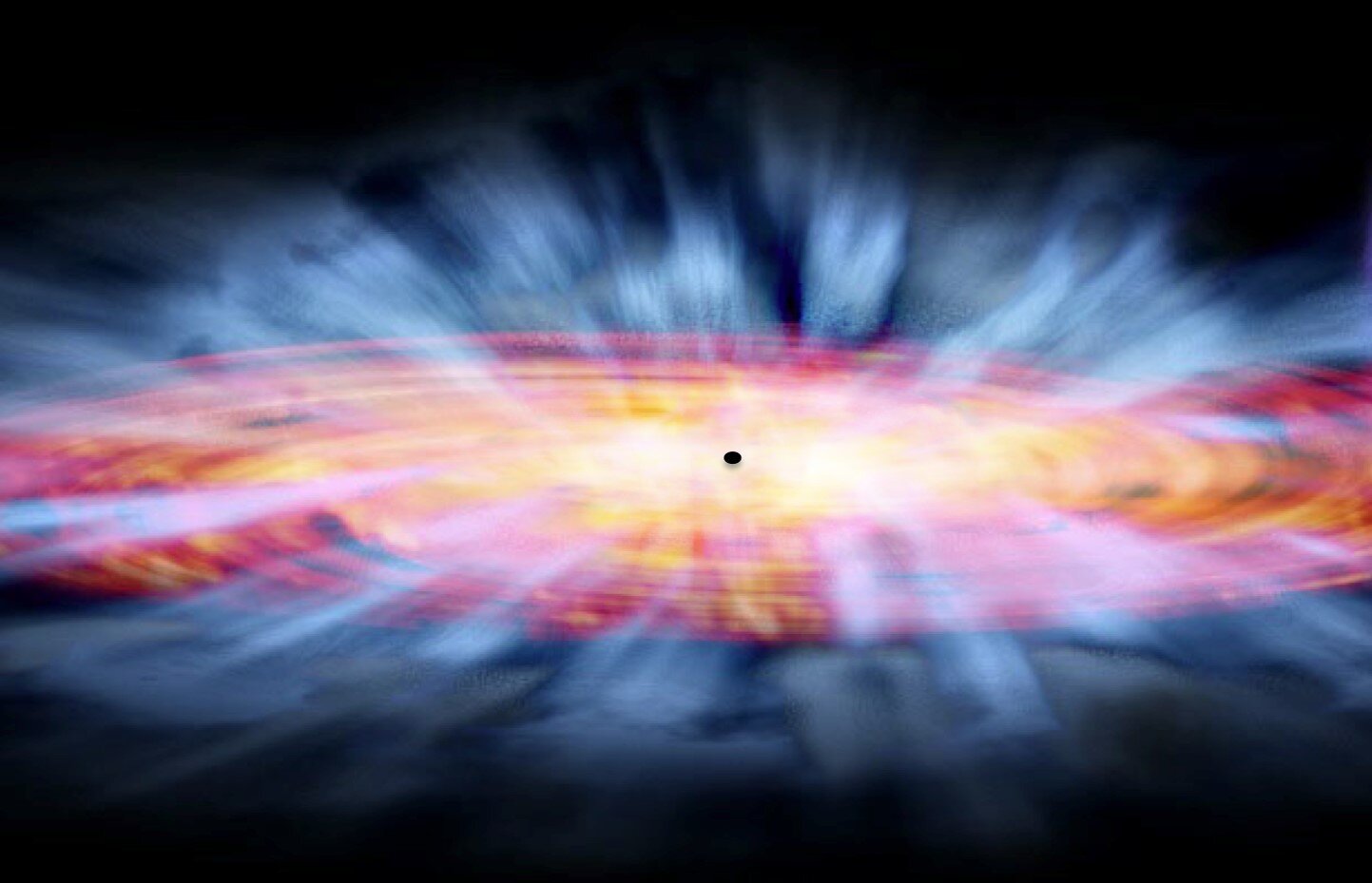
A team led by researchers from the University of York studied the object J2318 in the constellation Pegasus. Quasars are formed when matter spirals into and falls onto a supermassive black hole, forming an extremely hot accretion disk that can be larger than the Earth’s orbit around the Sun. Its temperature can be much higher than the surface temperature of the Sun, and the radiation of the brightest quasars can be observed almost throughout the visible universe.
The black hole at the center of J2318 has a mass of 1.7 billion solar masses. While these are not exceptional parameters for a quasar, the wind associated with it turned out to be unprecedented. Such speeds have never before been recorded in the ultraviolet range.
How does light disperse gas?
Unlike terrestrial winds, which arise due to differences in atmospheric pressure, a quasar wind is accelerated by light itself. Photons collide with or are absorbed by gas atoms, transferring momentum to them. Quasars emit such a large number of photons that the cumulative effect of these microinteractions accelerates the matter to colossal speeds.
However, there is a fundamental challenge here. These same photons are capable of knocking electrons out of atoms, making the gas invisible to observers. Researchers have not yet been able to fully explain how the gas accelerates to such speeds while keeping the carbon and silicon ions detectable.
Twenty years of observations
The discovery was based on data from the Sloan Digital Sky Survey (SDSS), an international sky-survey project that has been underway since 1998. Master’s student Marianna Veltri identified J2318 as a potentially interesting object in 2023, while she was still an undergraduate.
Analysis of the spectra revealed that the wind in this quasar sets a record in the ultraviolet range. This finding was confirmed using the 8-meter Frederick C. Gillett Gemini Telescope (also known as Gemini North) in Hawaii.
Brightness measurements of J2318 over 20 years of observations have shown that the object is changing slowly, just like other quasars. Only a detailed spectral analysis revealed the record-breaking wind speed. Changes in the absorbed light at different points in the observations indicate that wind conditions change over time.
Connection between the nucleus and the galaxy
Such extreme flows of matter carry an enormous amount of energy and are capable of influencing the galaxies surrounding the active nucleus. This so-called feedback between a galaxy’s active nucleus and the rest of the stellar system has been taken into account for decades in computer simulations of their formation. However, there is still a lack of observational data to test these models.
The search for even faster ultraviolet jets from quasars continues. According to the authors, finding a jet faster than J2318 will not be easy, but the team is continuing its survey from the nearest corners of the universe to the most distant ones observable.
According to phys.org

