

On December 21 at 03:04 p.m. UTC, an astronomical event that has long been considered mystical will occur in the Northern Hemisphere: the winter solstice. This is the day with the shortest daylight hours and the longest night, when the Sun rises to its lowest point above the horizon. Our ancestors called it the “solstice” — the moment when darkness recedes and light begins its journey toward spring. But what does science say about this?
What exactly is a solstice?
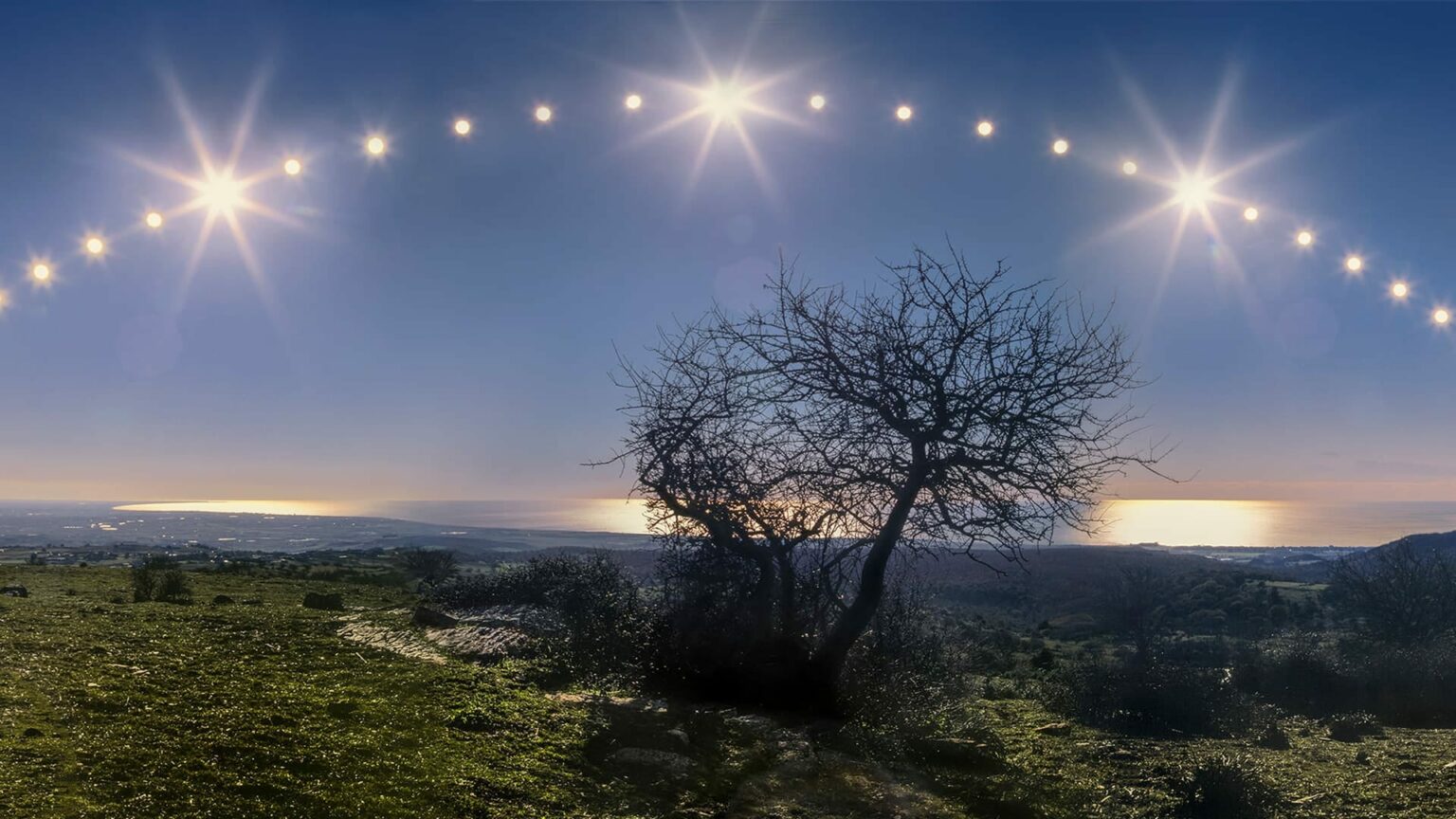
The solstice is not the Sun “stopping” in the sky, but rather a consequence of the Earth’s axis tilting at an angle of approximately 23.44°. Throughout the year, the height of the Sun at noon changes: before the winter solstice, it falls day by day, almost freezing on the day of the event, and then begins to rise.
This is the true astronomical “New Year of the natural cycle.”
Polar magic: Where the Sun disappears
Above the Arctic Circle, the Sun does not rise above the horizon for weeks or months. Arctic cities experience complete darkness from November to January. Meanwhile, in Antarctica, the polar day continues during this time—the Sun does not set at all, describing a circle above the horizon.
How did our ancestors celebrate it?

The solstice became the first starting point of the year in human history. Ancient cultures built megalithic “calendars” — Newgrange, Stonehenge, Carnac — aligned with the sun’s trajectory on these very days.
In modern-day Ukraine, the winter solstice gave rise to one of the oldest holidays—Koliada, where the birth of the new Sun symbolized the victory of light over darkness. Later, Christianity imposed its own meaning on these dates—Christmas, which is celebrated a few days after the event.
How does science explain this phenomenon?
In the 2nd century BC, Hipparchus of Nicaea was the first to turn the solstice into an accurate astronomical parameter. By measuring the length of the shadow cast by a vertical pole, he determined the minimum height of the Sun and calculated the winter solstice for the first time.
Today, this moment is recorded according to precise celestial coordinates: the winter solstice occurs when the Sun’s right ascension is 18 hours. This is how astronomical winter begins.
The main cosmic paradox
Many people believe that winter is cold because the Earth is “far” from the Sun. However, the opposite is true—in early January, the Earth will be closest to our star. Temperature is determined not by distance, but by the angle of the rays and the length of the day.
And what about other planets?
The solstice is a universal geometry for all planets with an inclined axis.
- Mars also has seasons — just with dust storms instead of snow.
- On Uranus, one hemisphere can be plunged into continuous night, while the other experiences endless daylight.
- On Saturn, the solstice determines when the rings are most open — that’s when they are most visible from Earth.
Why is this day still special?
The winter solstice is the point at which darkness reaches its peak, but immediately begins to recede. It is a moment of symbolic “return of light” — and the meanings that have been attached to it for millennia have not disappeared. For some, it is mysticism; for others, it is the mechanics of the cosmos. In reality, the truth lies somewhere in between.

