

An AI model trained on thousands of Wikipedia pages has compiled a list of the 100 technologies gaining momentum the fastest in science and industry—and it did so without relying on any expert input.
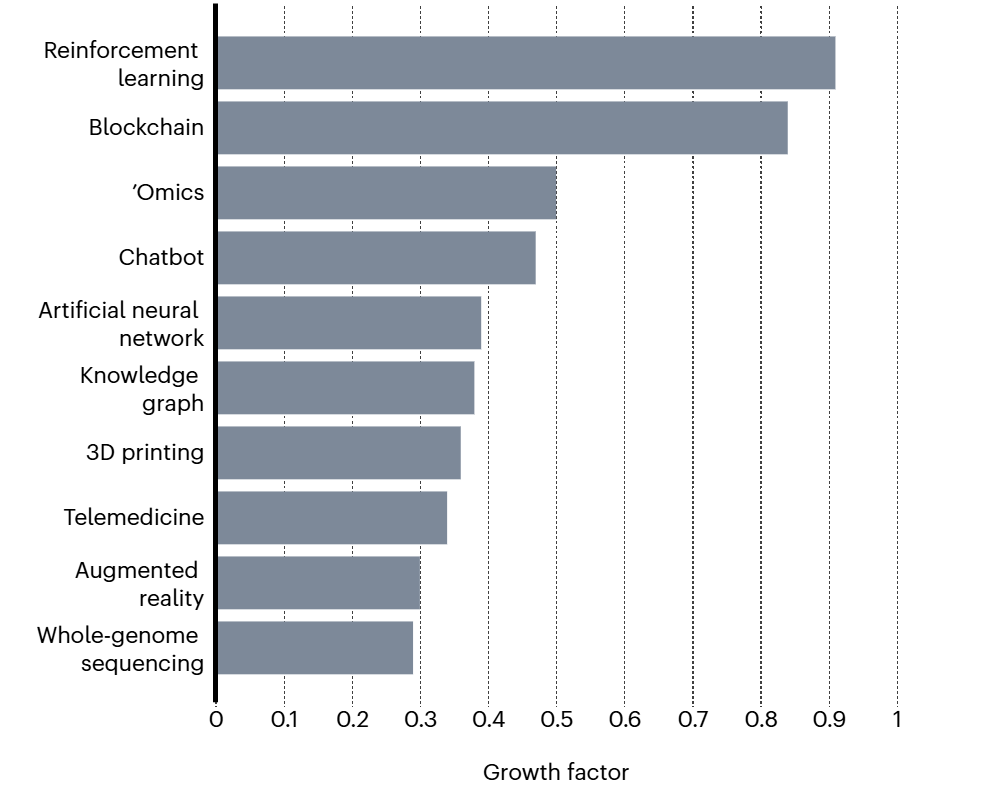
The Australian company League of Scholars has released the Momentum 100 ranking, which is led by reinforcement learning, blockchain, and 3D printing. This is the first attempt to replace traditional expert panels with pure data analysis—and, according to the researchers, they plan to repeat it every year.
How the model was built
The ranking is based on the Cosmos 1.0 open dataset, published in the journal Scientific Data. The team used the Wikipedia2Vec language model, which converts Wikipedia articles into numerical vectors—so-called embeddings. These capture not only the content of the articles but also the logic of the hyperlinks between them.
One article served as the starting point: “List of emerging technologies.” From this data, the algorithm constructed a network of nearly 55,000 interconnected pages, filtered them down to over 23,000 technologies and concepts, and then evaluated each one based on several metrics—including the age of the technology and the dynamics of page views over time.
The Momentum 100 ranking of technologies by growth rate. Source: League of Scholars. Interactive chart by James Bayliss and Tanner Maxwell.
Why is reinforced learning so popular?
First place went to reinforcement learning—an approach in which a system learns through trial and error, receiving a “reward” for correct decisions.
This method is the basis for the AI that beats humans at chess, Go, and the Japanese game of shogi, and is also used in drug development and drone control. Its versatility—the ability to make consistent decisions in a complex, ever-changing environment—is what secured its leading position.
In fact, the algorithm mathematically replicates natural learning mechanisms—successful actions are reinforced with positive feedback, while unsuccessful ones are filtered out. This is roughly how pets learn commands in exchange for treats.

Blockchain beyond cryptocurrencies
Blockchain’s second-place ranking reflects a broader research interest that extends far beyond the technology’s origins in cryptocurrency. Among the most cited publications on this topic is a paper on swarm learning: a method that allows hospitals and laboratories to collaboratively train AI on medical data without sharing patients’ personal information.
The article has received over 800 citations. Blockchain technology is also used to monitor food supply chains, verify clinical trial data, and track renewable energy production.
Raw data without expert opinion
Most annual technology rankings—including those from the World Economic Forum, Stanford University, and MIT Technology Review—are based on the opinions of a small group of experts.
Momentum 100 deliberately avoids this approach. “Our work was driven by the idea of mapping technologies from the bottom up—using AI’s ability to uncover hidden knowledge within large, complex systems,” explains Paul McCarthy, co-founder of the League of Scholars.
Catherine Aiken of Georgetown University, who specializes in emerging technologies, acknowledges that over the past six years, the methods used in this field to identify promising areas have seen virtually no updates—they are too expert-driven, too labor-intensive, and too individualized. She described Cosmos 1.0 as a “useful addition to the field.”
According to nature.com

