

In the 1960s, Freeman Dyson proposed the idea of a hypothetical astro-structure in the form of a sphere that an advanced civilization could surround its star with in order to collect maximum energy. It was named a Dyson sphere. Later, this design was reimagined as a Dyson swarm — a bunch of space stations whose orbits are coordinated to avoid crashing into each other.
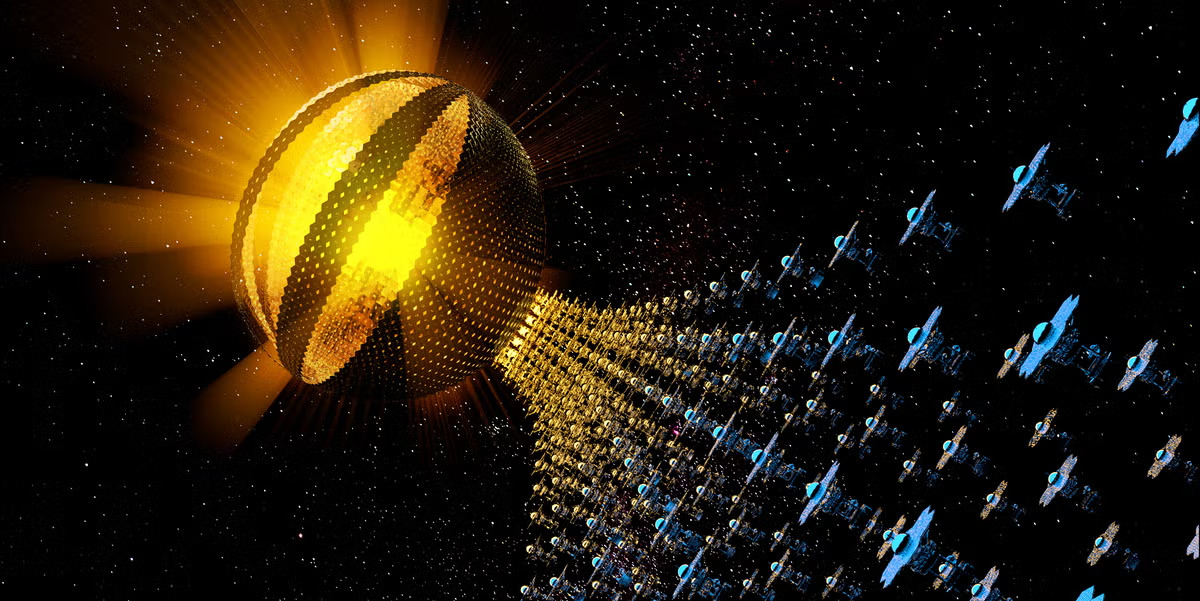
Despite the fact that scientists have not yet been able to find traces of such astro-structures in reality, the concept still attracts considerable interest. British scientist Brian C. Lacki from the Breakthrough Listen project wondered if these structures could outlive their creators. How long can the Dyson swarm survive without maintenance and control?
During the simulation, Lacki calculated that for the smallest swarm around a sun-like star, consisting of 340 elements, the average time between collisions among the elements would be one million years. However, since several collisions will occur well before the median time, a Kessler syndrome-like “cascade” effect, in which the elements of the swarm will be destroyed in a series of collisions with each other, could occur in just 41,000 years. That’s not much by astronomical standards.
The time required for cascading destruction of the cluster increases significantly with increasing star radius. For a red giant with a mass equal to that of the Sun and a radius 25 times greater than the Sun’s radius, it could be 5.3 billion years, with a minimum swarm consisting of 4,800 elements. In contrast, a swarm around a small red dwarf, whose mass and radius will be 0.2 and 0.1 times that of the Sun, will disintegrate in just four months.
During the study, Lacki also found that the best option would be to place the elements of the swarm in rings around the star, with their radius increasing, similar to the location of Earth satellites at different altitudes: from low Earth orbit to geosynchronous orbit. In any case, according to Lacki’s estimates, most of the Dyson swarms should completely disintegrate within a few million years after losing control.
Earlier, we discussed how a Dyson swarm could destroy life on Earth.
According to Phys.org

