

The XRISM X-ray satellite is observing a binary system consisting of a black hole and a normal star. It found out some amazing things about the flow of gas between them and the energy emitted during this process.
Observing black holes in the X-ray range
An international group of researchers has reported impressive results from XRISM observations of the binary X-ray system 4U 1630–472, located in our galaxy. XRISM is an X-ray astronomy satellite developed by Japan in collaboration with the United States and Europe, launched from the Tanegashima Space Center on September 7, 2023.
This observation, conducted during the extinction of the flare, made it possible to successfully record the absorption lines of highly ionized iron in the weakest X-ray state of the system. The results provide a rare opportunity to look into the structure and motion of hot gas around a black hole during its weakest X-ray phase, providing new insights into how these extreme systems evolve and interact with their surroundings.
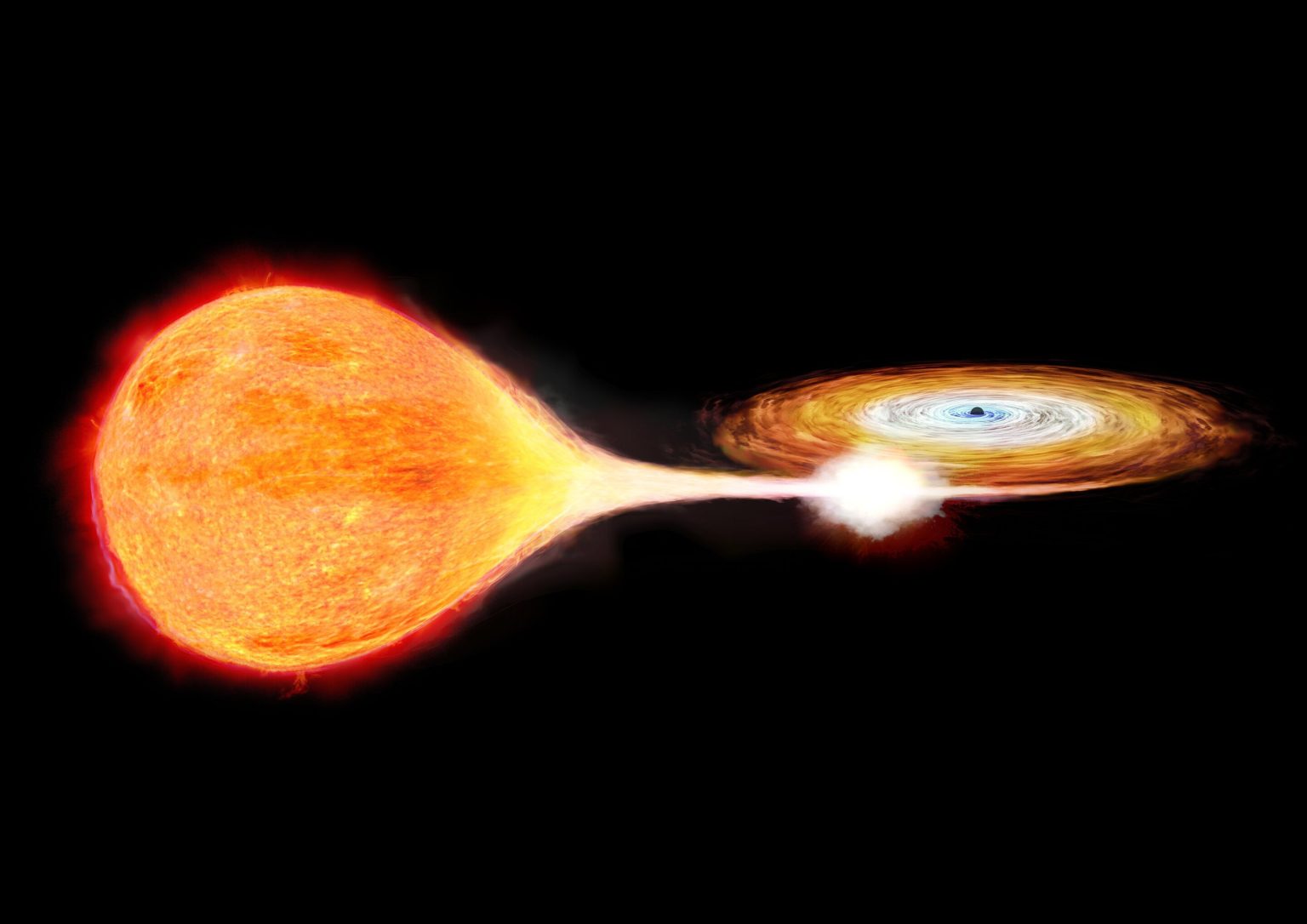
The size of black holes varies from a few to billions of solar masses. An X-ray binary black hole contains a black hole with a stellar mass, typically less than a few dozen times the mass of the Sun, orbiting a normal star. Gas extracted from the companion star spirals toward the black hole, forming an extremely hot accretion disk. In its inner regions, temperatures can reach around 10 million kelvins, generating intense X-ray radiation.
Behavior of X-ray binary systems with BH
There are about 100 confirmed or probable X-ray binary systems with black holes, including the well-known Cygnus X-1. These systems are dim most of the time, but occasionally experience flares during which their X-ray brightness can increase by a factor of 10,000 in just a week. During such episodes, some systems emit powerful winds from their accretion disks, but the conditions that cause such large flares and trigger winds remain poorly understood.
Studying these stellar-mass black holes also provides valuable information about the behavior of supermassive black holes at the centers of galaxies, which can have a strong influence on star formation and galaxy evolution. By observing nearby stellar-mass black holes, astronomers seek to discover the Universal processes that shape the cosmic environment.
What was recorded using XRISM?
XRISM is equipped with Resolve, the most advanced soft X-ray spectrometer capable of measuring X-ray energy with unprecedented accuracy. Shortly after beginning regular operations, the team observed 4U 1630-472, an X-ray binary system with a black hole located in the constellation Cygnus. For approximately 25 hours from February 16 to 17, 2024, XRISM recorded the system just before it returned to quiescence at the end of the flare, when its X-ray brightness had already fallen to about one-tenth of its peak value.
Observing transitional phenomena required rapid coordination. The team monitored X-ray binary systems with black holes daily using wide-angle X-ray instruments, then worked closely with the XRISM operations team to quickly adjust the schedule, making this observation possible.
The spectra obtained revealed clear absorption lines of highly ionized iron, even at this dim stage. It is noteworthy that in the second half of the observation, the absorption intensified, despite insignificant changes in the brightness of the X-ray radiation.
The analysis showed that the absorbing gas was located in the outer accretion disk, moving at a speed of less than 200 km/s — much slower than the 1000 km/s winds observed in brighter phases. At such low speeds, the gas remains gravitationally bound to the black hole. The increase in absorption in the second half of the observation was probably caused by a localized gas cloud at the outer edge of the disk, which may have formed at the point of collision between the falling stream from the companion star and the disk.
Gas flow near a black hole
These observations are the first time when detailed absorption features have been detected in an X-ray binary system with a black hole at such low luminosity. Thanks to the exceptional spectral capabilities of XRISM, astronomers were able to map the motion and distribution of hot gas near the black hole in a previously inaccessible mode.
The results show that even with weak X-ray radiation, highly ionized gas may be present around the black hole, possibly in motion. This provides valuable information about gas inflow and outflow in the accretion disk and the physical conditions that may lead to wind formation.
The team’s next goal is to record future flares of varying brightness using XRISM, which will allow them to track changes in the properties of the gas over time. They are currently on standby, ready to respond quickly when the next black hole flare occurs in the X-ray binary system.
According to phys.org

