

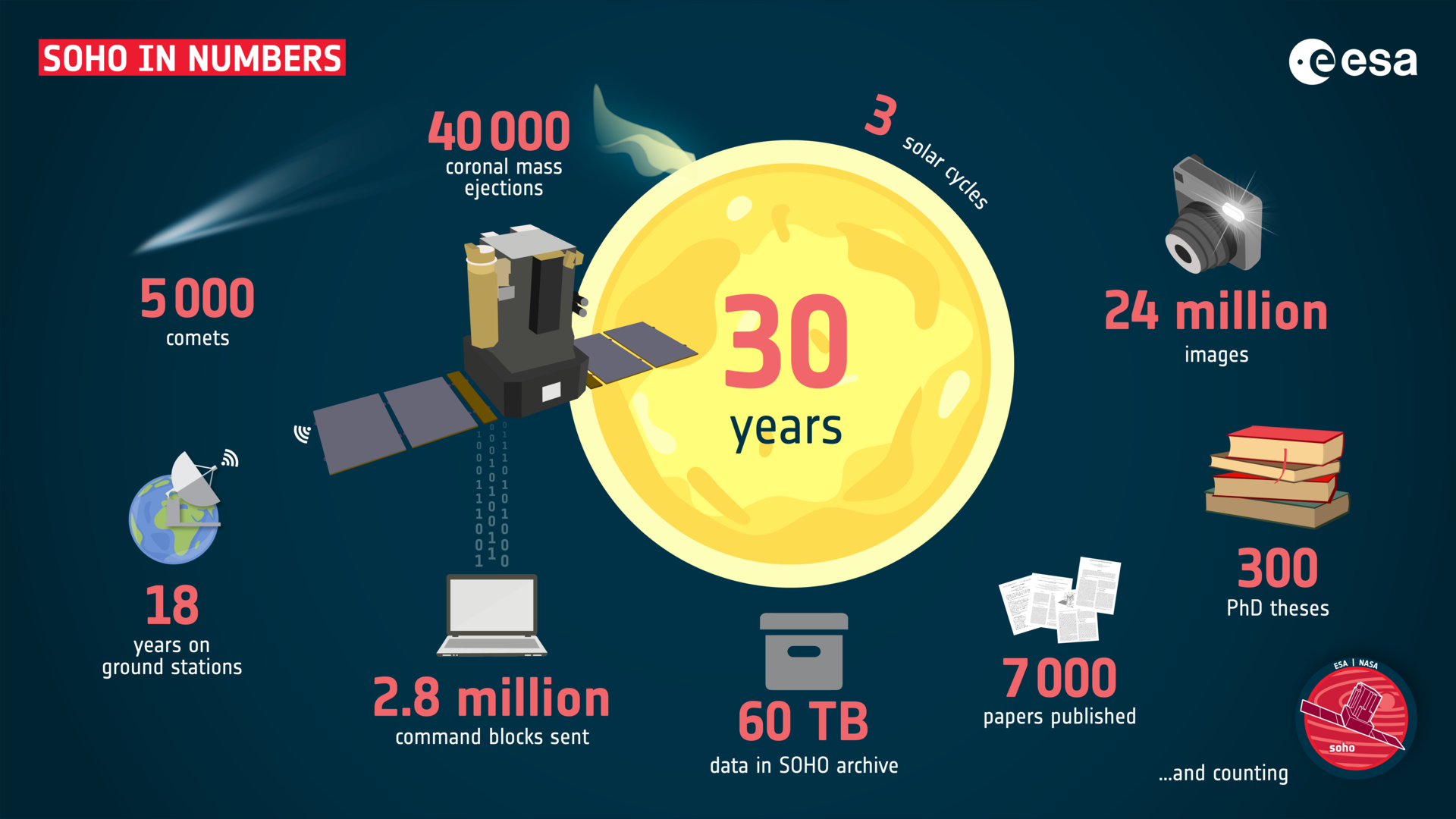
December 2 marked the 30th anniversary of the launch of the SOHO observatory. It studies solar activity.
History of SOHO
SOHO is a joint project between ESA and NASA. The spacecraft was launched on December 2, 1995, and placed in a halo orbit around the Lagrange point L1 of the Sun-Earth system. Its main task is to study our star. The observatory collects information about its activity, the state of its atmosphere and deep layers, and measures the characteristics of the solar wind.
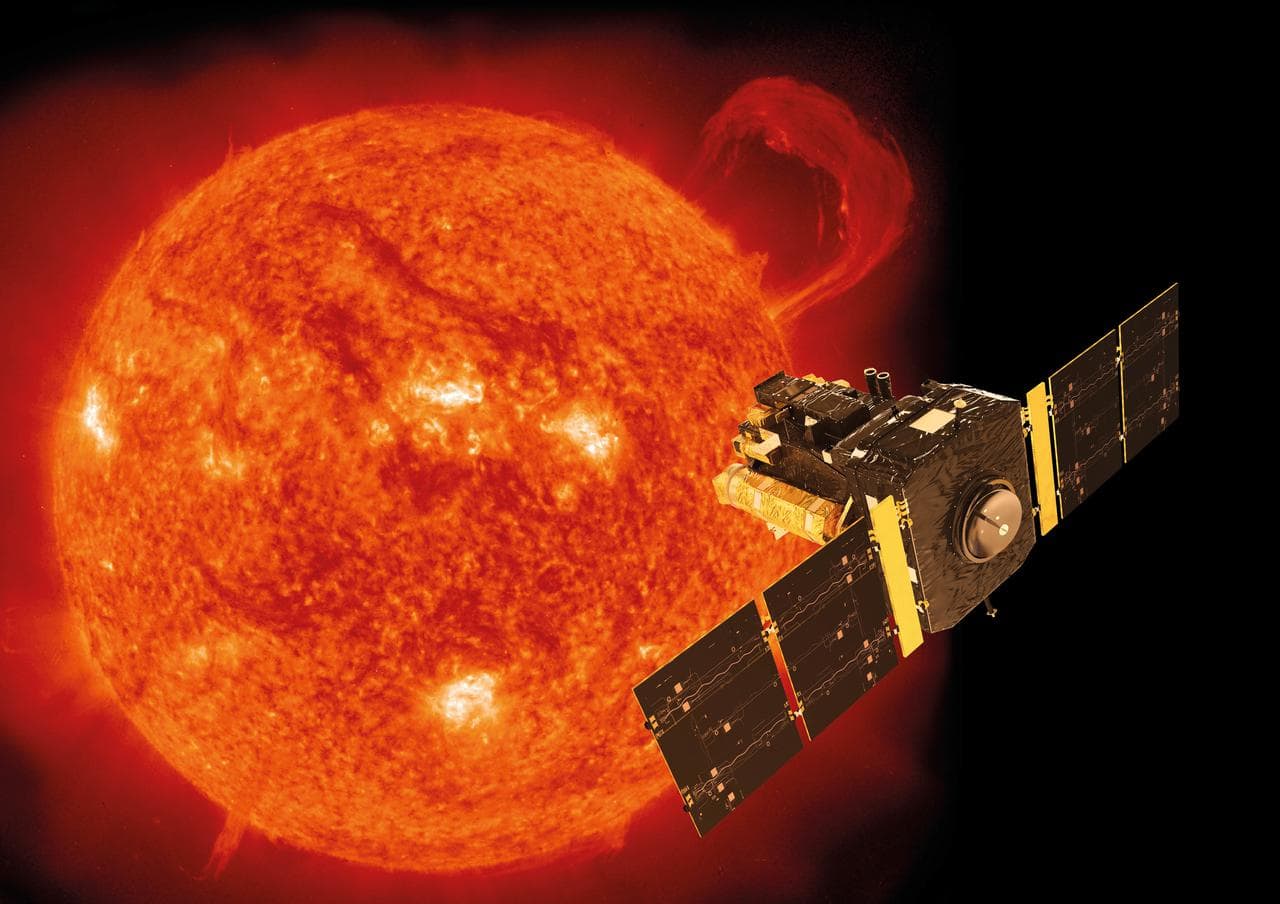
The nominal service life of SOHO was only two years. But it exceeded this figure by a considerable margin, becoming one of the longest-lived space observatories. Only the Hubble telescope can boast a longer service life, despite having been repaired several times in orbit, while the solar telescope did not have this luxury.
Of course, during its operation, this unique observatory has encountered many technical problems. In 1998, controllers unexpectedly lost contact with SOHO. As part of a rescue operation, NASA used the Arecibo and Goldstone radars to determine the location of the spacecraft. After that, commands were sent to it, allowing it to restore its orientation in space, recharge its batteries, and return to normal operation. To this day, the revival of SOHO is considered one of the most difficult rescue operations in deep space.
By the end of 1998, all three gyroscopes at the observatory had broken down. But engineers solved this problem too, devising a way to change the orientation of the device without using them.
SOHO’s main achievements
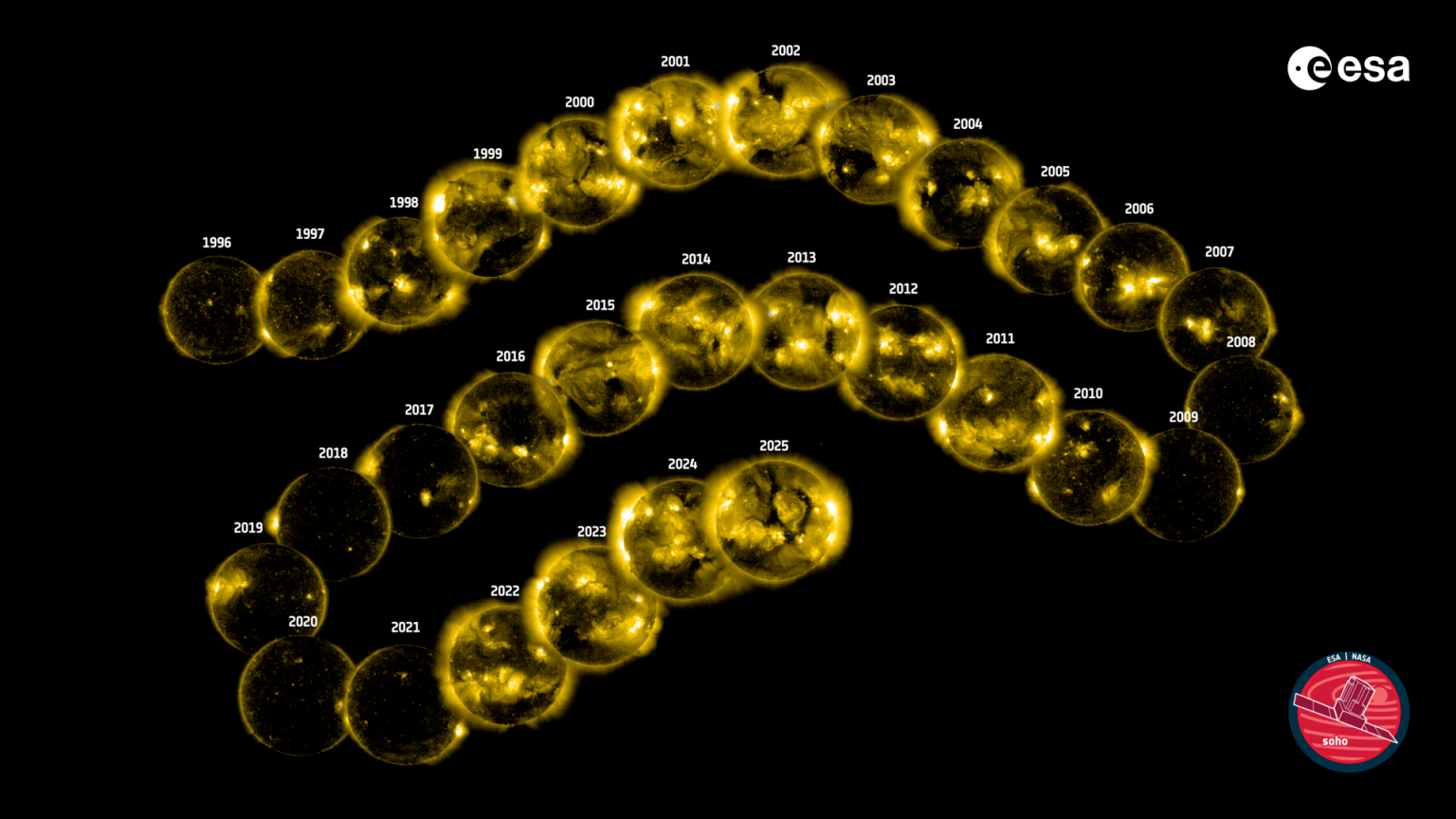
Over a quarter of a century of operation, SOHO has collected a wealth of valuable data about our star. It has observed a full 22-year cycle of solar activity, recording both record-breaking flares and periods of calm, when not a single sunspot appeared on the star’s surface for many weeks. In honor of the mission’s 30th anniversary, ESA has compiled a list of its five main achievements.
1. Helioseismology
SOHO has pioneered the field of helioseismology. Similar to studying how seismic waves travel through the Earth during an earthquake, helioseismology investigates the interior of the Sun by studying how sound waves are reflected within it. Thanks to SOHO, scientists have discovered a “conveyor belt” through which solar plasma flows from the equatorial regions to the poles and then back down to the equator. It takes about 22 years to complete this journey, which corresponds to the timescale of the Sun’s magnetic cycle.
2. Is the Sun shining steadily?
The amount of energy emitted by the Sun is a fundamental quantity for understanding the influence of solar heat on Earth’s atmosphere and climate. Three decades of SOHO data, combined with older measurements, provide unprecedented measurements spanning nearly fifty years.
The total energy emitted by the Sun varies very little—on average, only 0.06% per solar cycle. In contrast, fluctuations in extreme ultraviolet radiation are significant, doubling between the solar minimum and maximum. Extreme ultraviolet radiation from the Sun significantly affects the temperature and chemical composition of the upper layers of the Earth’s atmosphere, but is not a direct cause of global warming trends.
3. Monitoring solar storms
SOHO has played an important role in the development of real-time space weather monitoring systems. It is capable of detecting coronal mass ejections (large eruptions of solar material and magnetic fields), providing up to three days’ warning of geomagnetic storms.
4. 5,000 near-sun comets
One of SOHO’s most unexpected achievements was that the spacecraft proved to be an extremely effective tool for a task for which it was not originally intended—searching for comets near the Sun. This is the name given to icy bodies that come extremely close to our sun at perihelion, sometimes flying just a few thousand kilometers from its surface. In March 2024, SOHO discovered its 5,000th comet, becoming the most successful comet discoverer in history. Most of them were found by amateur scientists from around the world as part of the Sungrazer project.
5. New generation of solar researchers
The success of SOHO has influenced the development of next-generation solar observatory projects, such as SDO and STEREO. In addition, the data collected by SOHO is used in planning the work of Solar Orbiter and Parker Solar Probe, which are studying the Sun from close range.

