

Astronomers from Princeton University have discovered a previously unknown large exoplanet whose mass is 35 times greater than that of Earth. It was hidden in the already studied Kepler-139 star system.
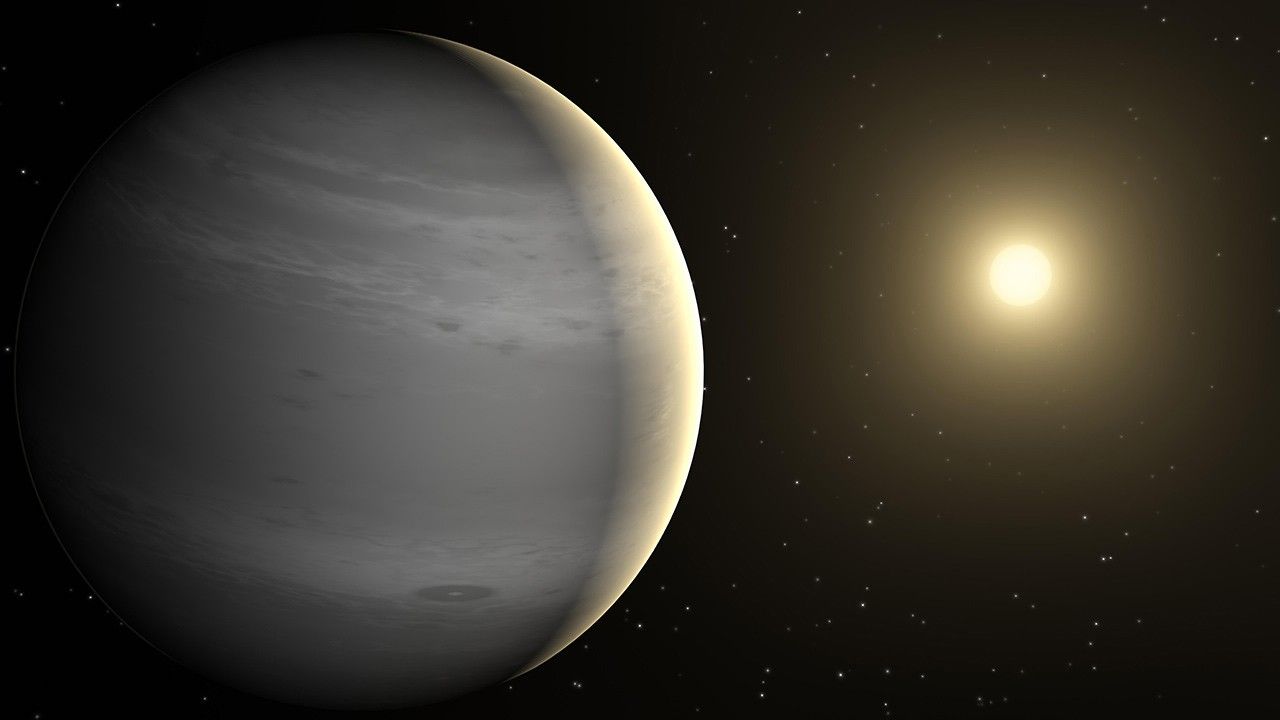
Kepler-139 is located 1,289 light-years from Earth. During observations over the past decade, the Kepler space telescope has detected periodic decreases in the star’s brightness, indicating the presence of invisible companions. They were caused by transits of three exoplanets whose orbits pass at a short distance from Kepler-139.
Using the radial velocity method, astronomers were able to determine the mass of three exoplanets and calculate them to be rocky super-Earths. They have also obtained data indicating that there are other unknown bodies in this system that are in inclined orbits and do not produce transits.
In 2023, researchers managed to find a fourth exoplanet — the gas giant Kepler-139e, which orbits its star once every 5.6 years. But the search did not end there. After studying the transit times of three super-Earths, astronomers discovered their “delays,” which could not be explained solely by the gravitational influence of the gas giant. This meant that there was at least one more exoplanet hidden in the Kepler-139 system.
Using the radial velocity method, astronomers were able to identify a fifth exoplanet that had previously escaped their attention. It was designated Kepler-139f. Its mass is 35 times greater than that of Earth, and it orbits its star once every 355 days. The orbit of Kepler-139f lies between the inner super-Earths and the outer gas giant.
The discovery also helped answer questions about the nature of Kepler-139e. Initially, astronomers obtained an unusually high value for its density, which was atypical for gas giants. The discrepancy arose because scientists were unaware of Kepler139f at the time, which affected their calculations. When they took its gravity into account, it turned out that the density of the gas giant was close to what was expected.
Researchers suggest that Kepler-139 may have other hidden worlds. To find them, additional observations are needed to record the smallest deviations in the transit times of the three super-Earths. Scientists have particularly high hopes for the PLATO telescope, which is scheduled to be launched in 2026. It will also observe systems with already known exoplanets. This will allow scientists to refine their characteristics and find hidden worlds that have so far managed to escape the attention of scientists.
According to Space.com

