

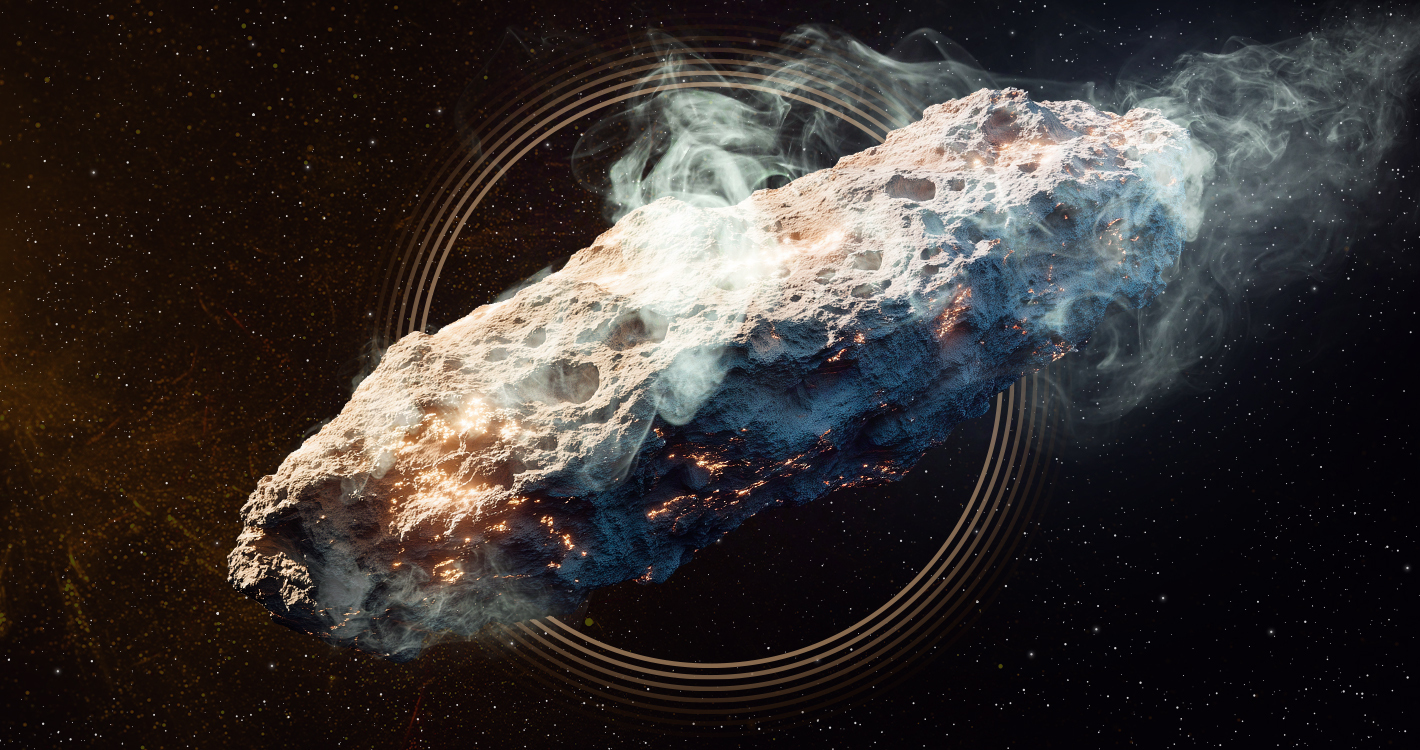
The 3I/ATLAS object has become a real sensation in modern astronomy. Most scientists agree that it is a comet that has come to us from another star. Many popular publications write that it is even more interesting, because it may turn out to be an alien probe. Let’s figure out what’s what.
Interstellar guest
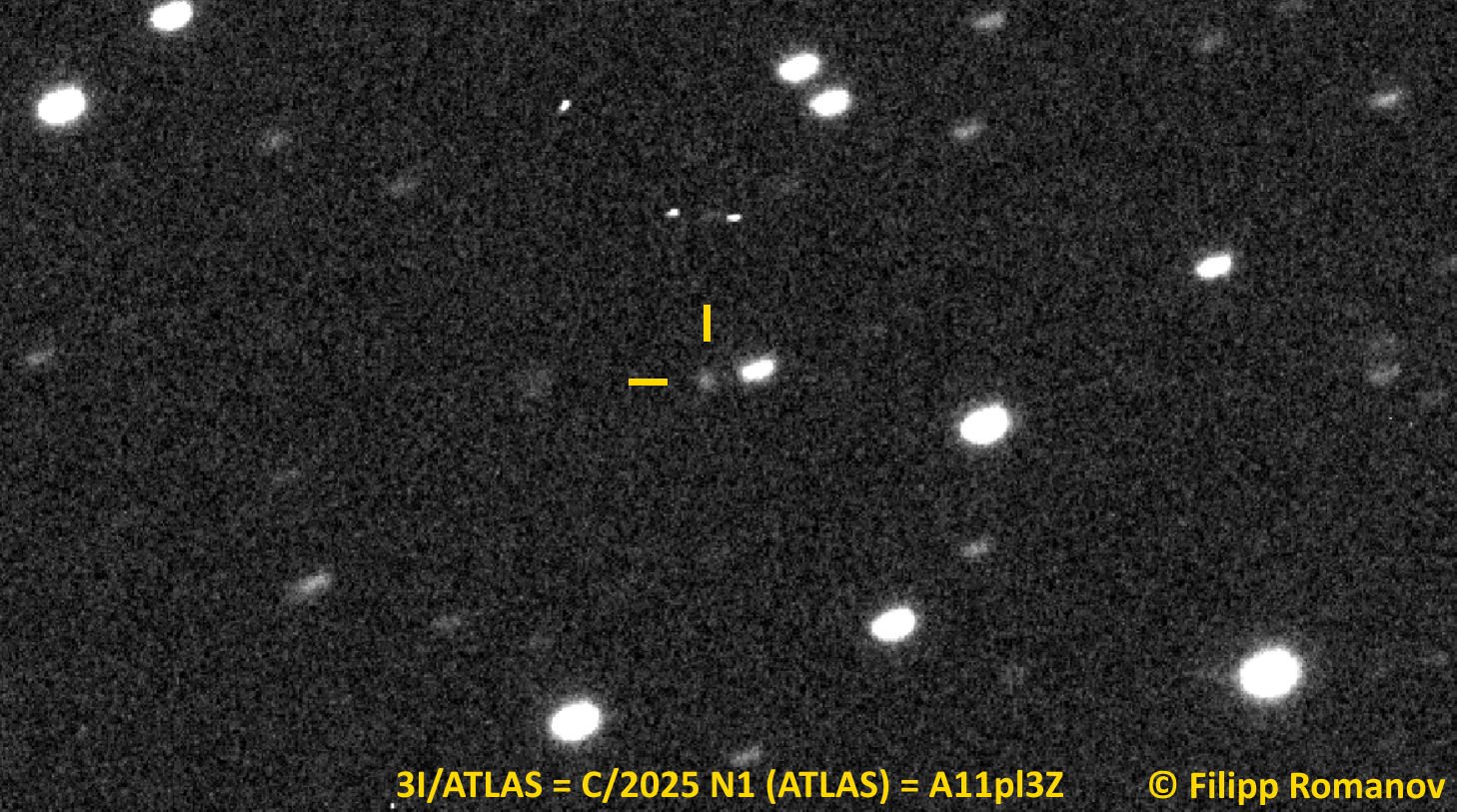
On July 1, 2025, the ATLAS robotic telescope system discovered an object beyond Jupiter’s orbit that was moving quite rapidly against the backdrop of stars. Such behavior typically indicates a comet that has originated from the Oort cloud, located at the outskirts of the Solar System. However, no cometary activity was detected at first.
However, the speed and trajectory of this object immediately made it one of the major astronomical sensations of 2025, and soon even people who were far removed from observing the sky began to talk about it. It turned out that the comet, which was soon named 3I/ATLAS (C/2025 N1), had flown in from interstellar space.
The “3I” in the name indicates that this is the third macroscopic interstellar object known to humans. The first two were the asteroid Oumuamua (1I/ʻOumuamua) and the comet Borisov (2I/Borisov), discovered in 2017 and 2019, respectively. The fact that interstellar visitors were not recorded before, but now appear so abundantly, may frighten some people. But in reality, there is nothing mystical about it.
Over the past few decades, astronomical technology has advanced rapidly, with the emergence of large survey telescopes, space observatories, robotic instruments, and a network of enthusiasts who constantly exchange information on the Internet. Humanity has reached a level of observation where it can see things in the sky that previously went unnoticed.
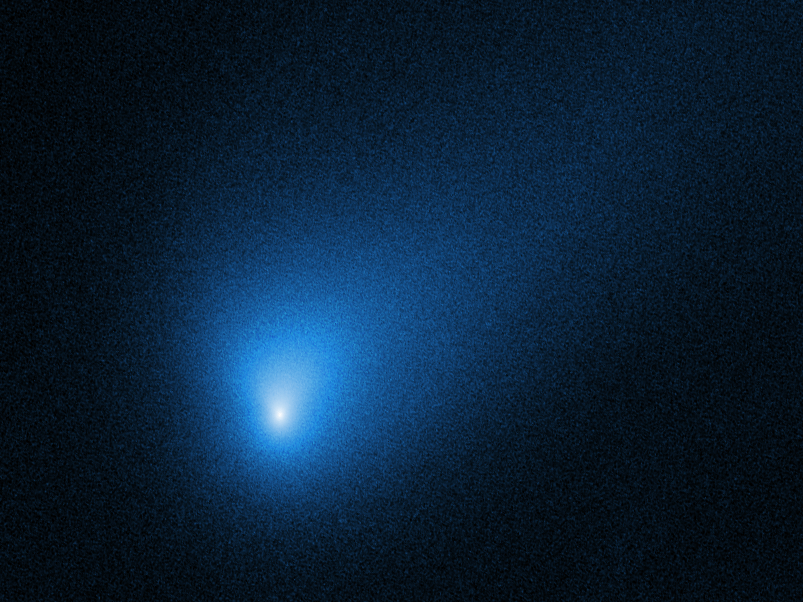
So, the appearance of the third interstellar object was eagerly awaited. Immediately after the announcement of the discovery of 3I/ATLAS, several powerful astronomical instruments were directed at it, thanks to which scientists were able to establish fairly quickly that it was indeed a comet and learn enough about it.
Comet characteristics
The first thing that interested scientists in 3I/ATLAS was its speed. In the Oumuamua and Borisov comets, it was significantly higher than in bodies with aphelion somewhere at the edge of the Solar System: 26 and 32 km/s, respectively.
However, in the case of 3I/ATLAS, this value was already 58 km/s at the moment when it entered the Solar System. That is, even then, it was flying a distance equal to the distance from Earth to the Sun in about a month. And this speed has only increased since then because now the gravity of our star acts on this body.
Such high speed determined the trajectory, which turned out to be too unusual for objects in the Solar System. Its eccentricity is 6.141. Some may say that eccentricity cannot exceed unity. But this only applies to closed elliptical orbits, which are possessed by all bodies that constantly revolve around the Sun.However, eccentricity is also present in parabolic and hyperbolic trajectories, and the latter includes the orbit followed by 3I/ATLAS. Moreover, its eccentricity is so great that the trajectory resembles a straight line rather than a curve.
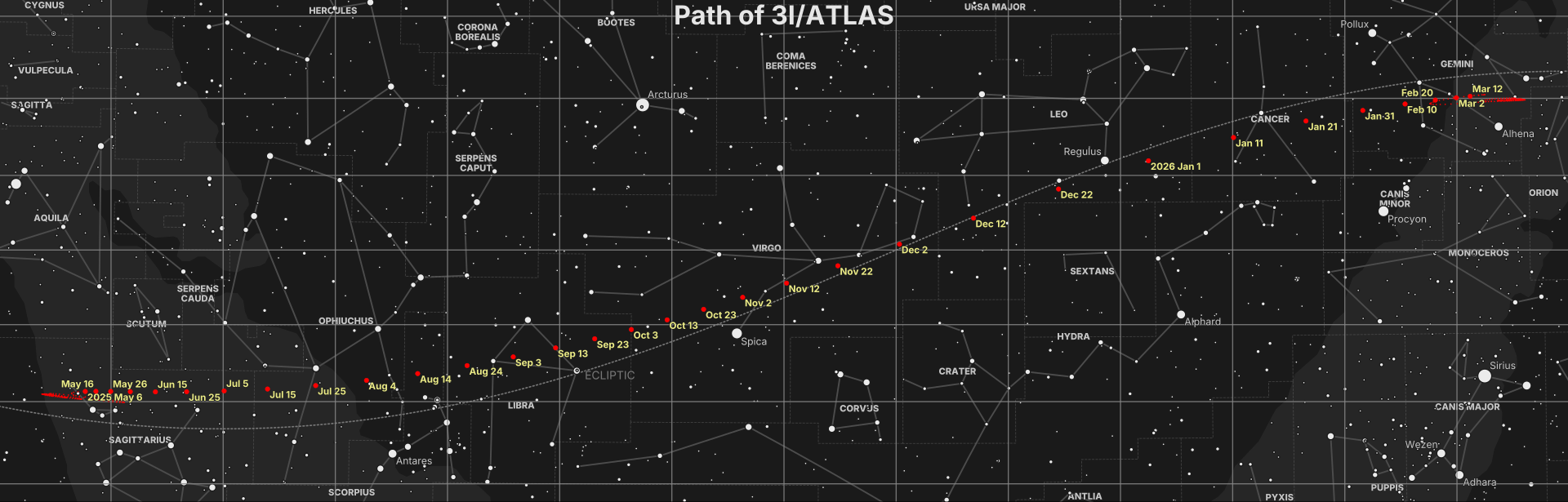
The second feature of 3I/ATLAS that caught the attention of scientists is the section of the sky from which the comet came to us. It is located in the constellation Sagittarius, close enough to the center of the Milky Way. At the same time, it has a sufficiently high vertical velocity component relative to the plane of our Galaxy’s disk, meaning that the comet flies through it rather than moving within it all the time.
All this indicates that it originated near a star in the thick disk of the Milky Way. And they, as a rule, belong to the most ancient generations of stars. It was from this that perhaps the most sensational statement about 3I/ATLAS was derived, which is considered scientifically true and recognized by most scientists. This interstellar comet is older than the Sun. Its age is estimated to be between 7.6 and 13 billion years, although there is another estimate that it formed somewhere between 3 and 11 billion years ago.
In addition, throughout July, scientists observed 3I/ATLAS and confirmed that it exhibits normal cometary activity, i.e., it forms a coma and something resembling a tail. This, in turn, allowed them to conduct spectroscopic studies and confirm that it consists mainly of water and contains hydroxyl ions, OH. In addition, carbon dioxide and carbon monoxide were found on it, and it seems that their evaporation is responsible for the formation of the comet’s shell.
However, cyanides, oxygen, or complex organic molecules, which are found in comets that constantly revolve around the Sun, have not yet been detected in 3I/ATLAS. Instead, there is a lot of dust, and its particles are quite large, with a diameter of about 1 micron.
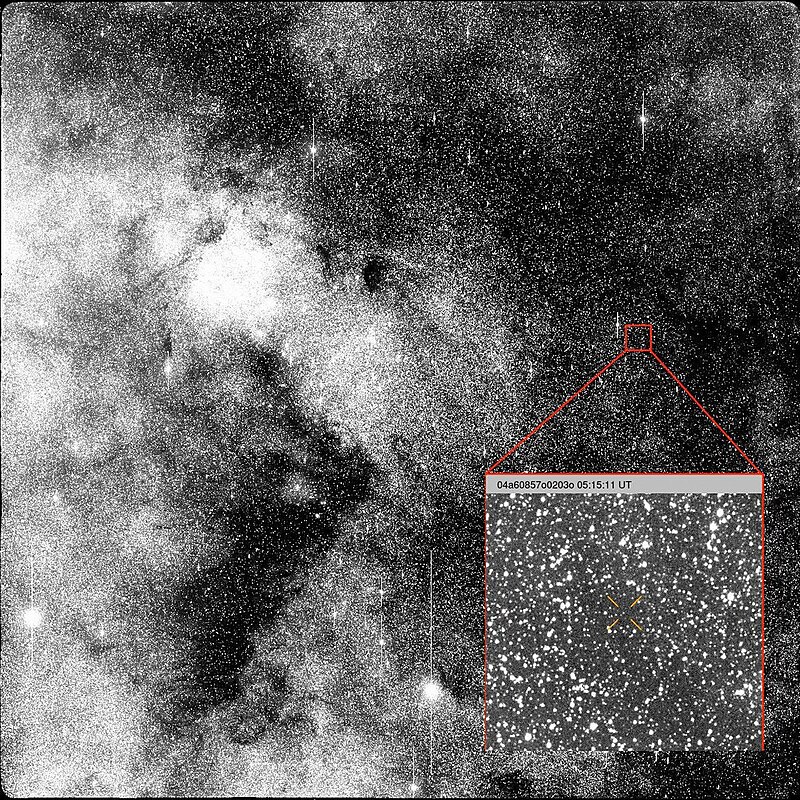
There is one interesting fact about 3I/ATLAS related to dust. When archival images from various telescopes were examined, an interstellar comet was found in images taken by the TESS satellite in May of this year. It operates in the infrared range, and its images show that this celestial body, even then, far beyond Jupiter’s orbit, was ejecting matter containing dust.
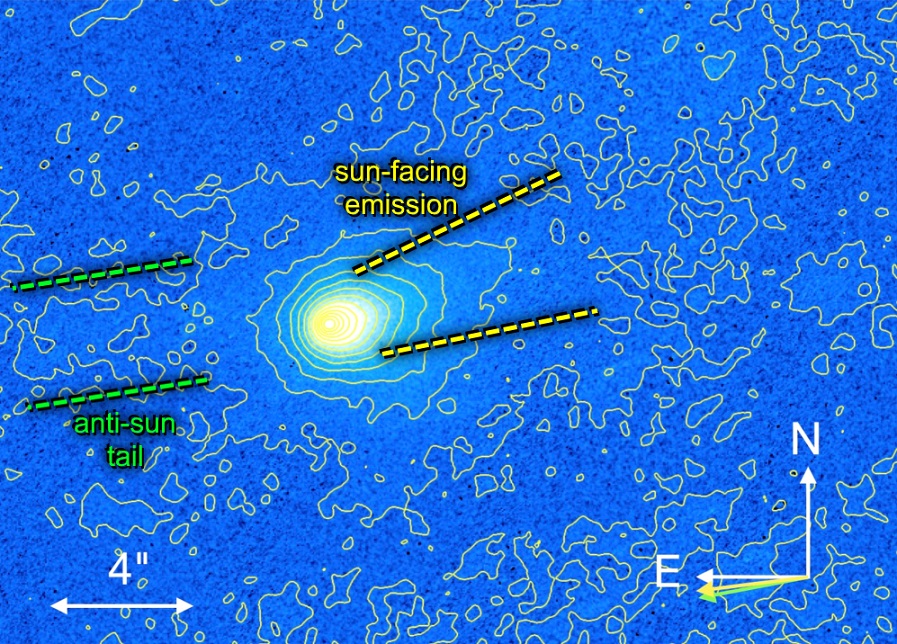
Finally, scientists were able to calculate the diameter of the comet’s nucleus with some accuracy. In early studies, it was estimated to be between 10 and 20 km. Then, thanks to the Hubble Space Telescope, it was reduced to a range of 0.32 to 5.6 km. But scientists disagree on whether its size is closer to the upper or lower limit. Some studies show that the nucleus is less than a kilometer in diameter, while others show that it is larger.
Aliens
It would be surprising if the appearance of 3I/ATLAS did not spark rumors that it was an alien spacecraft. This idea was expressed on social media almost from the very first days after the discovery, and on July 16, a certain Avi Loeb, a real professor of astrophysics at Harvard University, joined the discussion. He published an article in which he presented several entirely scientific arguments in favor of the idea that it could be an interstellar probe from aliens.
Of course, this sparked a flurry of publications speculating that this was a real alien spacecraft and that we should expect aliens to land in late autumn. Loeb has a rather scandalous reputation in academic circles: he has many high-quality scientific works to his credit, but he often makes overly bold predictions that are mostly unconfirmed.
After such a sensational statement, other scientists rushed to refute the words of Loeb and his colleagues. Their assumptions were mainly based on the fact that the orbit of 3I/ATLAS lies almost in the plane of the ecliptic, so it will pass close enough to several inner planets, which may indicate plans to explore them or even land on them.
In addition, Loeb stated that the object did not exhibit classic cometary activity. He was reasonably told that at the time of his statements, the object was far enough away from us that we could not see any emissions from it. Indeed, 3I/ATLAS subsequently showed quite standard cometary activity.
In addition, scientists pointed out that if it were an extraterrestrial probe, it would be a small metal object that we would see, at best, as it approached Mars’ orbit, but certainly not at a distance greater than 4 AU.
As for the comet’s orbit, although it is close to the ecliptic, it is still inclined at an angle of 5° relative to it, which may well be a coincidence. In general, its passage within the system deserves separate consideration.

Comet flight
Speaking about the possibility that there are aliens on 3I/ATLAS, it is important to note that at the moment of its closest approach to the Sun, Earth will be on the other side of it. Therefore, to approach it, a hypothetical alien spacecraft would have to detach itself from the ice mountain and perform a braking maneuver.
Many of those who like Loeb’s hypothesis says that all the prerequisites are in place because the comet’s trajectory is such that it will approach several large planets at once, and it will be possible to perform a gravitational maneuver near them.
However, let us consider what these approaches will look like. The first object on the path of 3I/ATLAS will be Mars. The comet will approach it at a minimum distance of 29 million kilometers. This is 75 times the average distance from Earth to the Moon. This is somewhat excessive for a gravitational maneuver.
Then, on October 29, 3I/ATLAS will pass through perihelion – the point closest to the Sun. At that time, it will be 1.36 AU away from the Sun. This means that it will be inside the orbit of Mars, but still very far from the orbit of our planet, which at that moment will be on the other side of our star.
Shortly after that, on November 3, the comet will pass at its closest distance to Venus, but that will still be 97 million km away. Earth regularly comes much closer to our neighbor. What gravitational maneuvers can be expected in this case remains unknown.
After that, Earth will appear in front of 3I/ATLAS, which will already be moving away from the Sun. The maximum approach will occur on December 19, and the distance will be 1.8 AU, which means that the interstellar visitor will be much farther away from us than the Sun. Finally, on March 16, 2026, 3I/ATLAS will approach a planet that could give it a nice gravitational maneuver – Jupiter. However, this will happen after it has flown through the entire inner Solar System and will have to turn back and catch up with Earth, which at that time will again be on the opposite side of the Sun from it. And the distance from the gas giant will be 53 million km. Which is quite a lot.
Of course, we can assume that the aliens’ spaceship will detach from it precisely during its approach to Mars, or during its passage through perihelion when we cannot see it. In this case, it will have to slow down by more than 20 km/s.
And even so, this will not help the aliens much, because the trajectory will remain retrograde relative to the direction of the planets’ rotation around the Sun. So, if the aliens who flew to us billions of years ago have a plan that is a little more complicated than becoming kamikaze pilots, they will have to slow down again, spending a lot of energy on it. And the aliens still need to get that energy from somewhere.
So, most likely, we should not expect any extraterrestrial visitors at the end of the year. And we will not be able to admire the interstellar comet itself. By the time it emerges from behind the Sun, its brightness will already be approximately 11 stellar magnitudes, meaning it will be inaccessible even to small amateur instruments, let alone the naked eye.
And it will not be possible to launch a spacecraft to study it up close. Calculations show that to catch up with it, it would have to launch from Earth, and this would be a mission at the limit of our capabilities in terms of accelerating spacecraft. Better yet, it would have to launch from Mars’ orbit.
But scientists continue to study 3I/ATLAS. Now we can be sure that it is not the last one, and in a few years, we can expect the next interstellar visitor. And perhaps by then, we will be able to prepare a device that will take a closer look at it.

