

NASA announced the successful completion of a two-year demonstration of Deep Space Optical Communications (DSOC) aboard the Psyche spacecraft. In the final session, Earth received a laser message from a distance of approximately 351 million km (218 million miles). A total of 13.6 terabits of data were transmitted for the program, and earlier, DSOC carried out the first-ever broadcast of 4K video from deep space at a speed of 267 Mbit/s from a distance of ~30.6 million km.
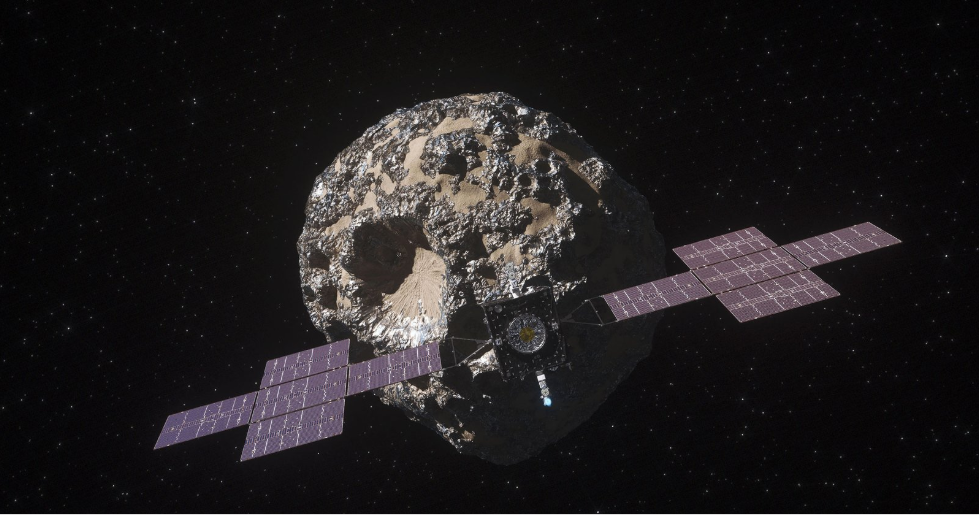
Among the key milestones is a record signal reception in December 2024 from a distance of 494 million km, which is more than twice the average distance between Earth and Mars. At the same time, the speed naturally decreases with increasing distance: in April 2024, DSOC transmitted engineering data at speeds of up to 25 Mbit/s from ~225 million km, and in June — up to 8.3 Mbit/s from ~401 million km.
How does it work? Unlike radio communication, DSOC encodes information into streams of near-infrared photons and sends them in a narrow beam. Ground-based telescopes require ultra-precise guidance, stabilization, and ultra-sensitive detectors. NASA’s optical facilities in California (Table Mountain and the Hale Telescope at Palomar) are involved in the tests.
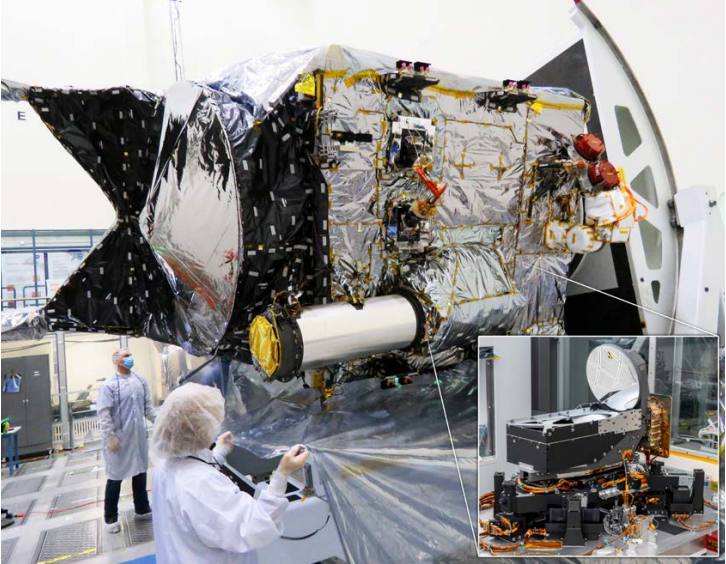
Imagine a space-based fiber optic internet, but without the fiber. On board the probe, a small infrared laser flashes at a fantastic speed — on/off and phase changes encode zeros and ones. The beam is very narrow, like a laser flashlight: thanks to this, almost all of the energy travels in the desired direction and does not scatter, as in radio communication (which is more like a megaphone). Super-precise drives aim the beam at a ground-based telescope — it’s like hitting a coin from millions of kilometers away. On Earth, highly sensitive receivers count photons and convert them back into video and files.
The secret to speed lies in the combination of a narrow beam, high light frequency, and ultra-precise guidance: this allows much more data to be transmitted at the same time.
Why is this important? Optical communication offers significantly higher bandwidth for the same weight and power consumption, which is critical for future missions to Mars and beyond. This means more raw scientific data, high-resolution streaming video from planetary surfaces, rapid software updates for spacecraft, and relief for the overloaded Deep Space Network. For manned expeditions, this is a prerequisite for telepresence and high-quality communication between crews.
Want to experience the dawn of the hypersonic era? Immerse yourself in the history of the X-15 rocket plane — the rocket aircraft that was the first to reach the edge of space, set incredible speed and altitude records, and paved the way for modern space programs. This is not just technology — it is dramatic flights on the edge of possibility, bold tests and decisions that were ahead of their time. Read more in the fascinating article “Faster and higher! The history of the X-15 rocket plane.”
According to nasa, interestingengineering

