

Research conducted by scientists at the University of St Andrews has shown that particles in solar flares are 6.5 times hotter than previously thought. This provides an unexpected answer to a 50-year-old mystery about our star.
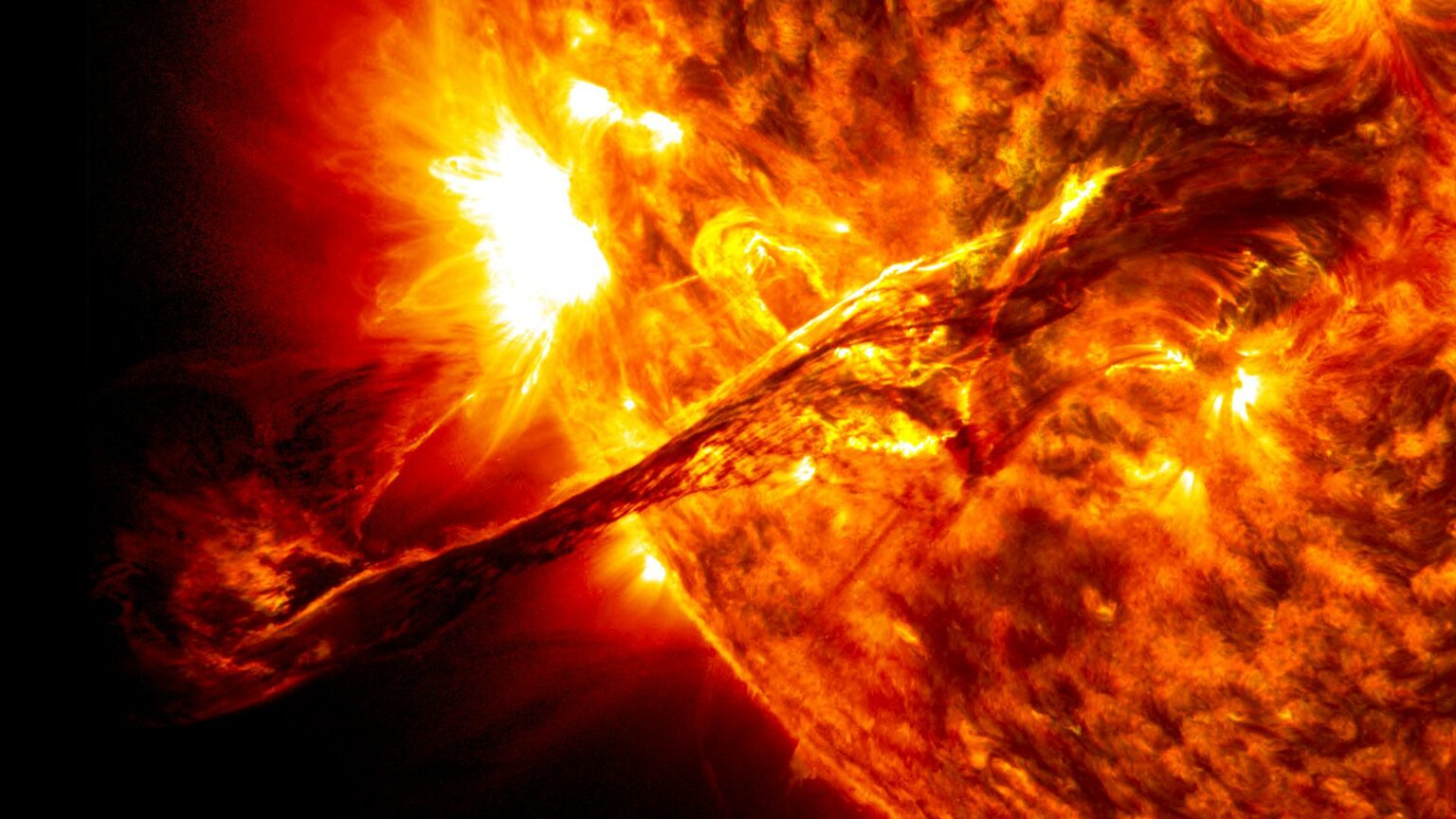
Solar flares are sudden and powerful bursts of energy in the Sun’s outer atmosphere that heat parts of it to temperatures exceeding 10 million degrees. They are accompanied by a significant increase in X-rays and radiation and can pose a danger to spacecraft and astronauts, as well as affecting the upper layers of our planet’s atmosphere.
The plasma ejected by the Sun consists of ions and electrons. Previously, it was believed that both types of particles should have approximately the same temperature. However, recent discoveries have shown that a process called magnetic reconnection should heat ions 6.5 times more than electrons. This was demonstrated by computer simulations and later confirmed for near-Earth space and solar wind. But until recently, no one had tested how well this law was valid for solar flares.
Scientists from the University of St Andrews decided to shed some light on this issue. After performing calculations using modern data, they discovered that solar flares most likely heat ions more than electrons. The difference in their temperatures can persist for tens of minutes, which opens up the possibility of studying superheated ions for the first time. The higher ion temperature also fits well with the width of the spectral lines of the flares, potentially solving an astrophysical puzzle that has been around for almost half a century.
The fact is that since the 1970s, there has been a long-standing question as to why the spectral lines of solar flares in certain “colors” in extreme ultraviolet and X-ray light are broader than expected. Historically, it was believed that this could only be related to turbulent motions, but this interpretation was challenged when scientists attempted to determine the nature of turbulence. And now, almost half a century later, an answer has been found, according to which the extremely high temperature of ions can largely explain the mysterious width of the spectral lines of solar flares.
Earlier, we reported on the “scar” left on the Sun after a super-powerful flare.
According to Phys.org

