

Martian glaciers consist mainly of pure water ice. This is good news for future explorers of the Red Planet, who will be able to use them as a source of water, air, and rocket fuel components.

Scientists have long known that there are dust-covered glaciers on the slopes of many Martian mountains. Initially, it was believed that they consisted mainly of dust and rocks and contained only 30% ice. However, research conducted in recent decades has cast doubt on this picture, showing that at least some of them are cleaner than previously thought. Now scientists have confirmed this, establishing that glaciers across the planet actually contain more than 80% water ice.
The discovery was made using the radar instrument (SHARAD) installed on board the MRO spacecraft. An international team of researchers decided to study how quickly radar waves pass through glaciers and how quickly they scatter. This data could shed light on the ratio of rock to ice.
For their research, the team selected five sites on Mars. Analysis of the collected SHARAD data revealed a surprising uniformity in the purity of these glaciers, which consist of at least 80% ice. It is covered with a layer of dust and soil.
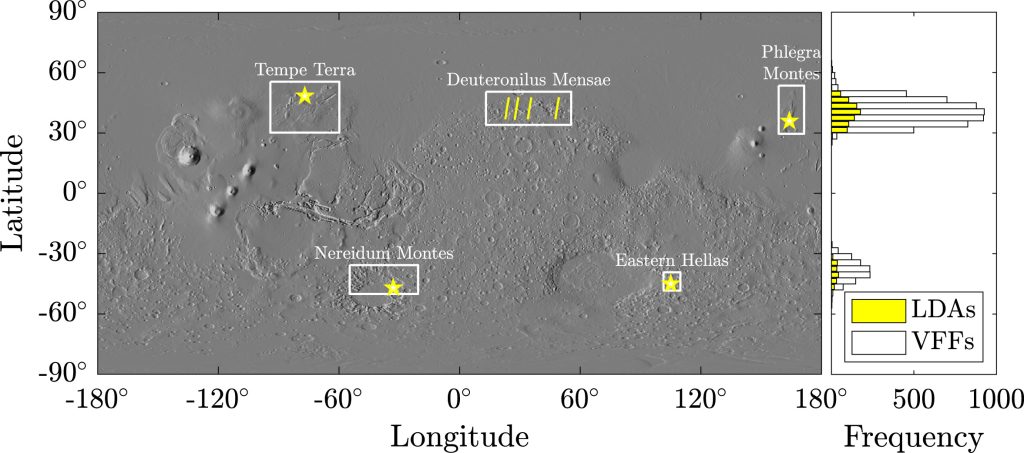
Researchers emphasize that the composition of glaciers is the same even in different hemispheres of Mars.This indicates that the environmental conditions in which the ice formed and remained intact were probably the same across the entire planet. Ice could have formed as a result of atmospheric precipitation (snowfall) or as a result of direct condensation due to an increase in frost. At the same time, it does not appear that ice could form as a result of water vapor from the atmosphere diffusing into subsurface layers and forming ground ice, which occurs in regions such as Alaska and Antarctica under terrestrial conditions.
The discovery plays an important role in understanding Mars’ past and the processes taking place on it. In addition, it can assist in planning future manned missions, for which accessible ice deposits may become a critical component of success.
We previously reported that brines may exist on the surface of Mars.
According to Space.com

