

When it comes to long-distance missions — from orbital telescopes to lunar bases — the main enemy of any technology is the inability to quickly obtain new parts. That is why the space industry has been developing the in-space manufacturing approach for many years — printing tools and parts on demand directly in orbit: an additive manufacturing facility for producing plastic components is operating on the ISS, and Europe has already demonstrated the printing of metal parts in space.
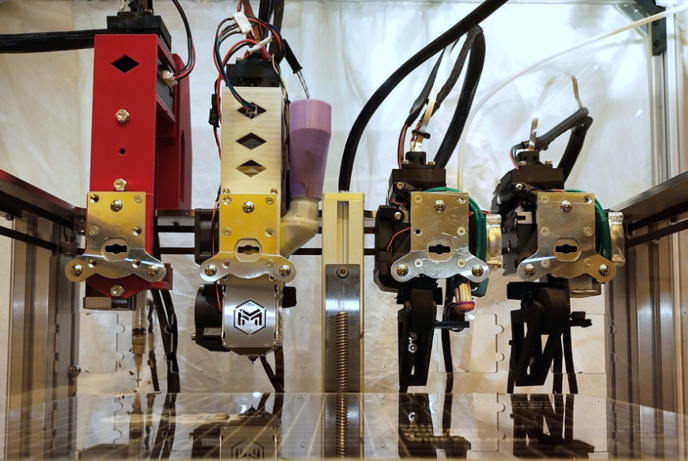
Researchers at the Massachusetts Institute of Technology (MIT) propose an alternative: printing electric machines directly on site, without relying on global supply chains. The team has created a multi-material extrusion 3D printing platform capable of manufacturing electrical devices. This multi-material platform is moving away from housings and brackets toward full-fledged electromechanics — they printed a working electric linear motor in a few hours, which means they could potentially make the same drives that move precision positioning mechanisms in robots, instruments, and optical systems.
The system uses four extrusion tools and can work with several functional materials, including electrically conductive and magnetic ones. At the demonstration, scientists printed an electric linear motor (an actuator that creates linear motion) from five materials in a matter of hours; after printing, only one post-processing step is required. It took about three hours to make the prototype, and the materials cost about 50 cents.
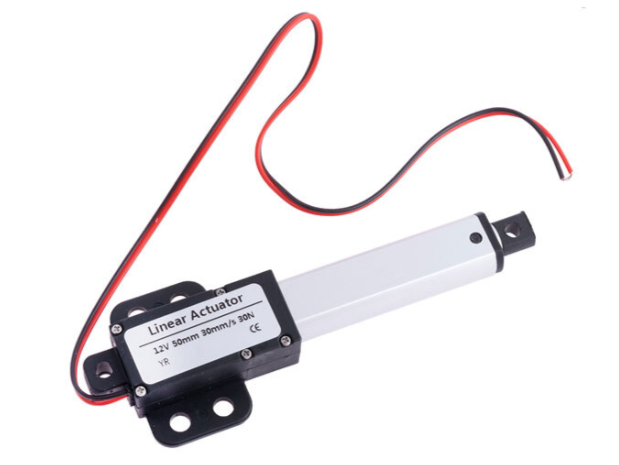
According to MIT, the assembled device performed equally well, and in some cases even better, than its counterparts, which require more complex manufacturing or additional operations. The key engineering challenge is to reconcile materials with very different requirements: conductors are extruded under pressure, while filaments or granules require heating. To ensure that the layers align precisely, the platform uses sensors and a control system for high repeatability in tool positioning. In the future, researchers want to integrate magnetization directly into the printing process and move toward fully printed rotary electric motors.
How does it work? Imagine a 3D printer that can print not just with one type of plastic, but with several functional materials at once. One extruder applies the insulating (dielectric) layer, another applies the conductive tracks/coils (conductive ink), and still others apply the magnetic parts and flexible elements. After printing, the magnetic inserts are magnetized, and the motor becomes operational: the current in the coils creates a magnetic field that moves the linear motor slider back and forth. In such prototypes, simple dipole magnetization is most often used (one pair of N–S in the desired direction — for example, across the thickness for a plate/insert, or axial for a cylinder).
Why is this important? Maintainability and autonomy are critical for space missions: when a component breaks down, waiting for supplies from Earth is expensive and time-consuming. The on-site printing approach potentially reduces the need to stock a large range of spare parts and speeds up the restoration of robots/mechanisms to working order. Linear actuators are also used in optical systems (positioning, focusing, feed mechanisms), so rapid manufacturing of custom actuators can also be useful for instruments used in astronomy and related laboratories.
According to mit

