

Although at first glance it may seem unremarkable, just another spiral galaxy among thousands of others in the Universe, this object, captured in a new Hubble Space Telescope photograph, provides many reasons for study. It is known by the designation NGC 7456.
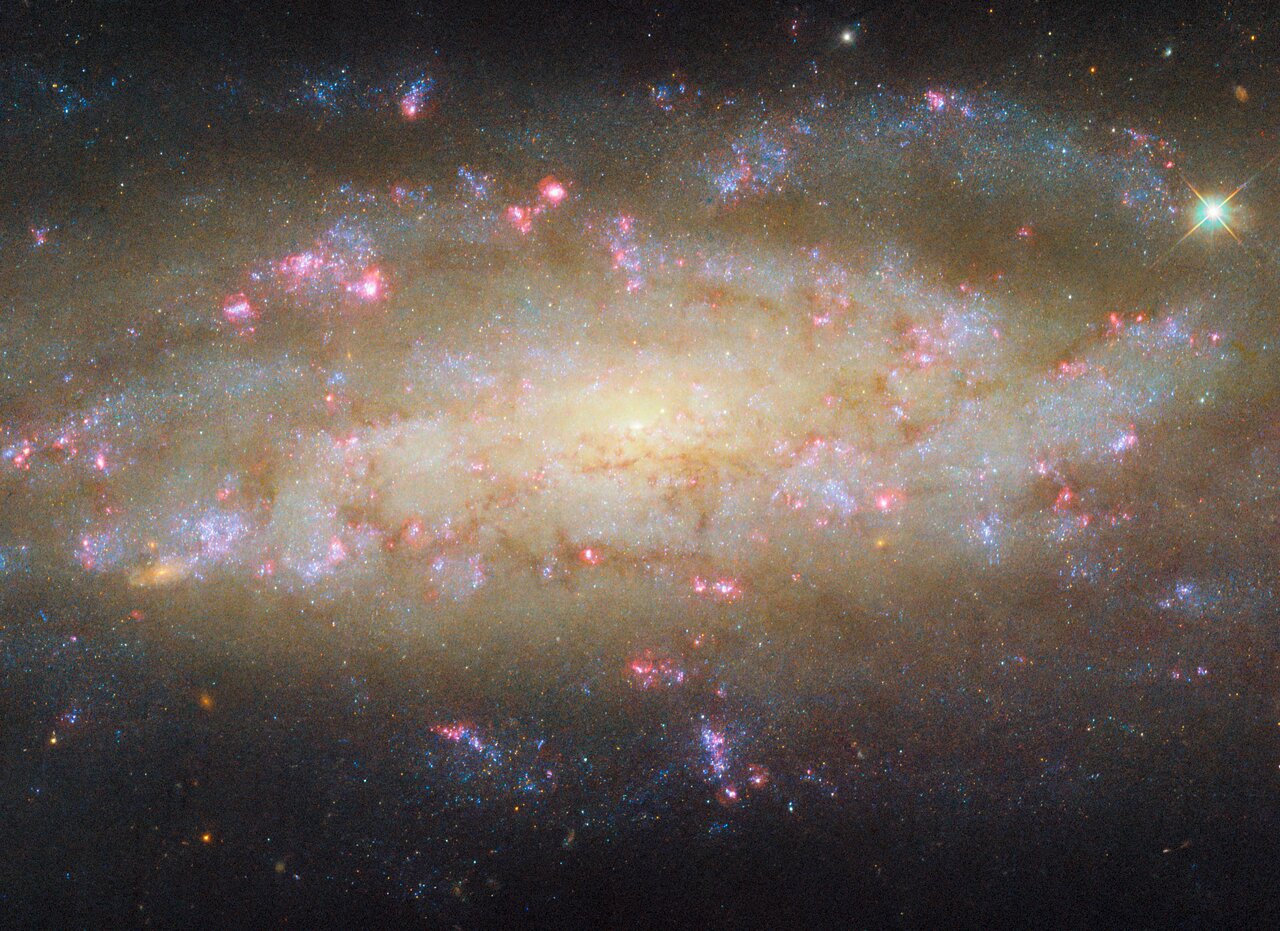
The galaxy NGC 7456 was discovered in the 19th century by John Herschel. It is located more than 51 million light-years from Earth in the direction of the constellation Grus.
The Hubble photo shows the finest details of this galaxy’s uneven spiral arms, followed by clusters of dark dust. The pink spots resembling blooming flowers are gas-rich regions where new stars are currently forming. Their radiation ionizes the surrounding gas clouds, causing them to emit a characteristic red light. Many of Hubble’s observations focus on this type of activity. By tracking new stars, hydrogen clouds, and star clusters, astronomers learn how galaxies evolve over time.
Hubble is not the only observatory studying NGC 7456. The ESA’s XMM-Newton spacecraft has observed it repeatedly, detecting a number of so-called super-bright X-ray sources. These small, compact objects emit incredibly powerful X-rays, much stronger than anyone would expect given their size. Astronomers are still trying to determine what powers these extreme objects.
NGC 7456 also boasts an active supermassive black hole at its center. It absorbs matter, which forms an accretion disk around it. This disc is heated to a very high temperature and is a powerful source of radiation in various ranges of the electromagnetic spectrum.
Earlier, we reported on an asymmetrical galaxy photographed by the Hubble Telescope.
According to Esahubble

