

The Great Observatory for Long Wavelengths (GO-LoW) project was presented at the recent INSCIENCE Conference 2025 in Ukraine, among other events. It is currently under review by NASA and has the potential to help scientists hear ultra-long radio waves.
Ultra-long waves
INSCIENCE Conference 2025 is a popular science and technical conference recently held in Ukraine. Scientists from many countries participated in it. Among them was Mary Knapp, a researcher from the Massachusetts Institute of Technology.
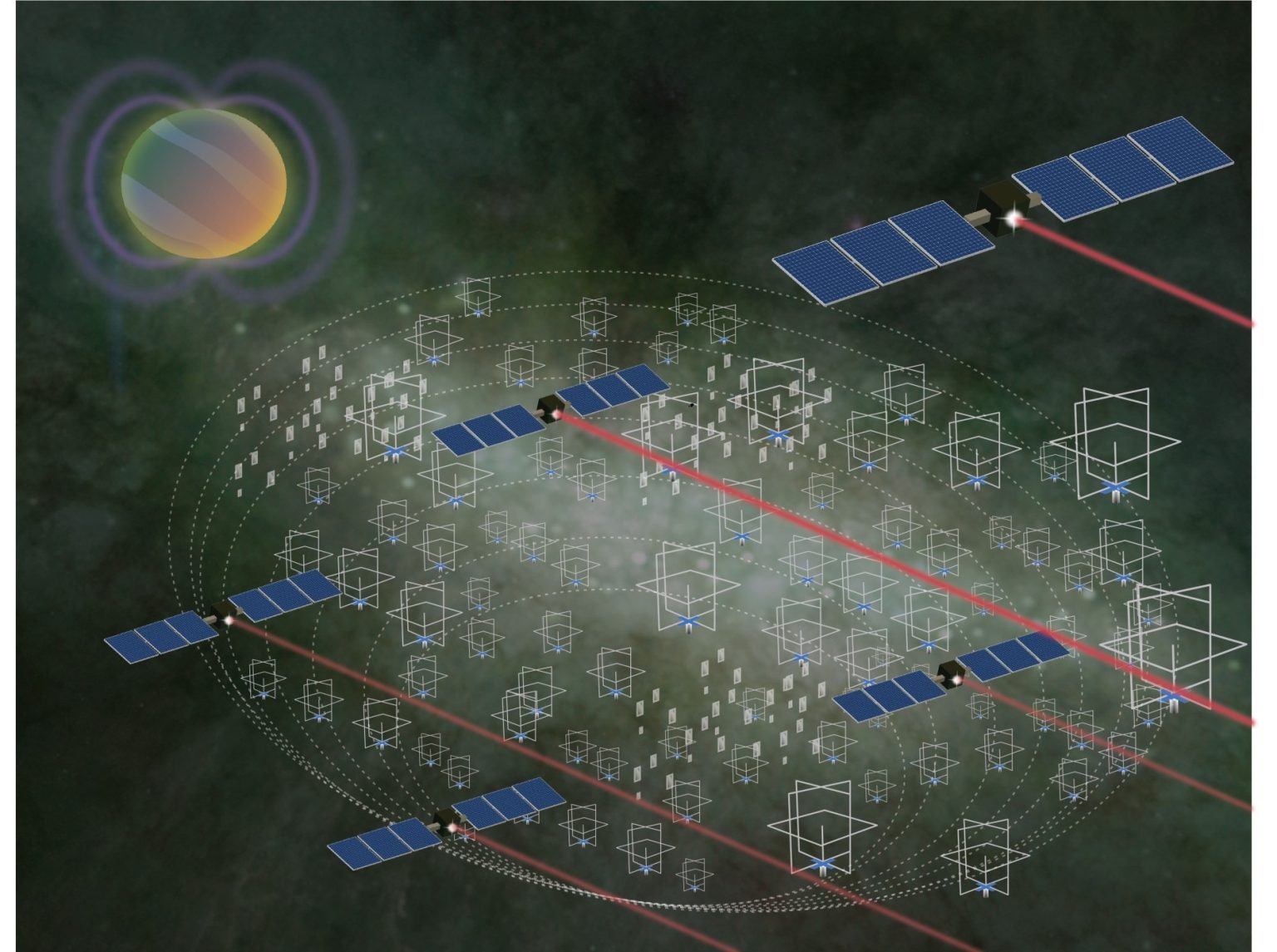
Her presentation focused on the Great Observatory for Long Wavelengths (GO-LoW) project. This is a constellation of spacecraft designed to detect the part of the electromagnetic spectrum that has remained inaccessible to scientists until now.
It would seem that scientists have long since mastered the entire electromagnetic spectrum: the visible, infrared, and ultraviolet ranges, as well as X-rays and various radio ranges. Of course, our atmosphere does not allow waves of certain lengths to pass through. But that is why space telescopes exist, and more than a dozen have already been launched.
But it turns out that super-long waves with a length of more than 30 m and a frequency of less than 10 MHz are still unattainable. The fact is that they are also blocked by the Earth’s atmosphere, and the antenna needed to capture them needs to be several times longer than the wavelength, which means it’s a structure that’s harder to fit into a rocket than the James Webb telescope.
How and why to build GO-LoW
Nevertheless, according to Knapp, GO-LoW needs to be built. After all, many things in our Universe are visible at ultra-long wavelengths. For example, one of the tasks that can be accomplished with their help is the study of exoplanets. No matter how small they are, not only their size and rotation process, but also the characteristics of their magnetic field can be determined using this system.
However, how can the issue of a massive antenna in orbit be resolved? This requires replacing it with a swarm of smaller devices that will function as a single unit. This concept has been applied in astronomy before and has already proven its effectiveness.
However, it has not yet been applied to space telescopes, although it has been proposed. This architecture would indeed greatly simplify the launch. Each individual GO-LoW device would collect data and send it to Earth, where it would be processed and an image would be obtained.
According to www.youtube.com

