

Astronomers have published a new image taken by the James Webb Space Telescope (JWST). It shows a pair of interacting dwarf galaxies, NGC 4490 and NGC 4485.
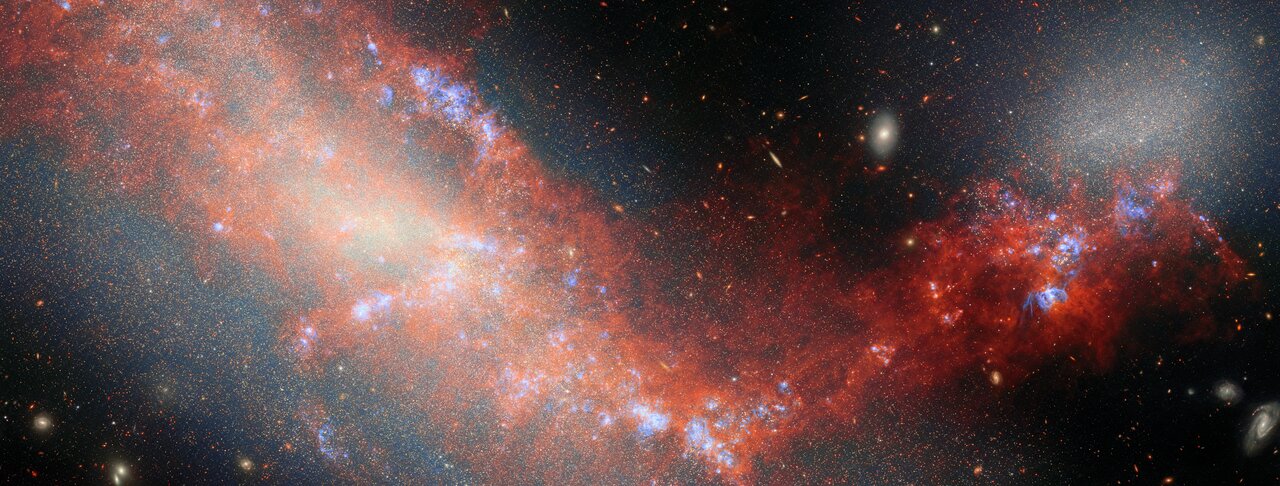
NGC 4490 (left) and NGC 4485 (right) are located about 24 million light-years from Earth in the direction of the constellation Canes Venatici. Apart from the Large and Small Magellanic Clouds, this is the closest known pair of interacting dwarf galaxies to us.
Such systems are of considerable interest to astronomers. They are believed to have much in common with young galaxies from the early Universe. These galaxies are much less massive than galaxies like our Milky Way, typically contain small amounts of metals, and have relatively few stars but large amounts of gas. When such objects collide, merge, or steal gas from each other, it can tell us about how the first galaxies evolved billions of years ago.
of gas connecting NGC 4490 and NGC 4485, indicating that they had interacted in the past. It is believed that 200 million years ago, the galaxies came close to each other. The larger NGC 4490 captured a stream of gas from its neighbor, and now this gas stretches between the galaxies like dancers connected by outstretched arms.
The formation of the bridge led to the mixing of gas between galaxies and a burst of star formation. The concentrated areas of bright blue color visible in the JWST image indicate highly ionized regions of gas formed by newly formed star clusters.
The image of NGC 4490 and NGC 4485 was taken as part of the FEAST program. Its goal is to study star formation in the galaxies closest to us.
Earlier, we reported on how James Webb discovered helium “leaking” from the atmosphere of a giant exoplanet.
According to Esawebb

