

Using data from the James Webb Space Telescope (JWST), an international team of scientists has detected helium leaking from the atmosphere of a giant exoplanet. This provides valuable clues for understanding this phenomenon, which influences planetary evolution and shapes some of their characteristics.
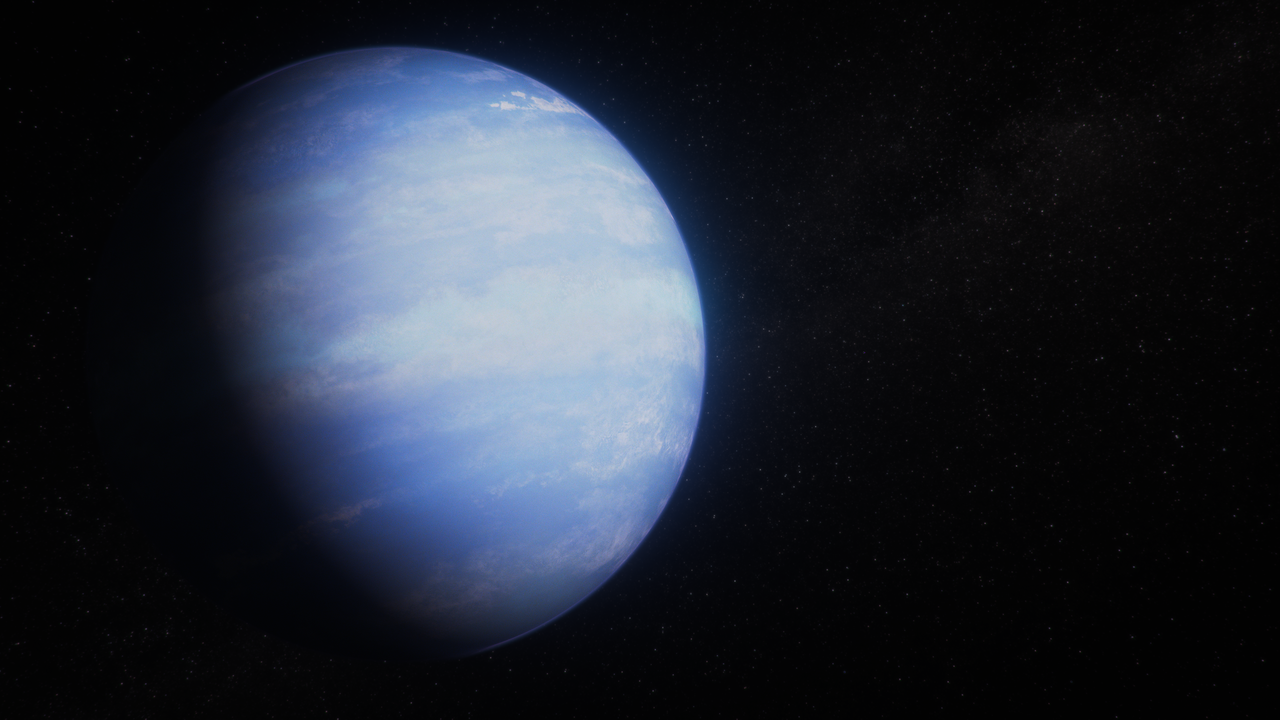
Sometimes a planet’s atmosphere escapes into space. This is what happens to Earth, which loses just over 3 kg of matter (mostly hydrogen) every second. This process, called “atmospheric escape,” is of particular interest to astronomers when studying exoplanets located very close to their star, which, heating up to extreme temperatures, are particularly susceptible to this phenomenon. It plays an important role in their evolution.
Thanks to JWST, an international team including scientists from the University of Geneva Observatory (UNIGE) and McGill, Chicago, and Montreal universities has observed large flows of helium escaping from the atmosphere of WASP-107b. This is the first time this chemical element has been identified using JWST on an exoplanet, allowing for a detailed description of this phenomenon.
WASP-107b is located 210 light-years from Earth and is a “super-fluffy” gas giant. Similar in size to Jupiter, this world’s mass is only one-tenth of Jupiter’s. This low density is explained by the fact that WASP-107b’s orbit is only 0.056 AU (8.5 million km) from its star. Its atmosphere is heated to high temperatures and inflated.
While studying WASP-107b, JWST discovered enormous streams of helium both in front of and behind the planet, extending in the direction of its orbital motion to almost ten times its radius.
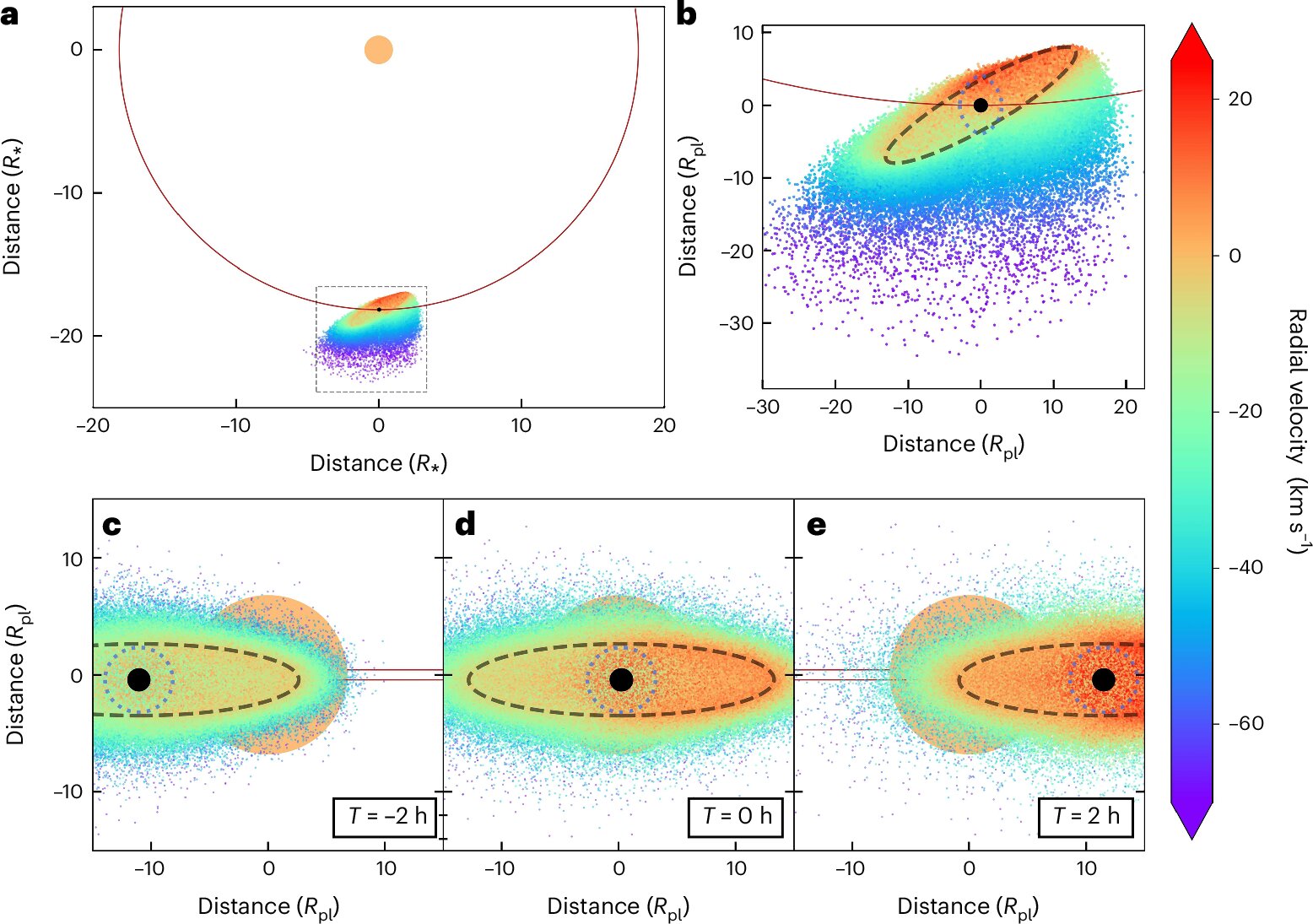
In addition to helium, astronomers were able to confirm the presence of water and various chemical compounds (including carbon monoxide, carbon dioxide, and ammonia) in the atmosphere of WASP-107b, while noting the absence of methane. These are valuable clues for reconstructing the history of the formation and migration of this gas giant. WASP-107b formed far from its current orbit and then moved closer to the star, which explains its bloated atmosphere and loss of gas.
The study of WASP-107b is very important for better understanding the evolution and dynamics of exoplanets. It may also shed light on the past of our Solar System. On Earth, atmospheric leakage is too weak to have a significant impact. But it may be the reason for the absence of water on our closest neighbor, Venus.
Earlier, we reported on how astronomers were searching for exoplanets in the remnants of a dwarf galaxy absorbed by the Milky Way.
According to Phys.org

