

Once upon a time, the Milky Way tore apart and swallowed a dwarf galaxy. This affected the metallicity of the stars in it. Now scientists are searching for planets that could have formed as a result of this event.
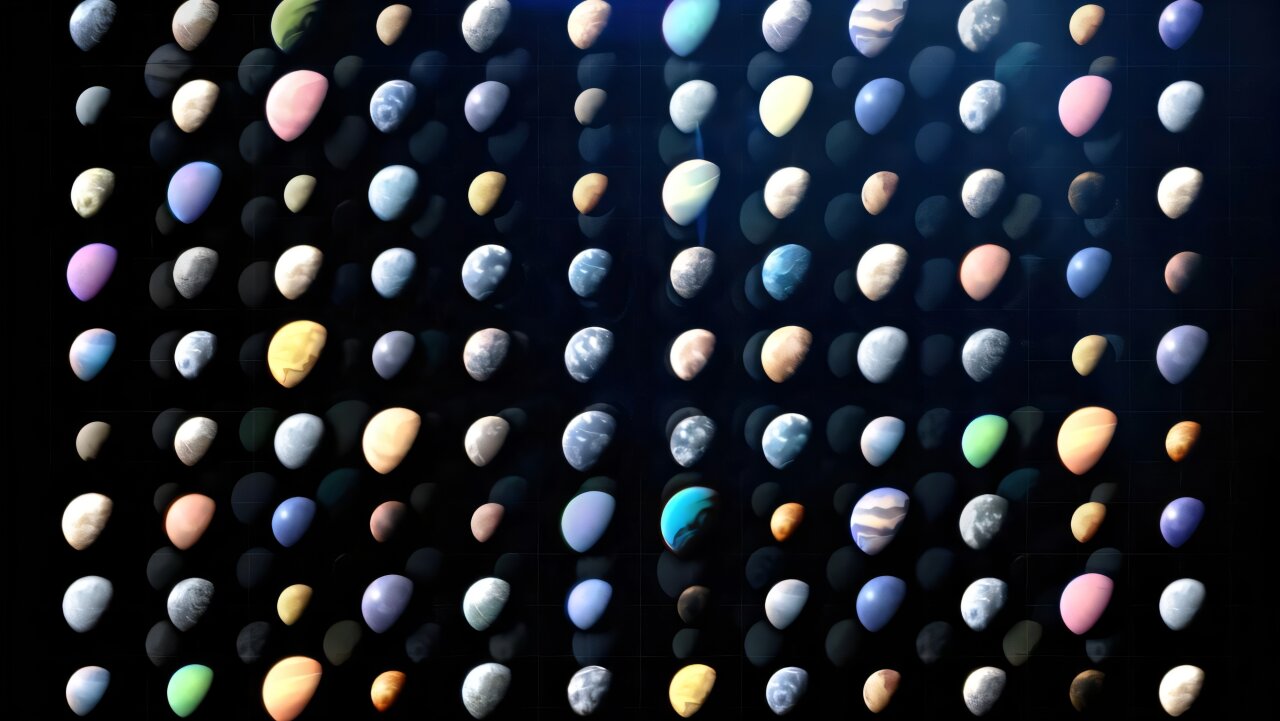
Remnants of other galaxies in the Milky Way
Our search for exoplanets has focused on stars in the Milky Way. It has been successful: to date, more than 6,000 exoplanets have been discovered. Scientists are even beginning to go beyond simple detection and are working to determine other characteristics of these planets, especially their atmospheres.
But the Milky Way has 61 confirmed satellite galaxies, and there are probably many more. Many of these smaller galaxies have lost the hydrogen necessary for star formation due to interactions with the Milky Way’s halo. In other galaxies, tidal interactions have created streams of stars stretching across space. Still other satellite galaxies are mere remnants, having lost most of their stars as a result of merging with the Milky Way. How do these environments affect exoplanets?
To understand this, astronomers have to find exoplanets in these satellite galaxies or their remnants. A new study describes and defines efforts to search for exoplanets in one of the Milky Way’s residual satellite galaxies. It is called “Searching for Exoplanets Born Outside the Milky Way: VOYAGERS Survey Design.”
Features of exoplanets around the remnants of dwarf galaxy stars
“Observations over the past few decades have found that planets are common around nearby stars in our galaxy, but little is known about planets that formed outside the Milky Way,” the authors write. “We describe the design and early implementation of a survey to test whether planets also exist orbiting the remnant stars of ancient dwarf galaxies that merged with the Milky Way, and if so, how they differ from their Milky Way counterparts.”
VOYAGERS stands for Views Of Yore — Ancient Gaia-Enceladus Exoplanet Revealing Survey (a look into the past — a study of the ancient exoplanet Gaia-Enceladus). It focuses on Gaia-Enceladus (also known as Gaia-Sausage, Galaxy-Sausage, Gaia-Enceladus-Sausage), which is the remnant of a dwarf galaxy that merged with the Milky Way between 8 and 11 billion years ago. This is the last major merger in the history of the Milky Way. Astronomers have identified seven globular clusters in the Galaxy that were formerly part of Gaia Sausage.
6,000 exoplanets is a large sample, but still limited. Most of them orbit main sequence stars in the Milky Way disk. These stars typically have metallicities very close to that of the Sun, which is a weakness of the sample. “However, this census of known exoplanet hosts does not fully represent the wider diversity of stars across the universe, including metal-poor stars from the early universe and stars found in dwarf galaxies,” the authors explain. The new study aims to address this shortcoming.
Metallicity of stars in the formation of exoplanets
Metallicity is a critical factor for both stars and planets that form from solar nebulae. Each nebula has a specific metallicity, which refers to the concentration of elements heavier than hydrogen and helium. Metallicity in the Universe increases over time and with the appearance and disappearance of generations of stars, as stars create heavier elements through nucleosynthesis. When stars approach the end of their lives, these elements are spread back into space to be absorbed by the next generation of stars and their planets.
“We speculate that some planets likely formed in the low-metallicity, high-alpha element environment (elements formed by fusion of He nuclei) of the early universe, and this population may differ in occurrence rates and compositions compared to those found in more recently formed stars in the Milky Way disk,” the authors write. Alpha elements include oxygen, neon, sulfur, and magnesium. They are formed over a shorter period of time by stars that explode as supernovae with core collapse only after millions of years.
Our 6,000 exoplanets have revealed certain patterns in their formation processes. In particular, planets with masses exceeding that of Jupiter are less common around stars with low metallicity. However, the frequency of exoplanets with masses equal to or less than Neptune’s seems to be completely independent of metallicity. Scientists studying exoplanets have also found that planets with masses less than Neptune’s have lower densities if they form around stars with low metal content. Another link between exoplanets and stellar metallicity is that super-Earths with short rotation periods are relatively rare around stars with low metal content.
All of this contributes to a better understanding of the suitability of exoplanets for life. The question is, how are these patterns related to stars and exoplanets in residual satellite galaxies?
“Searching for planets in GES (Gaia-Enceladus Sausage) presents an intriguing opportunity, as it remains unclear how planets form in environments outside the Milky Way and how low-metallicity conditions influence these processes,” the researchers say.
Search for planets around low-metallicity stars in Gaia-Enceladus
VOYAGERS will use the radial velocity (RV) method to study main sequence stars and several evolved stars in the GES. The main goal is to search for exoplanets formed in low-metal environments separated from the Milky Way. There are more than 47,000 stars identified as GES stars, and researchers have started with them. They then filtered them, leaving only 156 stars suitable for exoplanet detection due to their brightness and other properties. The stars were further checked for suitability for RV observations, and after careful evaluation and selection, 22 stars remained in the GES.
The research team states that their future observations will focus on 10 main sequence stars in order to accelerate the acquisition of results, as well as on studying other objects under less optimal observation conditions.
“Further, the survey is designed such that if we detect no planets, we will be able to determine with confidence that occurrence rates for Neptune-mass exoplanets are significantly lower for GES targets than occurrence rates for stars born in the Milky Way,” the authors write.
If this proves to be true, it will confirm the metal hypothesis of planet formation. One of the tenets of the hypothesis is that metal-rich stars are more likely to form giant planets because they have more heavy elements to form large cores.
Star formation, metallicity, and exoplanet formation are all pieces of a large, complex puzzle. When these pieces fall into place, we will learn more about the potential habitability and prospects for life elsewhere. Finding Neptune-mass planets in these low-metallicity environments will bring the puzzle one small step closer to completion.
According to phys.org

