

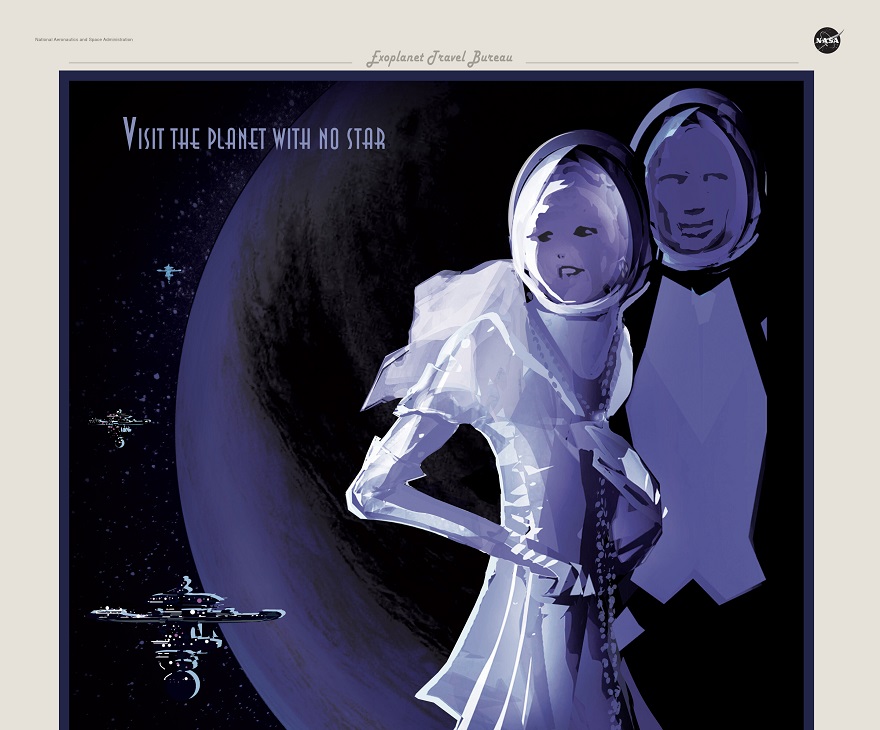
Ten years ago, NASA teamed up with a group of artists to launch a project to create promotional posters featuring exoplanets as places to visit. Why was this done and what results did it bring?
Popularizing exoplanets through art
In 2015, NASA launched an unusual and brilliant campaign to popularize exoplanets, offering retro-style posters, virtual tours, and even coloring books. The project quickly went viral around the world. What explains the success of the campaign in a relatively young field of science which, unlike other areas of space research, lacks impressive images?
Ceridwen Dovey, science communicator, writer, filmmaker, and researcher, recently published an article in the Journal of Science Communication entitled “Practice Insight,” presenting a case study of the Exoplanet Travel Bureau poster campaign. Dovey describes the productive working relationship between scientists and artists who created this outstanding work, and shows how, in such contexts, artists do not simply serve science, but can inspire research and help scientists refine their own thinking.
Challenges for the team of promoters
As Dovey explains, NASA’s creative team — led by visual strategist Joby Harris, who has experience in film and music — faced at least two challenges.
First, visualization is available. The existence of a planet orbiting one or more extremely distant stars is usually inferred from the analysis of a large amount of data: we cannot usually see the planet directly and should draw conclusions about its existence based on its impact on its star or on the light emitted by the star. Even when scientists are fortunate enough to obtain a direct image, it is often quite unsatisfactory. “Direct images of exoplanets are very rare, and they are usually not very impressive in terms of perception: they are just a grainy dot around the Sun,” says Dovey.
The second challenge lies in the rather inhospitable nature of the exoplanets observed: in most cases, they are completely unwelcoming to humans, which complicates the team’s task, given the campaign’s concept of imagining exoplanets as tourist destinations of the future.
Style and aesthetics of images
The Exoplanet Travel Bureau team decided to use 1930s-style imagery inspired by the magnificent posters of national parks such as Yosemite and Yellowstone. These posters sought to evoke the romance of visiting these places and the kinds of encounters with nature that would be possible there.
Joby Harris and his team decided to create a series of posters presenting exoplanets as if they were quite close — your next vacation destination. This is a playful way to encourage the public to imagine them as real places, using the aesthetics and imagery of the historic series of US National Park posters. However, an important question immediately arose during discussions between artists and scientists.
“Many of these exoplanets would actually be terrible places to visit on a human level,” Dovey notes. Therefore, in its public and online presentations about its work, the team describes many interesting conversations with scientists, during which they jointly presented these planets as places. This created a truly more interesting creative process of constant exchange of ideas between artists and scientists.
Collaboration between artists and scientists
During her research, Dovey realized that scientists in this field also took an imaginary leap to turn abstract scientific data into something concrete about a particular planet. Helping society “see” the object of their scientific research in these creative image-making practices can help scientists find new avenues of research and encourage society and financial institutions to remain committed to supporting exoplanet research.
In all of this, Dovey believes that collaboration with artists is crucial. Artists, writers, and visualizers should be useful to scientists: not only by challenging their assumptions about how the world works, but also by returning to the fundamentals of their planning — their mission — and showing how research design can be enriched by involving a multidisciplinary team from the beginning.
According to phys.org

