

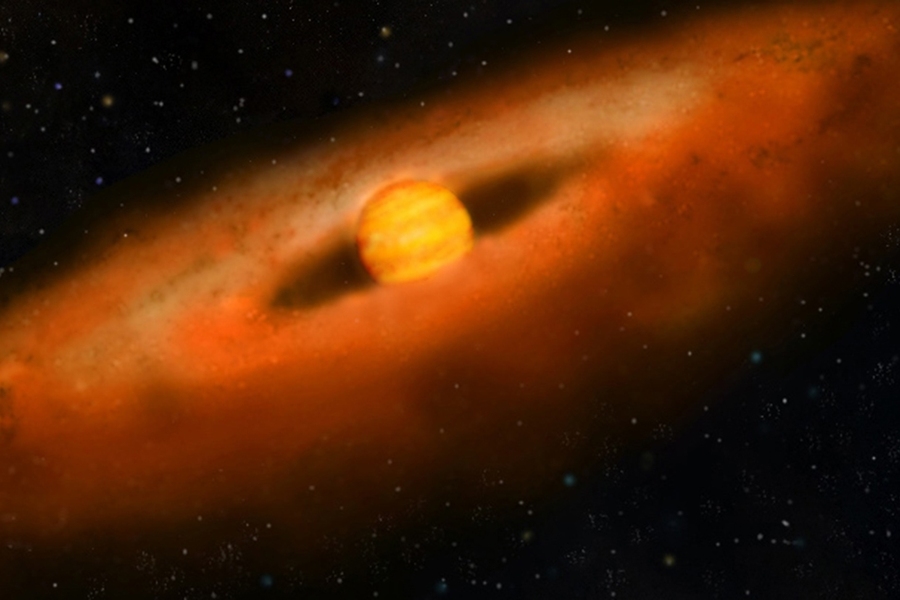
Using the James Webb Telescope, astronomers observed a young brown dwarf known as Chamaeleon Hα 1, or Cha Hα 1 for short. As a result, they discovered that the disk around this brown dwarf was rich in hydrocarbons.
Protoplanetary disks around brown dwarfs
Brown dwarfs (BDs) are substellar objects between planets and stars, whose mass ranges between 13 and 80 Jupiter masses (0.012 and 0.076 solar masses). Consequently, they have insufficient mass to support thermonuclear fusion of hydrogen, but enough to initiate deuterium burning.
Brown dwarfs often have protoplanetary disks composed of gas and dust. Studying these disks can provide crucial clues about the formation of planetary systems. However, the chemistry of the disks of brown dwarfs remains largely unexplored, mainly due to the weakness.
Cha Hα 1 is a brown dwarf of spectral type M7.5 with an effective temperature of 2805 K and a mass of about 0.04–0.05 solar masses. The brown dwarf is a member of the Cha Hα 1 South star formation at a distance of 625 light-years, estimated to be 1.4–2.4 million years old.
Exploration using the James Webb Telescope
Previous observations of Cha Hα 1 have found that it contains an optically dense, expanded protoplanetary disk. However, very little is known about the properties of this disk and its chemical composition.
That is why a team of astronomers led by Maria Morales-Calderon from the Spanish Center for Astrobiology in Madrid, Spain, used the Medium Infrared Instrument (MIRI) on board JWST to study Cha Hα 1 and its disk. MIRI allowed them to explore the inner, dense, and warm region of the disk where small planets can form.
Diverse chemistry of the protoplanetary disk
Observations have revealed that the disk of Cha Hα 1 contains a variety of hydrocarbons, including acetylene, methane, ethylene, diacetylene, ethane, or benzene. Overall, the results indicate the presence of 12 carbon-containing molecules in the disk.
The collected data indicate that the warm water is located along with all the hydrocarbons in the disk. Carbon dioxide, molecular hydrogen, and hydrogen cyanide were also detected, but carbon monoxide and hydroxyl radicals were absent from the spectrum.
Astronomers note that the hydrocarbons in the disk show temperatures ranging from 225 to 450 K, indicating that they originate from a common reservoir. The images indicate that large (approximately 4 μm in size) amorphous silicates predominate in the dust disk. The results indicate that particle growth began about 1.5 million years ago.
Evolution of the protoplanetary disk Cha Hα 1
Summarizing these new findings, scientists conclude that the disk of Cha Hα 1 may be transitioning from a very young, water-rich state to a more evolved state with a high carbon-to-oxygen ratio. They emphasize that this disk demonstrates the most diverse chemistry observed to date in the protoplanetary disk of a brown dwarf.
The rich molecular environment provides a unique opportunity to test our understanding of disk chemistry and its impact on potential planet formation. Obtaining information about the reservoirs of detected molecules may shed even more light on the composition of future planets forming around brown dwarfs.
According to phys.org

