

Scientists have discovered a giant molecular cloud in a previously little-studied region at the very center of the Milky Way. It stretches across space for 200 light years and provides a constant supply of matter to the core of our galaxy.
Giant molecular cloud
American astronomers from the Green Bank Observatory have announced the discovery of a giant reservoir of gas and dust right in the center of our galaxy. It is a gigantic cloud stretching across a previously little-studied region spanning 200 light years.
More details about this are provided in a publication in The Astrophysical Journal. The object has been named M4.7-0.8, or the Midpoint Cloud. According to researchers, its discovery is unexpected, as no one anticipated that something so significant could still be hidden from us.
However, even more important is the fact that there is a constant and fairly dense flow of gas in this reservoir. This was discovered by scientists who focused on searching for radiation from two molecules: ammonia (NH3) and cyanobutadiyne (HC5N). They clearly mark places where the density of matter in interstellar space is really high.
Other findings
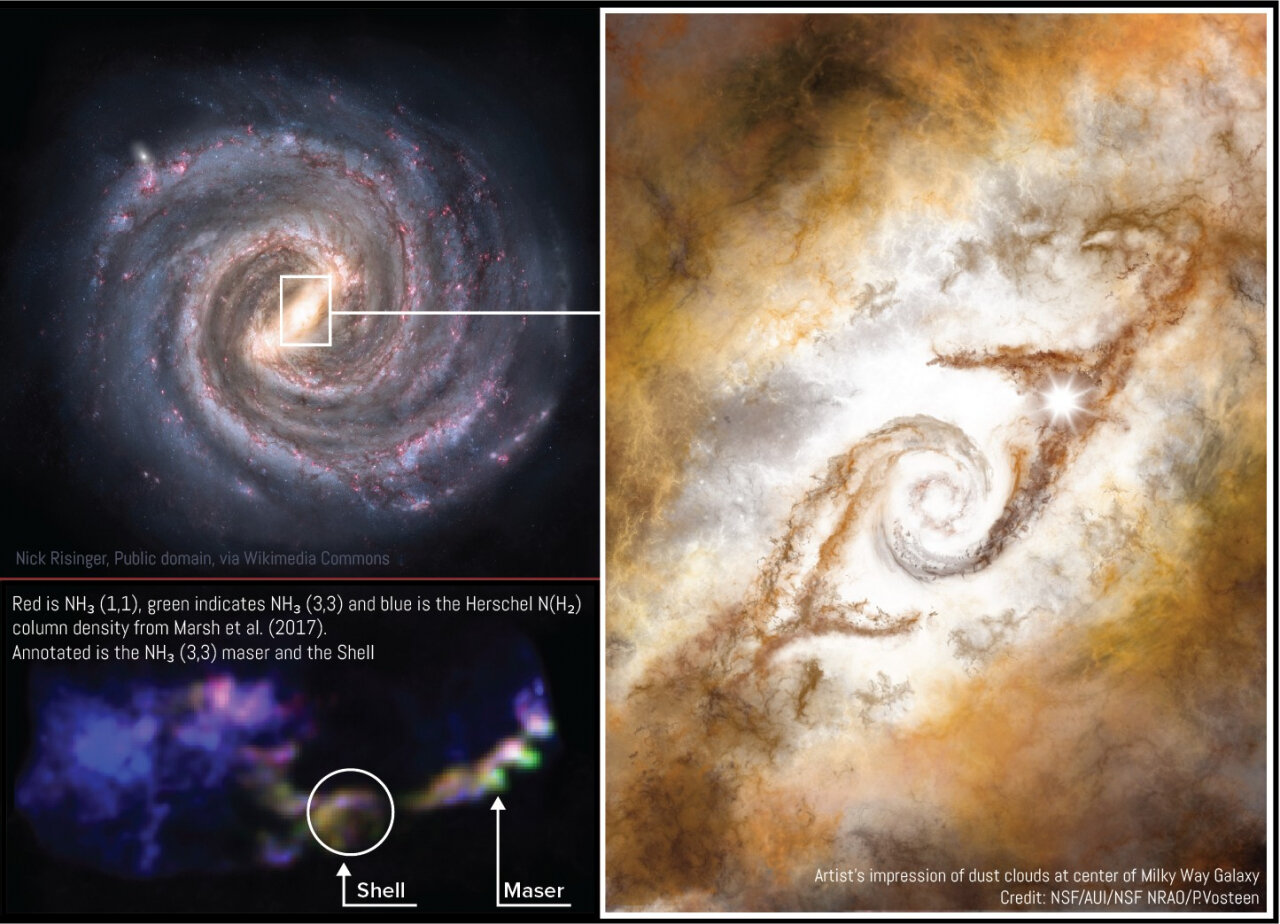
In addition, scientists have discovered several other interesting things related to the new cloud. The team discovered a previously unknown “maser” — a natural source of intense microwave radiation associated with ammonia gas. This is often a sign of active star formation.
It appears that the cloud contains compact clusters of gas and dust that seem to be on the verge of forming new stars. One of these clusters, called Knot E, may be a frEGG (free-floating evaporating gas globule) – a small dense cloud that is being destroyed by radiation from neighboring stars.
The team discovered a shell-like structure in the cloud, which was likely formed by the energy released by dying stars. The gas in the cloud is very turbulent, similar to what is observed in the central regions of the galaxy. This turbulence may be caused by the inflow of matter along dust lanes or collisions with other clouds.
All this suggests that the new reservoir of matter is part of complex feedback processes that regulate star formation in the bulge, the spherical central pillar of the Milky Way. They remain largely unexplored to this day.
According to phys.org

