

Astronomers have made a discovery that forces us to look at the early Universe from a new angle. Using the MeerKAT radio telescope, they detected an incredibly bright beam of microwave energy coming to us from a distance of more than 8 billion light-years. This phenomenon, known as a maser (a microwave analogue of a laser), proved to be so powerful that scientists classified it into a separate class — gigamasers.
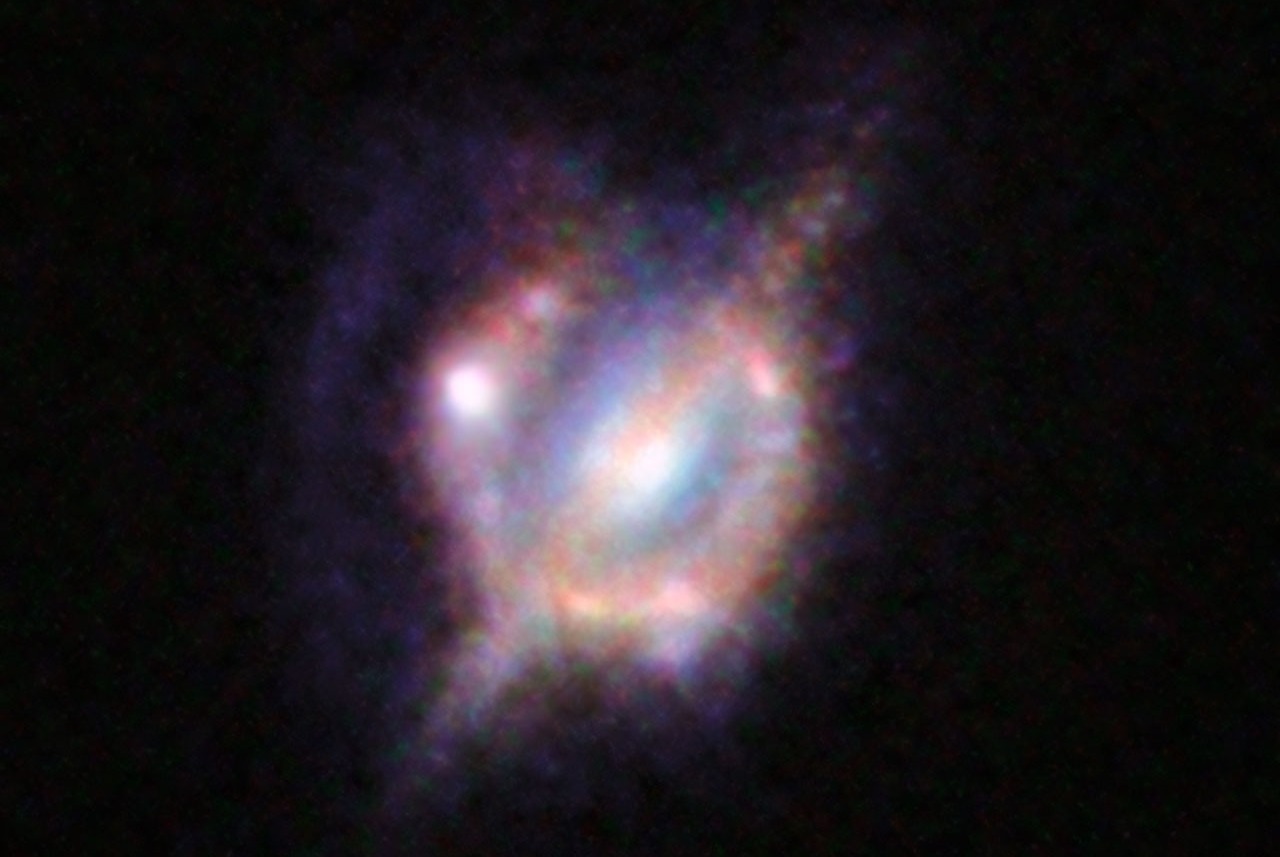
Imagine a laser, but not in visible light, but in the radio spectrum, and on an incredible scale. In space, such objects are born under extreme conditions. When two galaxies collide, their gravity creates enormous pressure. This pressure literally “squeezes” the gas and dust, causing small dust grains with hydroxyl ions to emit energy. If there is a powerful source of radio waves nearby (for example, an active black hole), it compresses this radiation into a dense, coherent beam — this is how a maser is born.
How was it possible to see the laser?
Such objects are usually extremely difficult to observe because they emit at a wavelength of 18 cm, which is inaccessible to optical telescopes. Moreover, most of them are too dim to be seen from Earth. But this time, the cosmic “magnifier” worked.
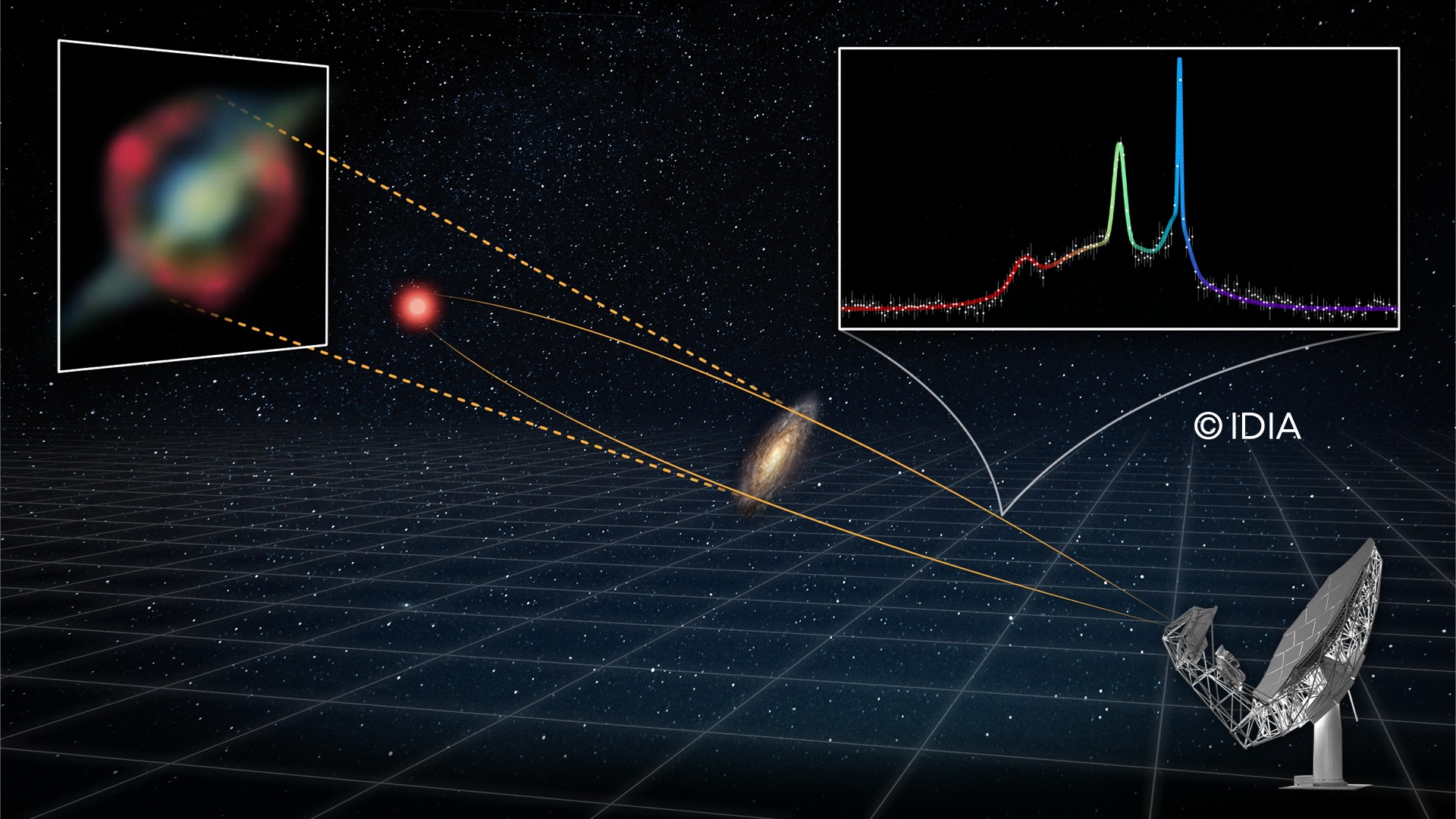
Between us and the distant source galaxy, designated H-ATLAS J142935.3−002836, there happened to be another galaxy. It acted as a gravitational lens: its mass curved space-time, amplifying the signal from the maser in the same way that a drop of water on glass curves light. This allowed the MeerKAT telescope to see what normally remains invisible.
Gigamaser: champion among the “giants”
The discovered object impressed researchers with its brightness. While astronomers had previously discovered so-called “megamasers” — extremely bright sources — this example surpassed them by hundreds of times. Its power is 100,000 times greater than that of a typical star, but all this energy is concentrated in a narrow microwave range. Hence, it was named the “gigamaser.”
Masers arise during chaotic and dusty collisions between galaxies, which were a frequent occurrence in the early Universe. By studying such objects, scientists can trace the history of cosmic cataclysms and the evolution of galaxies. This particular gigamaser shows us an event that occurred when the Universe was less than half as old as today.
Research leader Thato Manamela from the University of Pretoria notes that this is only the first step. Using the sensitivity of the MeerKAT telescope, the team plans to find hundreds, and eventually thousands, of similar systems. This would allow us to create a detailed map of galaxy collisions and better understand how structures in space were born and changed. The study has already been accepted for publication in Monthly Notices of the Royal Astronomical Society.
According to sarao.ac.za

